
How to make ghee at home from malai, the way our village does it
Here is how to make ghee at home the village way: set a week or two of collected malai with a spoon of curd, churn it with cold water until makkhan floats, then cook it on a low flame until the ghee is clear and nutty. Strain it. 500 g of malai gives about 200 to 250 g of ghee.
In our kitchen the ghee starts in a steel dabba at the back of the freezer. Every morning, after the milk has been boiled and cooled, someone lifts the thick malai off the top with a spoon and adds it to the dabba. By the second Sunday it is full, and by that afternoon the whole house smells of ghee. This is how to make ghee at home the way most Rajasthani families still do it: malai, set into curd, churned into makkhan, cooked slowly. It is the same road our danedar ghee takes, only in a smaller kadhai.
What you need
- Malai from boiled full-cream milk, about 500 g to start (two to three katori)
- 1 tablespoon of curd to set it
- Ice-cold water, about 2 to 3 cups
- A wooden mathani, a whisk, or a mixer jar
- A heavy-bottomed kadhai or pan
- A steel strainer or a clean muslin cloth, and a completely dry glass or steel jar
Buffalo milk gives a thicker malai and more of it. Cow milk gives less, but the ghee comes out more golden.
How to make ghee at home from malai, step by step
- Collect the malai. Boil the milk, let it cool, keep it in the fridge overnight and lift off the malai in the morning. Keep adding it to one clean box in the freezer. One to two weeks of malai is ideal. Much older than that, it picks up fridge smells.
- Bring it to room temperature. The evening before you churn, take the box out and let the malai soften for a few hours.
- Set it with curd. Stir in about a tablespoon of curd for every 500 g of malai, cover, and leave it in a warm corner for 8 to 12 hours. In winter it needs longer, or a spot near the stove. It is ready when it smells mildly sour and has thickened. This step gives cultured ghee its rounder curd aroma.
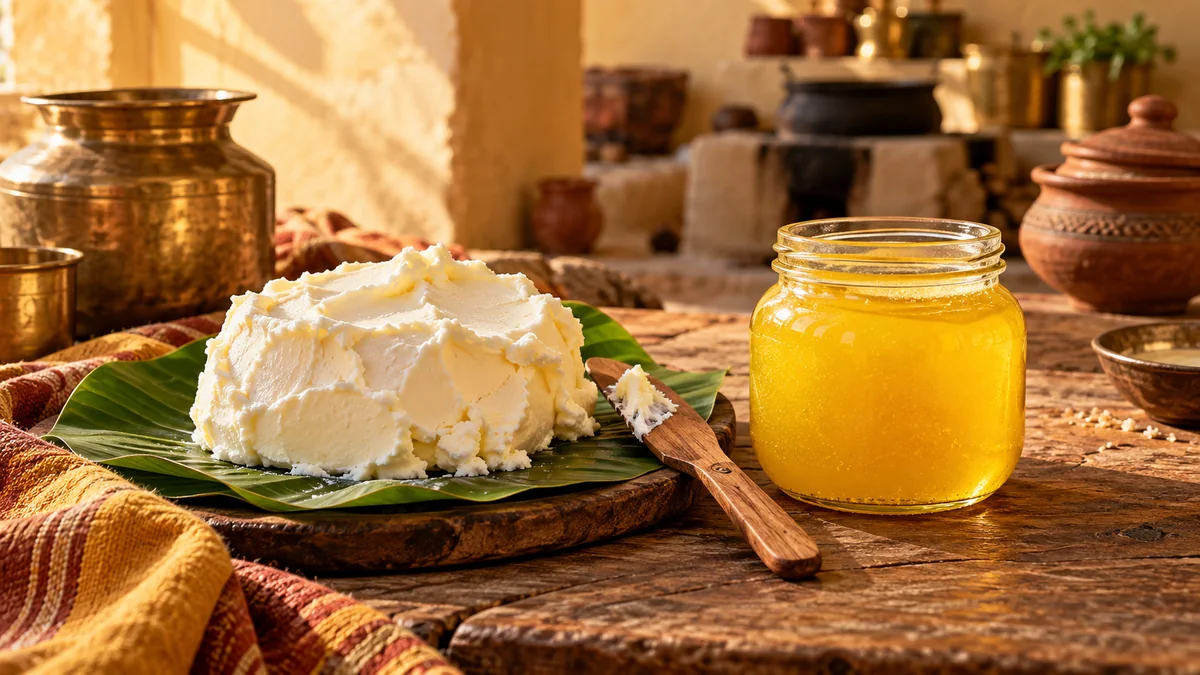
- Churn. Add a cup of ice-cold water and churn. Spin a mathani between your palms the old way, or run a mixer in short pulses on low speed. In a few minutes the mixture thickens and then suddenly splits: pale yellow lumps of makkhan float up in a thin, whitish liquid. Add another cup of cold water to help the makkhan gather.
- Wash the makkhan. Lift the makkhan by hand into a bowl of cold water. Press it, pour off the cloudy water, and repeat two or three times until the water stays almost clear. Chaach left in the makkhan is the main reason homemade ghee burns or spoils.
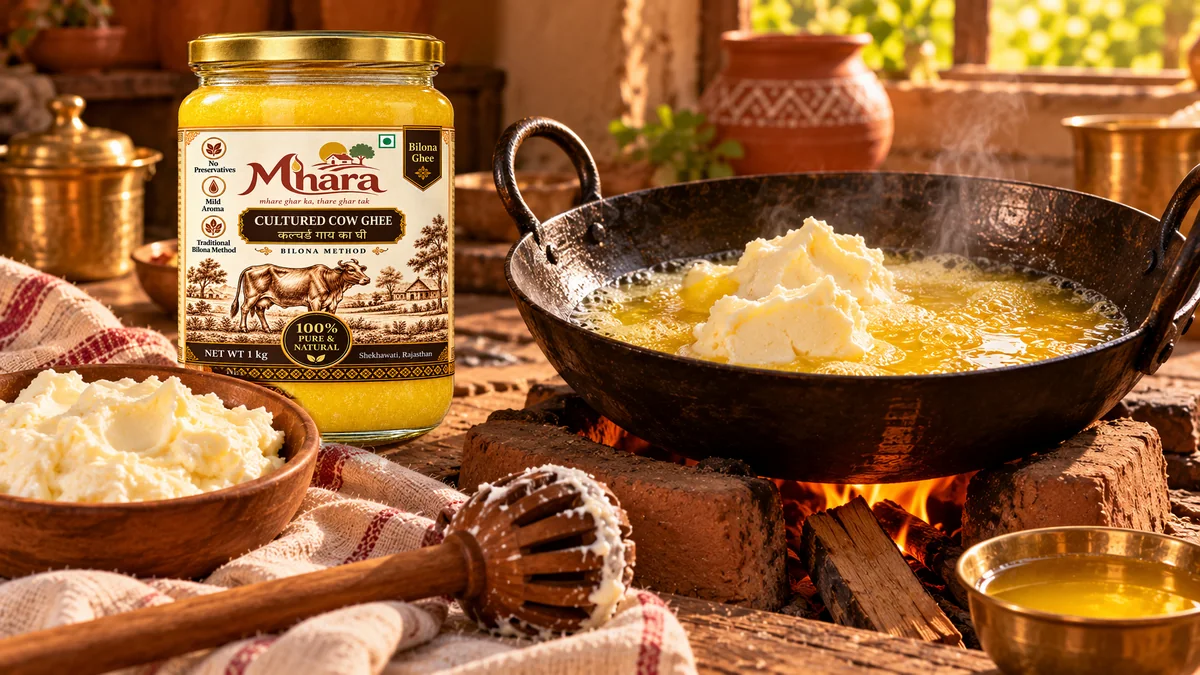
- Melt it on a low flame. Put the makkhan in the heavy kadhai on a low to medium flame. It melts, then foams up and crackles loudly as the water boils off. Stir now and then.
- Watch the stages. The big foam settles, the crackling goes quiet, and the ghee turns clear. The milk solids sink and slowly turn from white to light golden-brown, and the smell moves from buttery to nutty and toasted. This takes 20 to 40 minutes, depending on the quantity.
- Stop at the right moment. Switch off when the solids are golden-brown, not dark. The hot ghee keeps cooking them for a minute or two after the flame is off. Some families drop in a few curry leaves or a paan leaf at this point for aroma.
- Strain and cool. Let it settle for five minutes, then pour it through a strainer or muslin into the dry jar. Leave it open until it reaches room temperature, then close the lid.
How much ghee from 1 kg malai?
It varies, so take these as rough numbers. 500 g of good, thick malai usually gives about 200 to 250 g of ghee, so a kilo gives somewhere around 400 to 500 g. Buffalo malai is richer and sits at the top of that range. Thin malai from toned milk, or malai with a lot of milk caught in it, gives less. If you start from makkhan that is already churned, expect roughly three-quarters of its weight back as ghee.
Is making ghee at home cheaper than buying it?
Knowing how to make ghee at home pays off most in one situation. If you already buy full-cream milk for the family, the malai is a bonus, and homemade ghee costs you little more than gas and an afternoon. Then it is clearly worth doing. If you buy cream or butter specially to turn into ghee, it is often not much cheaper than a good jar, and it takes your time.
A home kitchen also has limits. Malai ghee is one kind of ghee. Whole-milk bilona ghee, where all the milk is set into curd and churned, needs 25 to 30 litres of desi cow milk for a kilo, which few city homes can manage. We explain that method in what is bilona ghee. When the malai box isn't filling fast enough, or the festival cooking is bigger than your freezer, buying makes sense.
Grainy or smooth: how your ghee will set
If you want danedar ghee, the grain comes from slow cooling, not from the malai or the curd. Let the jar cool on a kitchen shelf, away from the fridge, the fan and the window, and don't move it for a day. Put it in the fridge while it is warm and it sets smooth. The science is in our page on danedar ghee.
What to do with the chaach and the khurchan
Nothing goes to waste. The liquid left after churning is chaach. Add salt and roasted jeera and drink it, or use it for kadhi. The brown bits left in the kadhai after straining are khurchan, toasted milk solids with ghee still clinging to them. Mixed with a little sugar, they are the treat children in our village hang around the kitchen for. We have a whole page on ghee residue uses.
Common mistakes when you make ghee at home
- High flame. The solids burn before the water is gone, and the ghee tastes bitter and smoky. Low and slow, always.
- Cooking too long. Dark brown or black khurchan means burnt ghee. Stop at golden-brown.
- Stopping too early. If the ghee is still cloudy or crackling, water is left in it, and it can turn sour or grow mould within weeks.
- Unwashed makkhan. Chaach left inside burns at the bottom and spoils the ghee.
- A wet jar or spoon. Even a few drops of water shorten the life of ghee. Our guide on how to store ghee covers the rest.
- Old malai. Malai kept for a month picks up smells that go straight into the ghee.
Quick ghee from store-bought butter
No malai? Unsalted butter works. Put 500 g of it in a heavy pan on a low flame. It melts, foams, goes quiet, and the solids turn golden at the bottom in about 15 to 20 minutes. Strain it and you will have roughly 400 g of ghee. Avoid salted butter, because it leaves a salty khurchan and can give the ghee an odd taste.
Butter ghee tastes cleaner and milder than malai-curd ghee, because there is no curd step and no churning at home. It is perfectly good for everyday cooking. If you want to know why curd changes the aroma, read curd vs cream ghee. Either way, make ghee at home a few times and you will start judging every jar by its smell and its grain.
Questions people ask
How do you make ghee from malai at home?
Collect malai in the freezer for one to two weeks, set it with a spoon of curd for 8 to 12 hours, then churn it with ice-cold water until makkhan floats. Wash the makkhan and cook it on a low flame until the ghee is clear and the solids are golden-brown. Strain.
How much ghee do you get from 1 kg of malai?
Roughly 400 to 500 g, though it varies with how thick the malai is and which milk it came from. Buffalo malai gives more. Thin malai from toned milk, or malai with a lot of milk in it, gives less.
Why should you add curd to malai before making ghee?
Setting malai into curd makes it easier to churn into makkhan and gives the ghee a rounder, slightly tangy aroma. You can heat malai directly into ghee without curd, but the ghee smells more like cooked cream and the khurchan burns more easily.
How do I know when the ghee is ready?
The crackling stops, the foam settles, the ghee turns clear golden, and the solids at the bottom turn light golden-brown with a nutty smell. Switch off then. If the solids turn dark brown or black, the ghee has burnt.
Why did my homemade ghee turn sour or grow mould?
Almost always because water was left in it. Either the makkhan was not cooked long enough, the chaach was not washed out, or a wet spoon or jar was used. Cook until the crackling stops and keep everything bone dry.
Can I make ghee from store-bought butter?
Yes. Heat unsalted butter on a low flame until it foams, goes quiet and the solids turn golden, about 15 to 20 minutes for 500 g. Strain. You will get roughly 400 g of mild, clean-tasting ghee.