
Curd vs cream ghee: how to tell, and which we make
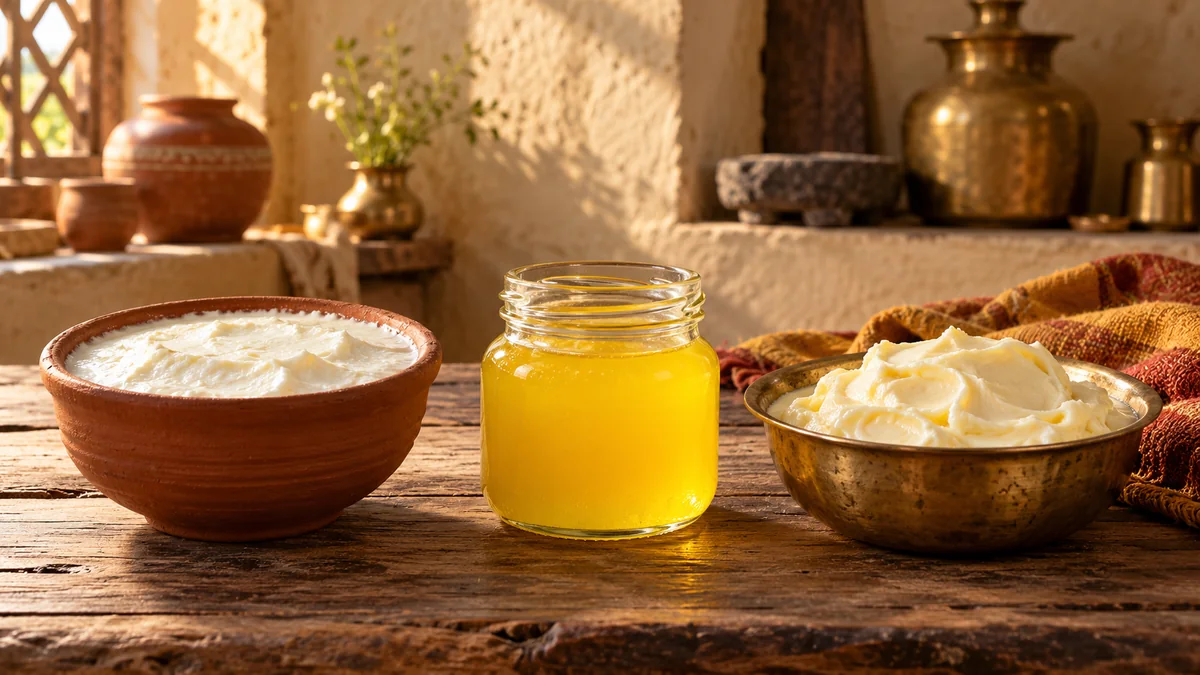
Curd ghee is made by setting milk or malai into curd, churning out makkhan and slow-cooking it, while cream ghee is cooked from separated cream or butter with no curd step. Our cow and buffalo bilona ghee come from whole-milk curd, and our danedar ghee comes from malai set into curd.
Every jar of ghee starts as milk fat, but the fat can reach the kadhai by three different roads: through curd made from whole milk, through malai that is set into curd, or straight from cream. People search for curd vs cream ghee because labels rarely say which road was taken. We make two of the three in our village near Pilani, so this article explains all three plainly, and tells you exactly which Mhara jar is made which way.
Three ways to make ghee
1. Whole-milk curd (bilona)
The milk is boiled, cooled to warm and set with a spoon of old curd. Nothing is skimmed off first, so all the fat in the milk ends up in the curd. Next morning the curd is churned with a wooden bilona until white makkhan floats up and the rest becomes chaach. The makkhan is melted slowly on a low flame, the milk solids brown and settle, and the clear ghee is strained off.
This is the slowest and costliest road. It takes about 25 to 30 litres of desi cow milk to make one kilo this way, because cow milk is only a few percent fat and some of that always stays behind in the chaach. If you want every step in detail, read what is bilona ghee.
2. Malai set into curd
This is the method many Indian homes already know. When milk is boiled and left to cool, a layer of malai forms on top. That malai is lifted off day after day and kept aside. Once there is enough, a little curd is added, it is left to set, and then it is churned into makkhan and cooked into ghee, just like the bilona makkhan.
It is still a curd-based ghee. It still gets the slight tang from setting, and it still gets slow-cooked. But it starts from the cream of the milk, not the whole milk. The milk under the malai goes on to be drunk, or made into tea or curd, so the fat in the ghee does not carry the cost of all those litres alone. That is why malai ghee costs less than whole-milk bilona ghee.
3. Cream straight to ghee (dairy method)
In a dairy, milk goes through a separator that spins the cream out. The cream is either heated directly until it turns into ghee, or first churned into butter and then melted. There is usually no curd step at all. The result is real ghee, sold under an FSSAI licence, with a clean and mild smell. It is the most efficient road and the reason ordinary ghee is affordable. We compare it with bilona point by point in bilona ghee vs regular ghee.
Which Mhara jar is made which way
We would rather you hear this from us than wonder about it.
- Desi Cow Bilona Ghee is made from whole desi cow milk, set into curd overnight, churned with a wooden bilona, slow-cooked and strained. That is road number one.
- Desi Buffalo Ghee is made the same way from whole buffalo milk: whole-milk curd, bilona, slow flame. Also road number one.
- Desi Cow Danedar Ghee is made from the malai of desi cow milk, set into curd, churned, slow-cooked, then cooled slowly so it sets grainy. That is road number two. It is curd-based, but it is not whole-milk bilona ghee, and we never call it bilona.
None of our jars is made by road number three. That is not because dairy ghee is bad. It is simply not what the households we work with do.
Curd vs cream ghee: what changes in the jar
Aroma
Setting milk or malai into curd adds a mild sourness. When that makkhan is slow-cooked, the sourness turns into a deeper, nutty smell, the one people here call sondhi. Whole-milk bilona ghee usually has the fullest version of it. Malai-curd ghee has it too, but lighter and a little sweeter. Ghee cooked straight from cream smells milky and gentle, more like warm butter.
Colour
Colour does not tell you the method. Cow ghee is yellow because of beta-carotene from the feed, and it is more yellow after the monsoon when the animals eat green fodder. Buffalo ghee is white or ivory whichever road it took. So a deep yellow jar is a cow ghee, not proof of bilona.
Texture
Texture does not tell you the method either. Any ghee cooled slowly forms grains, and any ghee cooled fast sets smooth. Our danedar ghee is grainy because we let it cool slowly, not because of the malai. There is more on this in danedar ghee.
Malai ghee, makhan ghee, cultured ghee: what the words mean
These words show up on labels and in recipes, and they overlap.
- Malai ghee usually means ghee made from collected malai. In most homes the malai is set into curd first and then churned, which is road two. Some people heat malai directly without setting it, which is closer to road three. If the label does not say, ask.
- Makhan ghee simply means ghee made by melting makkhan or butter. Makkhan can come from whole-milk curd, from malai curd, or from fresh cream, so the word alone does not tell you which.
- Cultured ghee is the term used abroad for ghee made from cream or butter that has been soured with a culture before churning. Setting milk with a spoon of dahi is the same idea, done the village way.
The useful question is always the same: what went into the curd, if there was curd at all? Whole milk, malai, or nothing? A maker who knows their ghee will answer that in one line. If you want to understand butter and ghee more broadly, we have also written about ghee vs butter.
How to tell curd ghee from cream ghee as a buyer
From the outside, you mostly can't tell for certain. There is no simple home test that shows whether the fat passed through curd. What you can do:
- Read the method on the label or product page. Look for a plain description of the starting material. "Made from curd of whole milk" and "made from malai" are both clear answers. "Traditional" and "premium" are not answers.
- Smell it next to a jar you know. A curd-based ghee usually smells deeper and slightly tangy. This is a hint, not proof.
- Look at the price. Whole-milk bilona ghee needs 25 to 30 litres of cow milk per kilo. If a jar says whole-milk bilona and costs about the same as ordinary dairy ghee, it is fair to ask how. For reference, our cow bilona 1 litre jar is ₹1,999 and our malai-based danedar 1 kg jar is the price on the jar page. The gap between them is the gap between road one and road two.
- Ask the seller directly. A small maker should be happy to explain. If the answer is vague, treat the label as vague too.
Which one should you buy?
For daily tadka, sabzi and paratha, a malai-curd ghee like our Desi Cow Danedar Ghee gives you a curd-based aroma at an everyday price, and it comes in bigger packs for families that cook a lot. For a spoon on hot roti, dal or khichdi, where you taste the ghee on its own, whole-milk bilona cow ghee is where the extra milk shows. For laddoo, halwa and churma, many homes here prefer bilona buffalo ghee for its richness and white colour.
And if you buy dairy ghee for frying and festivals, that is a sensible choice too. The only thing we would ask is that every jar, ours included, tells you plainly which road it took.
Questions people ask
What is the difference between curd ghee and cream ghee?
Curd ghee is made from makkhan churned out of curd, so the fat goes through a souring step first. Cream ghee is cooked from fresh cream or cream butter with no curd step. Curd ghee usually smells deeper and slightly tangy, cream ghee milder.
Is malai ghee the same as bilona ghee?
No. Bilona ghee in the traditional sense is made from curd of whole milk. Malai ghee starts from the cream that forms on boiled milk. If the malai is set into curd and churned, it is a curd-based ghee, but it is still not whole-milk bilona ghee.
Is Mhara danedar ghee bilona ghee?
No, and we do not sell it as one. Our danedar ghee is made from the malai of desi cow milk, set into curd, churned and slow-cooked. Our cow bilona and buffalo ghee are the ones made from whole-milk curd.
Can I test at home whether ghee was made from curd?
Not with any certainty. A curd-based ghee often smells deeper and a little tangy, but colour and texture do not tell you the method. A clear description from the maker is the most useful thing you have.
What is cultured ghee?
Cultured ghee is ghee made from cream or butter that was soured with a culture before churning. It is the same idea as setting milk or malai into dahi with a spoon of old curd, which is how ghee has been made in Indian village homes for a long time.
Why is curd-based ghee more expensive than cream ghee?
Churning curd leaves some fat behind in the chaach, and setting and churning take time and hands. Whole-milk bilona ghee needs about 25 to 30 litres of cow milk per kilo, which costs far more than fat taken out of milk by a separator.