
Danedar ghee: what it is and where the grains come from
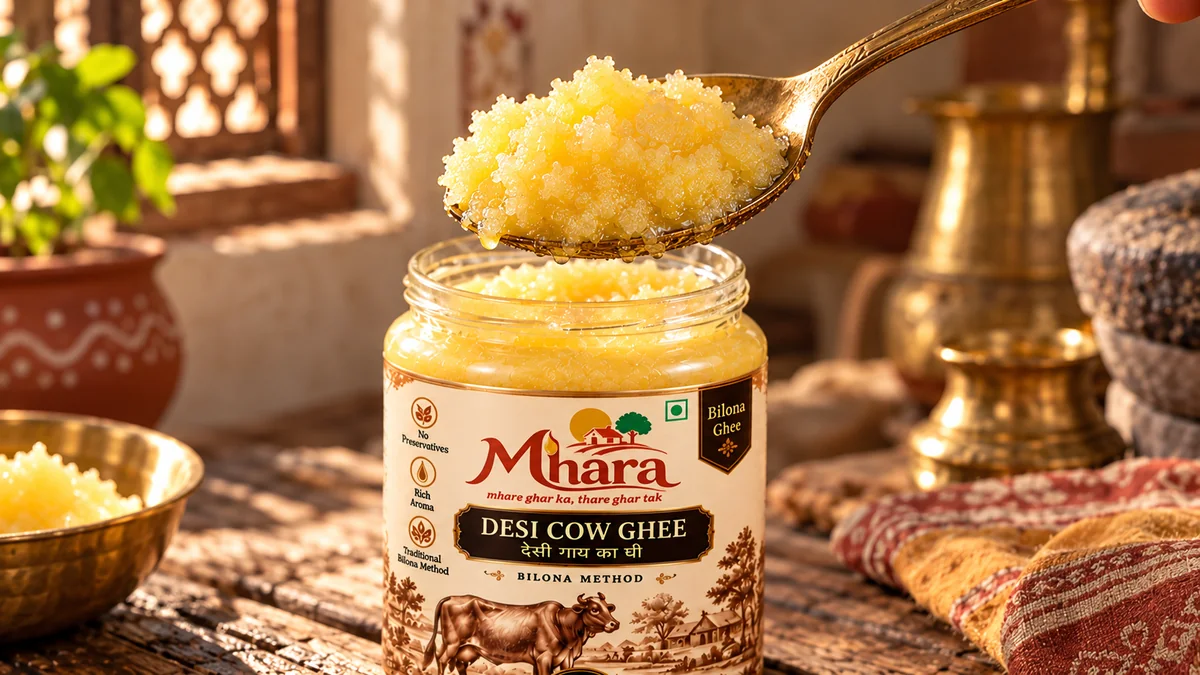
Danedar ghee is ghee that has set into small, visible grains. The grains come from slow cooling after the ghee is made, not from any special ingredient, so the word tells you about texture, not about how the ghee was made.
Danedar simply means grainy. Danedar ghee is ghee that has set into small grains you can see and feel, instead of a smooth paste, and in most Rajasthani homes that grain is what people picture when they say "achha ghee". We make a danedar jar ourselves, so here is how it works in our kitchen, including the part sellers don't usually say out loud.
What danedar ghee actually means
Daana is a grain. Spoon out good danedar ghee on a winter morning and it looks a little like wet sand or soaked suji: separate grains sitting in a thin film of liquid ghee. Rub a pinch between finger and thumb and you feel the grains for a second before they melt.
The word describes texture. It tells you how the ghee set after it was made. It does not tell you which animal the milk came from, whether the ghee was made from curd or cream, or how long it was cooked. Keep that in mind when you see "danedar" printed big on a label.
Why is ghee grainy? Where the grains come from
Milk fat is not one fat. It is a mix of many fats, and each one melts and sets at its own temperature. When hot ghee comes off the flame and starts to cool, the fats with the highest setting point go solid first and form tiny crystals.
If the cooling is slow, those first crystals have time to grow. More fat builds up on them, layer by layer, until they are big enough to see. That is a grain. If the cooling is fast, in a fridge or in a steel tin kept on a cold floor, thousands of tiny crystals form at once and none of them gets big. You get smooth ghee.
So the grain is made at the very end, after the cooking is over. In old village kitchens it happened by itself. A heavy kadhai of fresh ghee was taken off the chulha and left to cool in its own time, and the ghee set grainy. Dairies that sell granular ghee get the same result by holding the ghee at a controlled temperature while it sets.
This also clears up a common belief. Grains do not come from curd, from long cooking or from a special breed of cow. A bilona ghee can set smooth if it is cooled fast, and a cream ghee can set grainy if it is cooled slowly.
How our danedar ghee is made, honestly
Our Desi Cow Danedar Ghee starts with malai. In village homes, milk is boiled every day, and the thick layer of cream that forms on top as it cools is lifted off and kept aside. That malai is set into curd, churned until makkhan comes up, and the makkhan is cooked slowly on a low flame until the milk solids settle and the ghee turns clear. Then we strain it and let it cool slowly, without hurrying it into a cold room. That slow cooling gives the grain.
What it is not: it is not whole-milk bilona ghee. Our Desi Cow Bilona Ghee starts from curd set with the whole milk, and about 25 to 30 litres of milk go into one kilo. The danedar jar uses the cream, so it takes less milk and less work, and it costs less. The aroma is lighter and a little sweet, where the bilona jar is deeper and nuttier.
We would rather tell you this plainly than let the word do the talking. If you want to understand the difference properly, read what is bilona ghee and our note on curd vs cream ghee.
Grainy ghee vs smooth ghee: is one better?
No. Put the two side by side from the same pot and they taste the same, smell the same and cook the same. The only difference is how the fat crystals set.
- Grainy ghee feels richer on the tongue, and many people like the way the grains melt slowly on a hot roti. It is also easier to scoop in cold weather, because a grainy jar is rarely rock hard.
- Smooth ghee spreads more evenly and looks neater in a katori. Some households prefer it for that reason alone.
One more thing. A grainy texture is a sign that the ghee cooled slowly, not proof that it is pure. If purity is the worry, our 5 home tests to tell pure ghee from fake are more useful, and they are honest about what a home test cannot tell you.
Can the grains disappear?
Yes, and it worries people more than it should. In May and June, our kitchen in the village is well over 35 °C and the whole jar turns liquid. If that melted ghee then cools quickly, say in a fridge or an air-conditioned room, it can set smooth. The grains come back only if it melts and cools slowly again.
The same thing can happen in transit. A jar that sits in a hot delivery van and then lands in a cool flat may arrive half liquid, or set smooth. It is the same ghee.
We explain the whole setting process, and why a half-set jar has a liquid layer on top, in why ghee solidifies in winter.
How to use danedar ghee in the kitchen
Because its aroma is lighter, danedar ghee works for the cooking you do every day. It does not take over the dish.
- Tadka for dal, kadhi and sabzi
- A spoon on hot roti, bajra roti or khichdi
- Parathas and puris on the tawa or in the kadhai
- Upma, poha and halwa when you want ghee in the background, not up front
For festival sweets where the ghee is the main flavour, many families reach for a stronger ghee: cow bilona for its sondhi aroma, or buffalo ghee for a richer, creamier mithai. Danedar ghee still makes a perfectly good suji halwa. It is a question of taste.
Danedar ghee price and what to check before you buy
The grain itself costs nothing to make. What changes the price is everything underneath it: which milk, whether it went through curd or straight from cream or butter, how much was made at a time, and how it was packed. So two jars that both say danedar can be very different things.
Our Desi Cow Danedar Ghee comes in four sizes: 500 g at the price on the jar page, 1 kg at the price on the jar page, 2 kg at the price on the jar page and 5 kg at the price on the jar page. The bigger packs are for families that cook with ghee every day. A few things worth checking with any brand:
- Read the method, not just the word. Does the seller say whether it comes from whole-milk curd, malai or butter?
- Ask which milk. Desi cow, crossbred cow, buffalo or mixed all make danedar ghee.
- Look for an FSSAI licence number on the label and the product page.
- Don't judge the grain in summer. A smooth or liquid jar in June tells you about the weather, not the ghee.
- Smell it when you open it. Good ghee smells like ghee, warm and slightly nutty. A sour or stale smell is the warning sign.
Questions people ask
What is danedar ghee?
Danedar ghee is ghee that has set into small visible grains instead of a smooth paste. The word describes texture only. The grains form when the ghee is cooled slowly after cooking.
Why is my ghee grainy?
Milk fat is a mix of fats that set at different temperatures. When ghee cools slowly, the first fat crystals grow large enough to see as grains. It is normal and does not mean anything is wrong.
Is grainy ghee better than smooth ghee?
Not in taste or quality. Ghee from the same pot tastes and cooks the same whether it sets grainy or smooth. Many people simply prefer the feel of grainy ghee on hot roti.
Why did my danedar ghee turn smooth?
It probably melted in the heat and then cooled quickly, which gives tiny crystals instead of grains. Melt it fully in warm water and let it cool slowly on a shelf, and it usually turns grainy again.
Is danedar ghee the same as bilona ghee?
Not necessarily. Danedar is about texture and bilona is about method. Our danedar ghee is made from malai set to curd, while our bilona ghee is made from whole-milk curd. Any ghee can set grainy if cooled slowly.