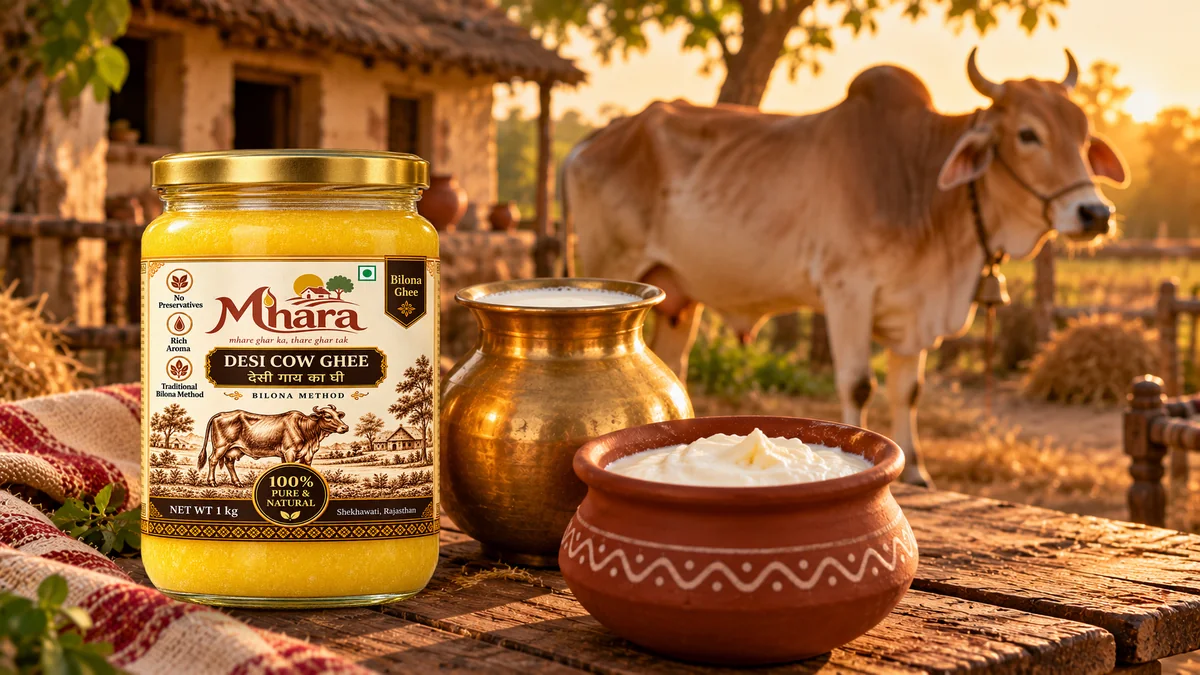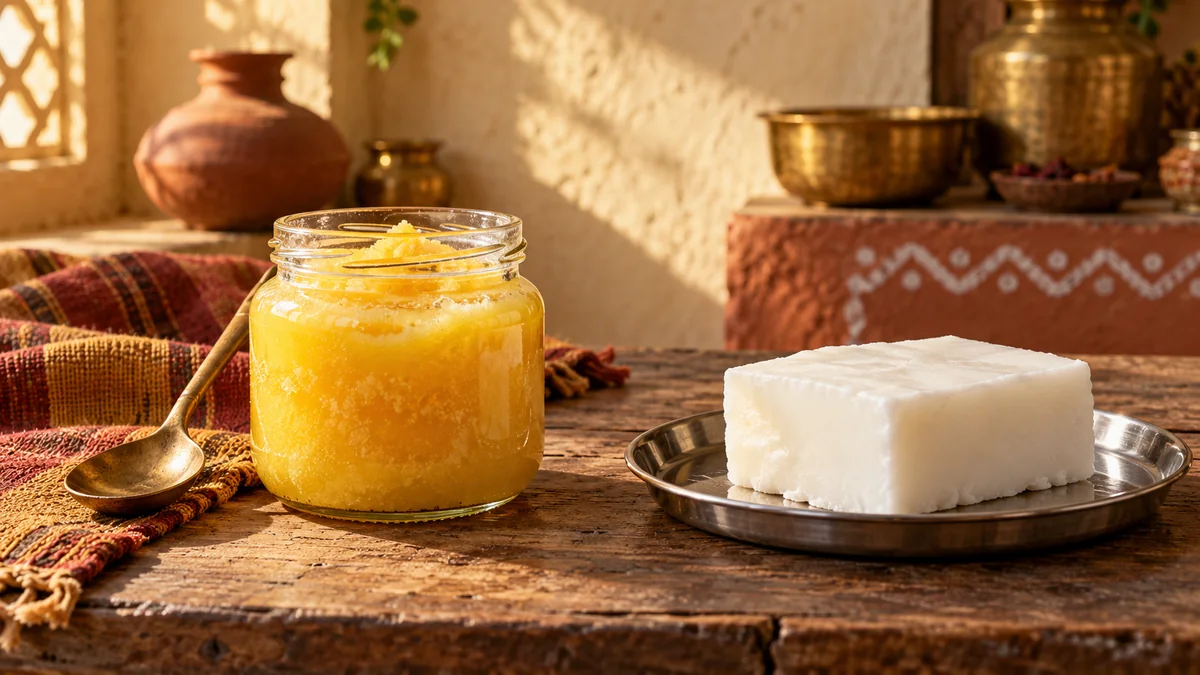

What is bilona ghee? Curd to jar, step by step
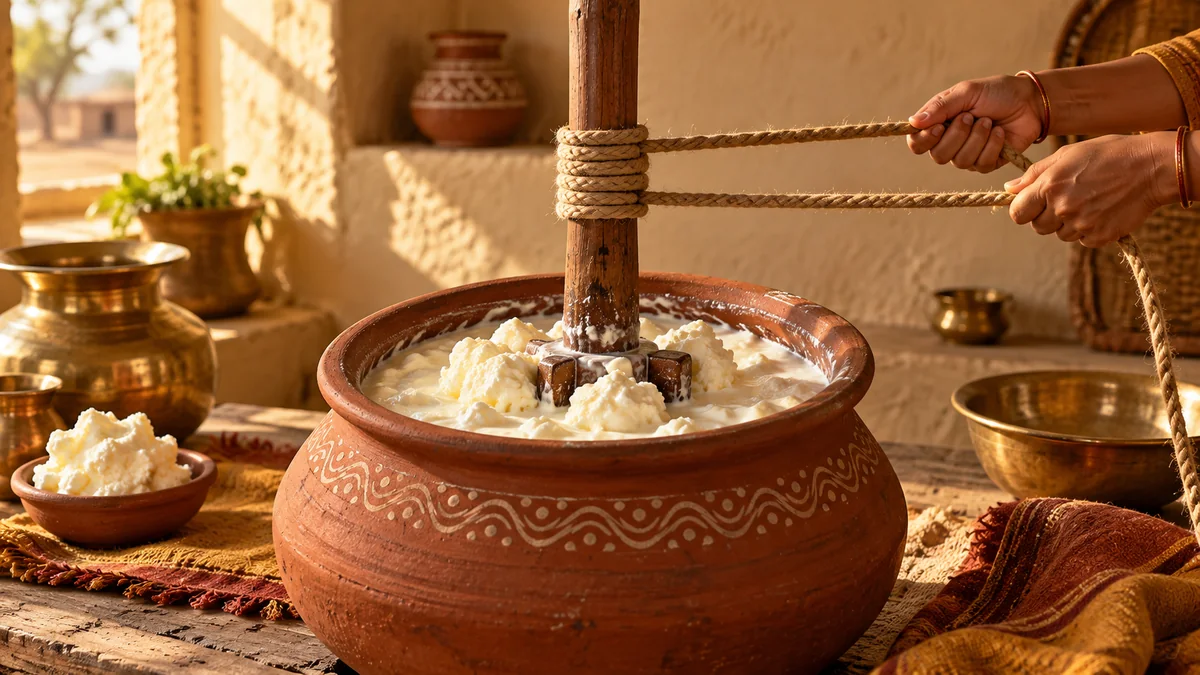
Bilona ghee is ghee made by setting milk into curd, churning the curd with a wooden bilona until makkhan rises, and slowly cooking that makkhan into ghee. Bilona describes this method. On a label it is the seller's own claim, not a grade or a proof of purity.
Ask a grandmother in our village what is bilona ghee and she will probably look puzzled, because for her there was never any other kind. It is ghee made the old household way. Milk is set into curd, the curd is churned to bring up makkhan, and only then is the makkhan cooked into ghee. Below we go through the word itself, each step from milk to jar as our village does it, and what the word on a label does and does not promise.
What is bilona ghee? Start with the word
Bilona is the Hindi word for churning, and in our part of Rajasthan it is also the name for the whole morning job of churning curd. The tool is a wooden churner, the madhani, standing in a deep pot. A rope is wound around its shaft, and you pull the two ends in turn, so the madhani spins one way, then the other. That back-and-forth is the bilona.
In village homes, bilona is something you hear before you see it: the soft knock of the madhani against the pot and the swish of the curd, early in the morning before the day's heat. We wrote about that hour on our morning page.
How bilona ghee is made, step by step
This is how our Desi Cow Bilona Ghee is made in the village households we work with. Nothing here is special to us. It is how ghee has been made in these homes for a long time.
- Boil the milk. Whole milk from the household's desi cows is brought to the boil and then left to cool until it is just lukewarm.
- Set it to curd. A spoon of the previous day's curd goes in as the starter. The pot is covered and left overnight. By morning it is thick, set curd.
- Churn with the bilona. The curd goes into the churning pot, usually with some cool water to thin it. Then the madhani goes in and the churning starts. It is steady work by hand.
- Lift the makkhan. Slowly the fat gathers into soft white lumps of makkhan that float up. What is left behind is chaach, thin and sour, which the household drinks with lunch.
- Cook it slowly. The makkhan is melted in a heavy kadhai on a low flame. It froths, then crackles, then goes quiet. The water cooks off, the milk solids sink and turn golden brown, and the ghee turns clear with that deep sondhi aroma.
- Strain and seal. The ghee is strained off the browned solids, allowed to cool, and sealed in glass jars.
Our site says about 25 to 30 litres of milk go into one kilo of this ghee. That number is the heart of why bilona ghee costs what it does. We work through the full milk maths in our note on cow ghee price per kg.
Why curd first?
It is a fair question. You could skim the cream off milk and make ghee from that, and many dairies do. So why set the whole milk to curd and churn it?
- Taste. Setting milk to curd sours it. That souring carries into the makkhan and then into the ghee, and it is a large part of the deeper, slightly tangy, nutty aroma people know as bilona ghee.
- Churning separates fat cleanly. Churning curd shakes the fat loose and lets it gather into makkhan, leaving the chaach behind. Homes have done it this way for generations because it works with simple tools.
- The whole milk is used. The family gets curd, chaach and ghee from the same milk. In a village kitchen, that matters.
Ghee made from cream or butter is real ghee too. It is simply a different method with a different taste. We lay the methods side by side in curd vs cream ghee and in bilona ghee vs regular ghee.
Hand churned ghee and machine churned ghee
The word bilona describes the method, curd churned into makkhan. It doesn't say who or what turned the churner. Some makers use a motor to spin the churner, which is still curd churning, and they may still call it bilona. Hand churned ghee means a person did the work with a rope and a madhani, as in our village.
Does the hand make a difference to taste? Honestly, the curd, the milk and the slow cooking matter far more. But hand churning keeps batches small, because one person can only churn so much curd in a morning, and small batches are easier to watch closely on the flame.
What "bilona" on a label does not guarantee
Bilona is a description, not a grade. The FSSAI standard for ghee sets limits that any ghee must meet, however it was made, but it does not check how the ghee was churned. So when you see the word on a jar, it is the seller's own claim. On its own, it does not tell you:
- whether the curd was set from whole milk or from cream or malai
- whether the milk was from desi cows, crossbred cows, buffaloes or a mix
- whether the churning was by hand or by motor
- how large the batches are, or how long the makkhan was cooked
- whether the ghee is pure, which only a lab can confirm
How to read a label that says bilona
When a jar says bilona, look for the rest of the story. A seller who really makes ghee this way usually has no trouble saying more. Ask, or look on the product page, for these:
- What is set to curd? Whole milk, or cream? Both are honest methods, but they are different products.
- Which milk? Desi cow, other cow, buffalo or mixed.
- Where is it made? A village, a farm or a plant, with a name and address you can check, and an FSSAI licence number.
- How many litres per kilo? Whole-milk bilona cow ghee takes a lot of milk. A seller who knows the number has probably made the ghee.
- Does the price make sense? Whole-milk bilona ghee cannot be cheap, because the milk alone costs a lot.
For a wider set of checks, including the home tests and what they can't tell you, see how to check purity of ghee at home.
Our two cow ghees, plainly
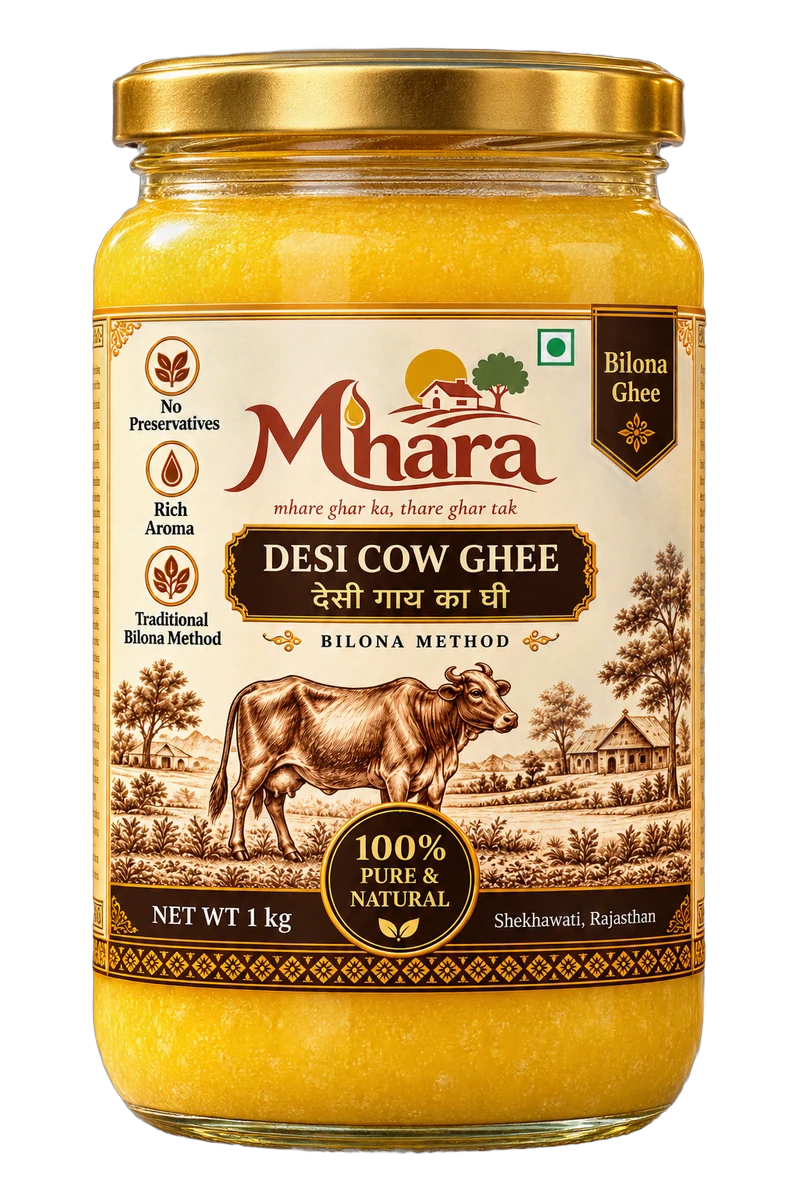
We sell two cow ghees, and we want the difference to be clear. Our Desi Cow Bilona Ghee is the one described above: whole desi cow milk, set to curd overnight, hand-churned with a wooden bilona, slow-cooked and sealed in glass. It has the deep, nutty aroma and comes in 500 ml and 1 litre glass jars, and 2 and 5 litre steel tins.
Our Desi Cow Danedar Ghee is made from the malai of desi cow milk, set to curd and churned, then cooled slowly so it sets grainy. It is good ghee, lighter in aroma, but it is not whole-milk bilona ghee and we don't call it that. You can read how it is made in danedar ghee.
Questions people ask
What is bilona ghee?
Bilona ghee is made by setting milk into curd, churning the curd to bring up makkhan, and slowly cooking the makkhan into ghee. The name comes from bilona, the Hindi word for churning.
Is bilona ghee made from curd or cream?
Traditional bilona ghee is made from curd set from whole milk. Some sellers set cream into curd and churn it, which is also churning but uses less milk. Check the label or ask which one it is.
How much milk is needed for 1 kg of bilona ghee?
For whole-milk desi cow bilona ghee, about 25 to 30 litres of milk go into one kilo. That is the main reason it costs more than other ghee.
Is hand churned ghee the same as bilona ghee?
Hand churned ghee is bilona ghee where a person turns the churner by hand with a rope. Some makers use a motor to churn the curd and still call it bilona. The curd and slow cooking matter more to taste than the hand.
Does bilona on the label mean the ghee is pure?
No. Bilona describes a method and is the seller's own claim. It does not prove purity, the type of milk or whether whole milk was used. Only a lab can confirm purity.
What is left after making bilona ghee?
Chaach, the sour buttermilk left after churning, which families drink, and the browned milk solids at the bottom of the kadhai after cooking the makkhan.