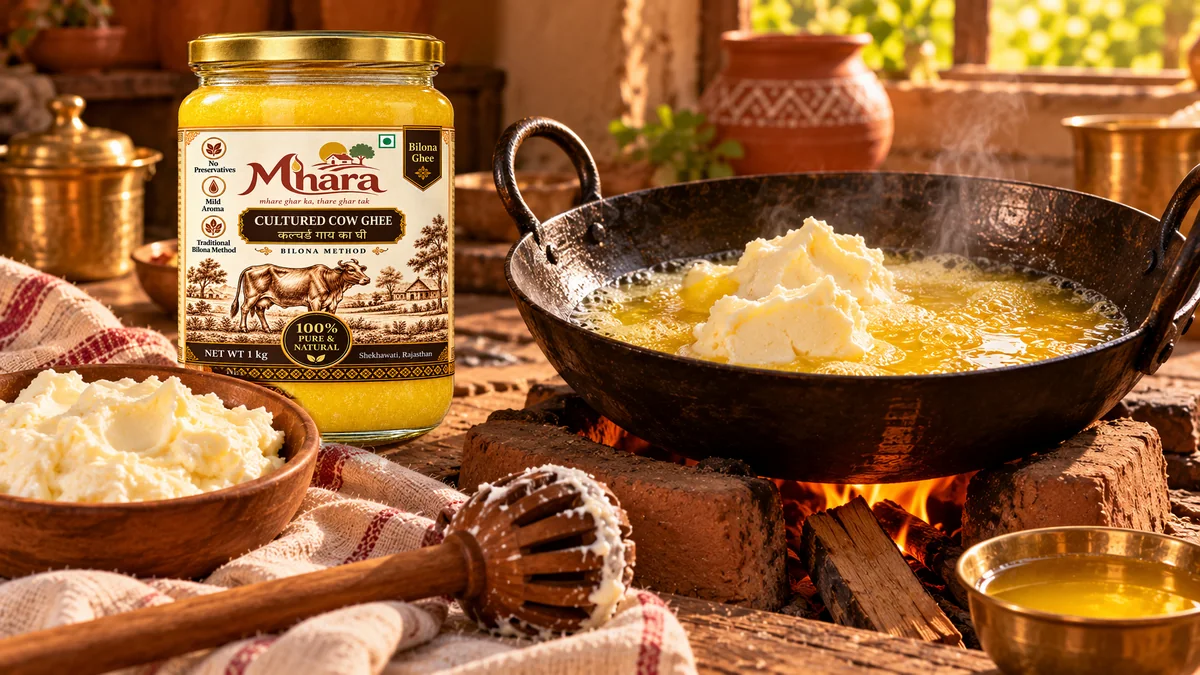

How to store ghee: the dry-spoon rule and ghee shelf life
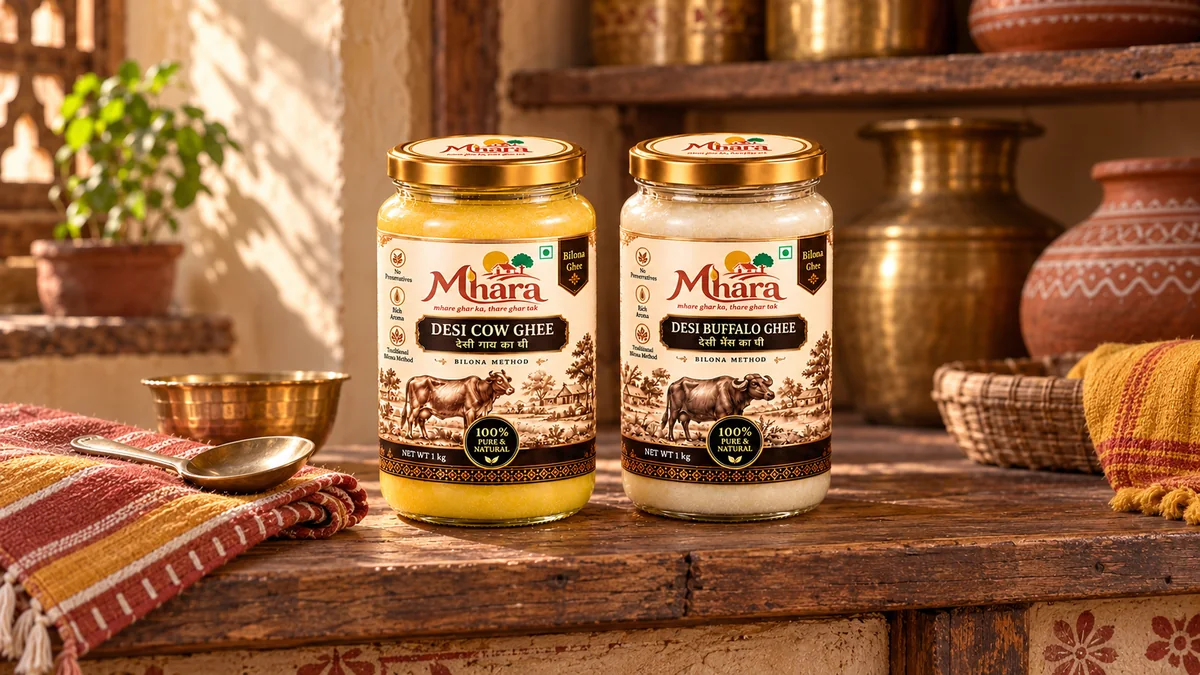
A sealed jar of pure ghee keeps well for about 12 months from packing. Once opened, it stays good for several months at room temperature if you use only a dry spoon and keep the lid shut, away from heat and sunlight.
Ghee shelf life is longer than most people think, and shorter than it could be in most kitchens. The ghee itself is very stable. What spoils it is almost always something we do to the jar: a wet spoon, a lid left open next to the stove, a container kept in the sun. The way our village stores it is simple, and it keeps a jar good for months.
Ghee shelf life: how long does a jar really last
A sealed jar of pure ghee keeps well for about 12 months from the day it was packed. Look for the packing date and best-before on the jar or label, and count from there.
Once you open it, there is no fixed number of days. In our homes a jar that is opened in October is often still fine in March, because nobody puts anything wet into it. In a kitchen where the spoon goes from the dal pot straight into the ghee, the same jar can start to smell off in a few weeks.
So when someone asks us "ghee kitne din chalta hai", the honest answer is: an unopened jar, about a year; an opened jar, several months, as long as you follow a few simple habits. Those habits matter more than the date.
The four things that spoil ghee
Ghee is about 99% fat with almost no water and very little milk solids left after clarifying. That is why it lasts so much longer than butter or malai. Four things wear it down:
- Water. Even a few drops give mould and bacteria a place to grow, and water also slowly breaks fat down into sour-smelling compounds. This is the biggest one.
- Air. Oxygen reacts with fat over time and makes it rancid. A lid left open does this faster.
- Light. Direct sunlight speeds up that same reaction. A jar on a sunny window sill ages quickly.
- Heat. Warmth speeds up everything above. A jar sitting right next to the gas, or on top of the fridge where the motor heats it, will turn sooner.
Cold is not on the list. Ghee that sets hard in winter is not spoilt. We explain why in why ghee solidifies in winter.
The dry-spoon rule
If you remember one thing from this page, make it this. Only a clean, completely dry spoon goes into the ghee jar. Not a spoon that was just rinsed, not the spoon you stirred the dal with, not a wet finger.
In village kitchens the ghee jar often has its own small steel spoon that lives in a katori next to it and is used for nothing else. It is a small habit and it is the main reason ghee in those homes lasts the whole season.
Steam is the hidden form of water. If you open the jar right over a boiling pot, or keep it on a shelf above the stove, moisture settles inside the lid and drips back in. Open it away from the cooking, and close it as soon as you are done.
Glass, steel or plastic: which container is best
For long storage, glass and steel are the best choices. Neither one reacts with fat or holds on to old smells, and both are easy to clean and dry fully. That is why we jar our ghee in glass. You can also see the colour and texture through glass, which helps you notice any change.
Plastic is fine for a few days on the table. For months of storage we would not use it. Fat can pick up smells from plastic, and plastic is harder to dry properly after washing. Old ghee smells also tend to stay in it.
If you move ghee into another container, make sure it is washed, dried in the sun or wiped completely dry, and only then filled. A container that looks dry but has a film of water at the bottom will cause trouble.
Do you need to keep ghee in the fridge
No. Village kitchens in Shekhawati keep ghee on a shelf, and have done for as long as anyone remembers. With a closed lid and a dry spoon it stays fine at room temperature for months.
The fridge is not harmful. It just makes the ghee very hard to scoop, and taking a cold jar in and out can pull moisture into it as it sweats. There are two cases where the fridge makes sense:
- You live somewhere hot and humid, and one jar lasts you more than a few months.
- You have bought a big pack and want to keep part of it aside for later.
In that case, split the ghee. Keep a small working jar outside and the rest in the fridge, tightly closed. Take the cold jar out a little before you need it and let it come to room temperature before opening, so water does not form inside.
Storing ghee in summer and in winter
In May our kitchen is 35 °C or more and the ghee is fully liquid. That is normal. Keep the jar in the coolest dark cupboard you have, away from the stove and away from any wall that gets afternoon sun. Liquid ghee is not spoilt ghee.
In December the same jar sets firm, sometimes grainy and sometimes smooth depending on how it cooled. Our danedar ghee sets in visible grains because it was cooled slowly. If it is too hard to scoop, stand the jar in warm water for a few minutes, or simply use a spoon of solid ghee on hot roti or dal where it melts at once.
What you should avoid is melting and setting the whole jar again and again. Every round of heating and cooling, especially near the stove, adds a little wear. Melt only what you need.
How to tell if ghee has gone bad
Your nose is the best test. Good ghee smells like ghee: warm, milky, a little nutty. Spoilt ghee tells you clearly. Watch for:
- A sour, sharp or rancid smell, like old cooking oil, crayons or paint
- A bitter or soapy taste on the tongue
- Mould, fuzzy spots or dark patches on the surface
- A watery layer at the bottom that was not there before
Colour change alone is not a sign of spoilage. Cow ghee can look pale yellow when set and deep gold when melted. Buffalo ghee is white. Grains coming and going with the weather is also normal.
If a jar smells rancid or shows mould, throw it out. Do not scrape off the top and use the rest, and do not use it for frying either. A small loss is better than eating something that has turned.
A strange smell is different from a doubt about purity. If you are not sure whether a jar is real ghee at all, our home tests to check purity of ghee explain what you can check at home and what only a lab can tell you.
Buy the jar size that fits your kitchen
The simplest storage advice is to buy a jar you will finish in a few months. For a family of four that uses ghee every day, a 1 litre jar usually goes in a month or two. A couple who uses a spoon on roti now and then may be better off with 500 ml, so they always have fresh ghee open.
Bigger packs are good value if you cook a lot of mithai or have a large family, and the danedar comes in 2 kg and 5 kg packs for that reason. If you buy big, keep the main pack closed and fill a smaller jar from it. When buying any ghee online, check the packing date on the page or the label. Our guide to buy desi ghee online has a short checklist for that.
If you want an everyday ghee for tadka and roti, our Desi Cow Danedar Ghee comes in glass jars, sealed, with nothing added. And if a jar ever reaches you broken, we send a new one free, as written on our guarantee page.
Questions people ask
Does ghee expire?
Yes, but slowly. A sealed jar is good for about 12 months from packing, so check the best-before date. An opened jar lasts several months if you keep water and steam out of it.
How long does ghee last after opening?
There is no fixed number of days. With a dry spoon, a closed lid and a cool, dark shelf, an opened jar usually stays fine for several months. A wet spoon can spoil it in a few weeks.
Should I keep ghee in the fridge?
It is not needed. Ghee keeps at room temperature with a closed lid and a dry spoon. The fridge helps only in very hot, humid places or when you are storing a big pack for months.
Can I store ghee in a plastic container?
For a few days it is fine. For long storage, glass or steel is better because they do not hold smells and dry fully after washing.
How do I know if my ghee has gone bad?
Smell it. A sour, rancid smell like old oil or paint, a bitter taste, or mould on top means it has spoilt and should be thrown away. Hardening, melting or a change in grains is not spoilage.
Why did my ghee get a sour smell so quickly?
Almost always water got in, from a wet spoon, a damp container or steam from the stove. Use only a dry spoon and open the jar away from cooking pots.