
A1 vs A2 ghee: what the label means, and what it doesn't
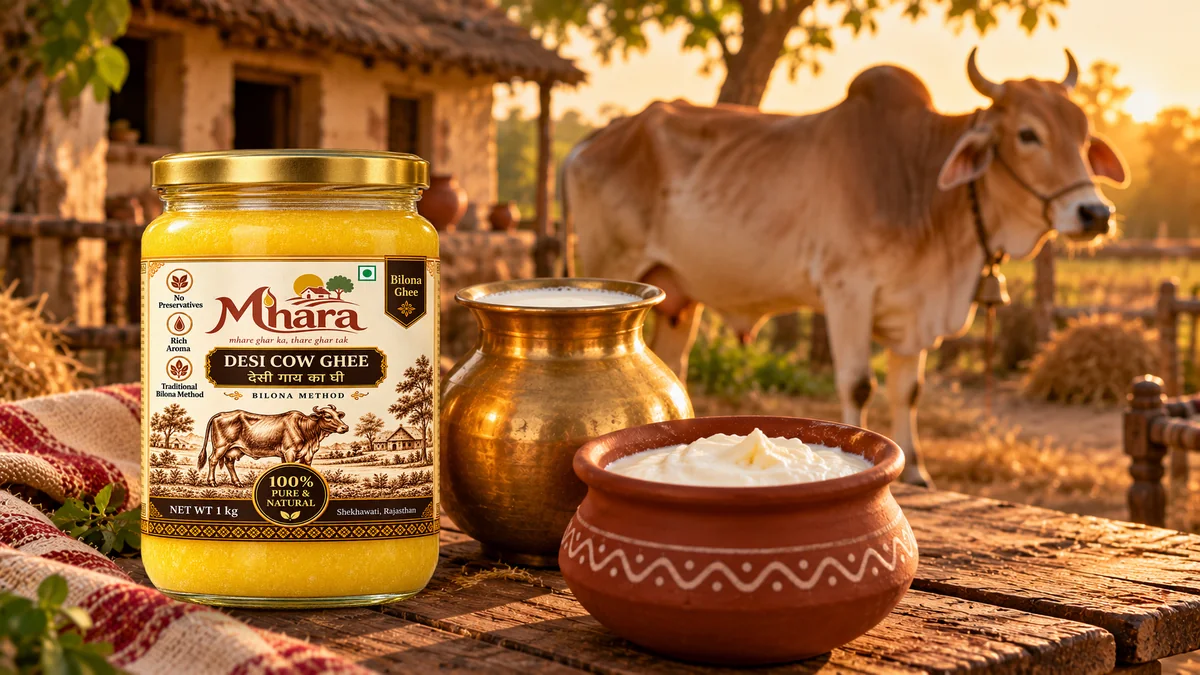
The A1 vs A2 ghee question really starts with milk: A1 and A2 are two forms of a milk protein called beta-casein. Ghee is about 99% fat with only a trace of protein left, so the label matters far less in a jar of ghee than in a glass of milk.
Walk into any shop that sells ghee today and you may find three jars that all say "A2", at three very different prices. Which one is the real thing, and is any of them worth the extra money? It is a fair question. The honest answer to the A1 vs A2 ghee debate takes a few minutes, so here it is, from a family that makes ghee and does not own a lab coat.
What do A1 and A2 actually mean?
A1 and A2 are not grades of ghee. They are the names of two forms of one protein in cow's milk, called beta-casein. Milk carries several proteins and beta-casein is one of the main ones. The two forms differ by a single building block in a long chain, and that small change affects how the protein breaks down in the gut. When A1 beta-casein is digested it can release a small fragment called BCM-7. A2 beta-casein releases very little of it.
Which form a cow makes depends on her genes. Some cows carry only A2, some only A1, and many carry both. Buffalo milk is generally reported to be of the A2 type as well.
A1 vs A2 ghee: why the label matters less than you think
This is the part most labels leave out. A1 and A2 are proteins. Ghee is fat. When makkhan is cooked into ghee, the water boils away and the milk solids, which hold most of the protein, sink to the bottom as brown khurchan and are strained off. What goes into the jar is about 99% milk fat, with only a trace of protein.
So when people compare A1 vs A2 ghee, they are comparing two jars that are almost entirely the same thing: butterfat. Whatever difference A2 milk may make in a glass of milk, ghee has very little protein left for that difference to work through. This is not our opinion against someone else's. It is simply what ghee is.
That does not mean all ghee is the same. It means the letters A1 or A2 are not what makes one ghee better than another.
Is A2 milk better for health? What the evidence says
The interest in A2 began with milk, and there is some research on it. A few small studies have found that some people who feel uneasy after regular milk feel less of it with A2 milk. The bigger claims, about heart disease, diabetes or autism, come from early or weak studies. A review by the European Food Safety Authority in 2009 found no proven cause-and-effect link between BCM-7 and such diseases.
The honest summary: A2 milk may sit a little better in some stomachs. That is a milk question. With ghee, even that small benefit has almost nothing to act on. If someone tells you A2 ghee will fix joint pain or control blood sugar, be careful. Nobody has shown that.
Which cows give A2 milk?
Studies on Indian cattle have found that our native humped breeds, such as Gir, Sahiwal, Rathi, Tharparkar and Red Sindhi, mostly carry the A2 form. Rathi and Tharparkar are Rajasthan's own desert breeds. Crossbred cows with Jersey or Holstein Friesian blood give far more milk, supply a big share of the milk sold in packets, and often carry A1.
That is why "A2" in India has become shorthand for "desi cow". The trouble is that shorthand is not proof. Village cows are not always pure breeds, and the only way to know about one particular cow is a genetic test. A word on a jar cannot show you that.
What FSSAI said about A1 and A2 claims
On 21 August 2024, FSSAI, India's food regulator, told companies to remove A1 and A2 claims from milk and milk products, ghee included. Its reasoning was that the difference lies in the structure of a protein, and its rules do not recognise that split. Five days later, on 26 August, it withdrew the advisory for further consultation with the industry.
So the regulator itself has gone back and forth, and A2 labels are still easy to find on shop shelves. That tells you the A2 label is a marketing question as much as a scientific one.
What matters more than the A1 or A2 label
If you want good ghee, these questions tell you far more than two letters:
- Whose milk? Desi cow, crossbred cow, buffalo or a mix. Each gives ghee its own colour, smell and texture.
- How was it made? From whole-milk curd churned into makkhan, from malai set into curd, or straight from cream or butter in a plant. The curd routes give a deeper aroma and take far more milk and time. We explain this in what is bilona ghee and bilona ghee vs regular ghee.
- How fresh? Ghee keeps well, but a jar made last month smells better than one made a year ago.
- Who stands behind it? Can the seller tell you in plain words where the milk comes from? Will someone answer the phone?
Smell, taste and how the ghee behaves in your kadhai will tell you more than any label. Our guide on how to check purity of ghee has simple tests you can do at home.
Why A2 ghee costs more, and the red flags to watch
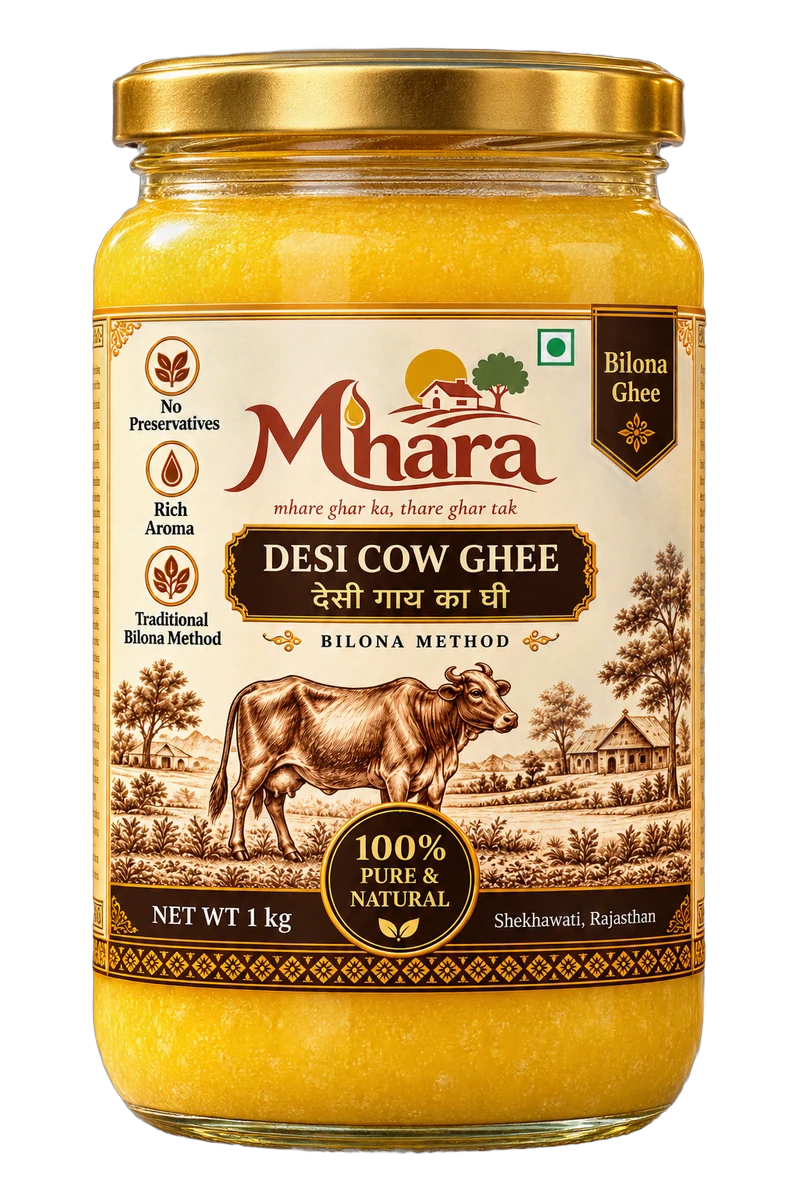
A2 ghee is usually priced high, and part of that is fair. Desi cows give much less milk than crossbred cows, and bilona ghee needs a lot of milk: commonly 25 to 30 litres of desi cow milk for one kilo. Fodder, care and slow churning all cost money. Our own Desi Cow Bilona Ghee is ₹1,999 a kilo for those reasons, and we break the numbers down in cow ghee price.
But a premium also invites shortcuts. Be careful when you see:
- "A2" ghee priced close to ordinary packet ghee. The milk alone cannot cost that little.
- Big health promises, cures, or "boosts immunity" in large print.
- No word on where the cows are or how the ghee was made, only A2 in bold letters.
- "A2" on ghee made from cream separated in a dairy, which is made very differently from curd-churned ghee.
Desi cow ghee vs A2 ghee: why our jar says "desi cow"
You may wonder why our label does not say A2. Our cow ghee is made at home in our Shekhawati village from the milk of desi cows, the humped Indian kind. We have not tested each cow's genes, and we will not print a claim we cannot prove, least of all on something that is 99% fat. So we say what we know: desi cow milk, set into curd, churned with a wooden bilona, cooked slowly.
If A2 matters to you for your own reasons, ask the seller for the test behind the claim. If what you really want is ghee that smells like a village kitchen, start with the milk and the method, because that is where the difference lives. To see that method up close, read our guide on how to make ghee at home.
Questions people ask
What is A2 ghee?
A2 ghee is ghee sold as made from the milk of cows that produce only the A2 form of beta-casein, a milk protein. Indian desi breeds mostly carry A2. Since ghee is about 99% fat, very little of that protein is left in the jar.
Is A2 ghee better than regular ghee?
Not because of the A2 label alone. The A1 and A2 difference is in milk protein, and ghee has only a trace of protein. The source of the milk, the method, freshness and the seller's honesty make a much bigger difference to the ghee you get.
Is desi cow ghee the same as A2 ghee?
Often the words are used for the same thing, because native Indian breeds mostly give A2 milk. But not every village cow is a pure breed, and only a genetic test can confirm A2 for a particular cow. Desi cow ghee simply tells you which animal the milk came from.
Did FSSAI ban A2 ghee?
No. In August 2024 FSSAI asked companies to remove A1 and A2 claims from milk products, including ghee, then withdrew that advisory five days later for more consultation. A2 labels are still common, so check FSSAI's latest position if the claim matters to you.
Why is A2 ghee so expensive?
Desi cows give less milk than crossbred cows, and curd-churned ghee takes about 25 to 30 litres of milk per kilo. That makes it costly. Some of the premium, though, is simply the label. A very cheap A2 ghee is a reason to ask questions.
Does A2 ghee help digestion?
There is no good evidence that A2 ghee digests differently from other ghee. A few small studies suggest A2 milk may suit some people's stomachs better, but ghee has almost no protein, so that effect has little to work on. Ask a doctor about any digestive problem.