Desi ghee vs vanaspati: what is actually different
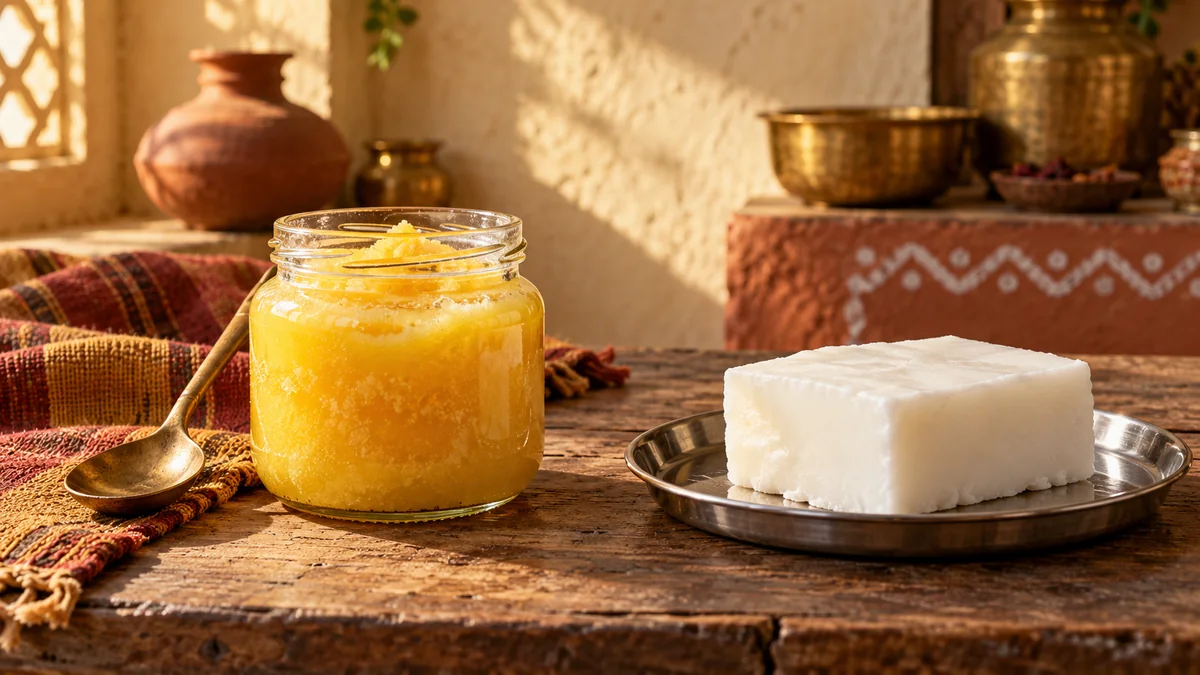
Desi ghee is pure milk fat, made by churning curd or cream into makkhan and cooking it down. Vanaspati is vegetable oil hardened by hydrogenation, a process that can create trans fats, which FSSAI now caps at 2% in oils and fats. They differ in source, aroma, taste and price.
Desi ghee vs vanaspati is a comparison between two things that look alike in a tin and are made from completely different sources. Desi ghee is fat from milk. Vanaspati is vegetable oil that has been chemically hardened into a solid fat. Both set white or pale in winter, both can be used for frying, and that is roughly where the similarity ends. Here is what is actually different, and how to read a label so you know which one you are buying.
What vanaspati actually is
Vanaspati starts as ordinary vegetable oil. In a factory, the oil is heated with hydrogen gas and a metal catalyst. This process, called hydrogenation, changes the structure of the fat so that a liquid oil becomes a solid, grainy fat that looks a little like ghee and stays firm at room temperature.
It became popular in India because it was cheaper than ghee, kept for a long time and could be used the same way in the kadhai. For decades, halwais, dhabas and many homes used it for frying and mithai.
The trouble is what partial hydrogenation creates along the way: trans fats. These are the fats that health bodies around the world have asked people to cut down on, and they are the reason vanaspati has been regulated so closely.
Desi ghee vs vanaspati: the differences that matter
- Source. Desi ghee comes from milk: curd or cream is churned into makkhan, and the makkhan is slowly cooked until only the fat is left. Vanaspati comes from plant oils that are hydrogenated in a factory.
- What the word means legally. Under FSSAI standards, ghee is fat made only from milk, curd, cream or butter. A product with vegetable fat in it cannot honestly be sold as ghee.
- Trans fat. Ghee from milk has small amounts of natural trans fats that come from the cow or buffalo's digestion. Partially hydrogenated vanaspati can carry industrial trans fats, which is why there is a legal limit on it.
- Aroma. Heat a spoon of ghee and the kitchen smells of it. Vanaspati is close to neutral. Any ghee-like smell in it has to come from added flavour.
- Taste and feel. Ghee melts cleanly on the tongue. Vanaspati often leaves a waxy coating in the mouth because some of its fat melts at a higher temperature.
- Colour. Cow ghee is yellow from beta-carotene and buffalo ghee is white. Vanaspati is white or pale unless colour is added.
- Price. Vanaspati costs a fraction of what pure ghee does. That price gap explains most of what follows below.
Trans fat and the FSSAI 2% limit
India now caps industrial trans fat in edible oils and fats. FSSAI brought the limit down in stages, to 3% from January 2021 and to 2% from January 2022. That rule covers vanaspati and other hardened fats.
This was a real improvement, and the cap pushed makers of hardened fats to change how they make them. But the guidance has not changed. The 2024 Dietary Guidelines for Indians from ICMR-NIN advise avoiding partially hydrogenated vegetable oils such as vanaspati, and limiting saturated fats like ghee and butter. So the honest picture is: keep all added fats modest, and leave hydrogenated fats out where you can.
Ghee is not a free pass either. It is mostly saturated fat. We wrote a separate, practical page on how much ghee per day is sensible.
Words to read on the label
The front of a tin or pouch can say almost anything in large letters. The ingredients list and the product name in small print are what count. Look for these:
- "Ghee" or "pure ghee" with milk fat as the only ingredient. That is what you want.
- "Vanaspati" or "hydrogenated vegetable oil" means it is a vegetable fat, whatever the picture on the front shows.
- "Partially hydrogenated" in the ingredients means the process that creates trans fats was used.
- "Interesterified vegetable fat", "vegetable fat" or "bakery shortening" are other plant-based hardened fats.
- "Cooking medium" or "ghee-like" or a picture of a cow on a product that never actually says ghee: read the ingredients before you buy.
- The FSSAI licence number, the maker's name and address, and the packing date.
Why ghee sometimes gets mixed with vanaspati
Pure ghee is expensive to make. Whole-milk bilona ghee takes many litres of milk for every kilo, and even cream-based ghee depends on a steady supply of milk. Vanaspati and other vegetable fats cost far less and look similar once they set. That gap is the whole reason mixing happens.
Adulterated ghee is a known problem in India, and news of seized ghee tends to come up around festivals, when demand is highest. Not every cheap ghee is mixed, and we would not accuse anyone without a lab test. But a price that seems far too low for real ghee is worth a second look.
Some home checks can raise a doubt. A mixed sample may smell flat when heated, leave a waxy feel in the mouth, or set in separate layers when melted and cooled slowly. None of these are proof, because pure ghee also varies with season and method. Our home tests to check purity of ghee go through each one honestly, along with what they cannot tell you. One related myth: hard ghee in winter is not a sign of vanaspati. Pure ghee sets too, as we explain in why ghee solidifies in winter.
Taste and aroma in the kitchen
The clearest difference shows up on the stove. Make two small tadkas side by side, jeera in a spoon of ghee and jeera in a spoon of vanaspati. The ghee tadka smells of ghee and roasted jeera. The vanaspati one smells only of jeera.
The same goes for a hot roti. Ghee melts into it and you can taste it. Vanaspati sits on top and leaves a film. In halwa and laddoo, ghee gives that rounded, milky richness that sweets are known for. Vanaspati gives the texture but not the taste, which is why sweets made with it often rely on extra flavouring.
Kitchen uses: where each one has been used
Vanaspati found its place where cost and long frying mattered most: large-scale frying, cheap sweets, bakery work. Its selling points were price and shelf life, not taste.
Ghee has always been the fat for tadka, for roti, for festival sweets and for anything where you want the smell to carry. It takes heat well, with a smoke point around 250 °C, and keeps for months at room temperature in a clean, dry jar.
At home, the simple rule we follow is to use a little real ghee where it adds flavour, a good cooking oil for the rest, and no hydrogenated fat at all.
Buying ghee you can trust
Read the small print, check the FSSAI licence, and ask the seller how the ghee is made. A seller who knows will tell you plainly whether it comes from curd or cream, and from which animal. Our page on bilona ghee vs regular ghee explains those methods, and our guide to buy desi ghee online has a short checklist.
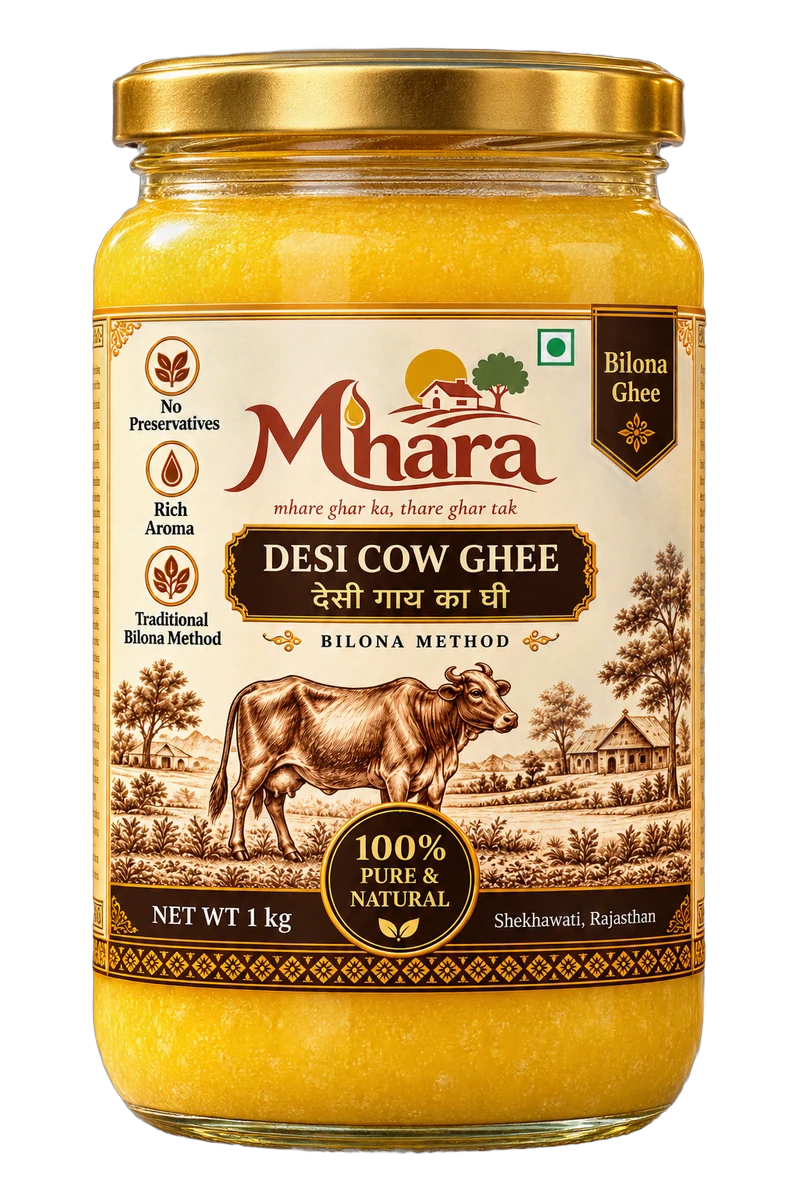
Our Desi Cow Bilona Ghee is made in village homes near Pilani from whole desi cow milk, set to curd overnight, churned by hand with a wooden bilona and cooked slowly. Nothing else goes into the jar.
Questions people ask
Is vanaspati the same as ghee?
No. Ghee is made only from milk fat, while vanaspati is vegetable oil that has been hydrogenated into a solid fat. Under FSSAI standards a product containing vegetable fat cannot be sold as ghee.
What is the trans fat limit for vanaspati in India?
FSSAI limits trans fat in edible oils and fats, including vanaspati, to 2% from January 2022. Before that it was 3% from January 2021.
Why is vanaspati cheaper than desi ghee?
Vanaspati is made from plant oils in large factories, while ghee needs a lot of milk for every kilo. That cost gap is also why ghee is sometimes mixed with vegetable fats.
How do I know if my ghee has vanaspati in it?
Read the ingredients for words like vanaspati, hydrogenated or vegetable fat. Home tests can raise a doubt, but only a lab test can confirm it.
Does vanaspati taste like ghee?
Not on its own. Vanaspati is close to neutral and can leave a waxy feel in the mouth, while ghee has a clear milky, nutty aroma. Any ghee smell in vanaspati comes from added flavour.
Which is better for cooking, ghee or vanaspati?
The ICMR-NIN 2024 guidelines advise avoiding partially hydrogenated oils such as vanaspati and keeping saturated fats like ghee limited. A small amount of real ghee where you want flavour is the common choice.