Gaon ka ghee: how one Shekhawati village makes every jar
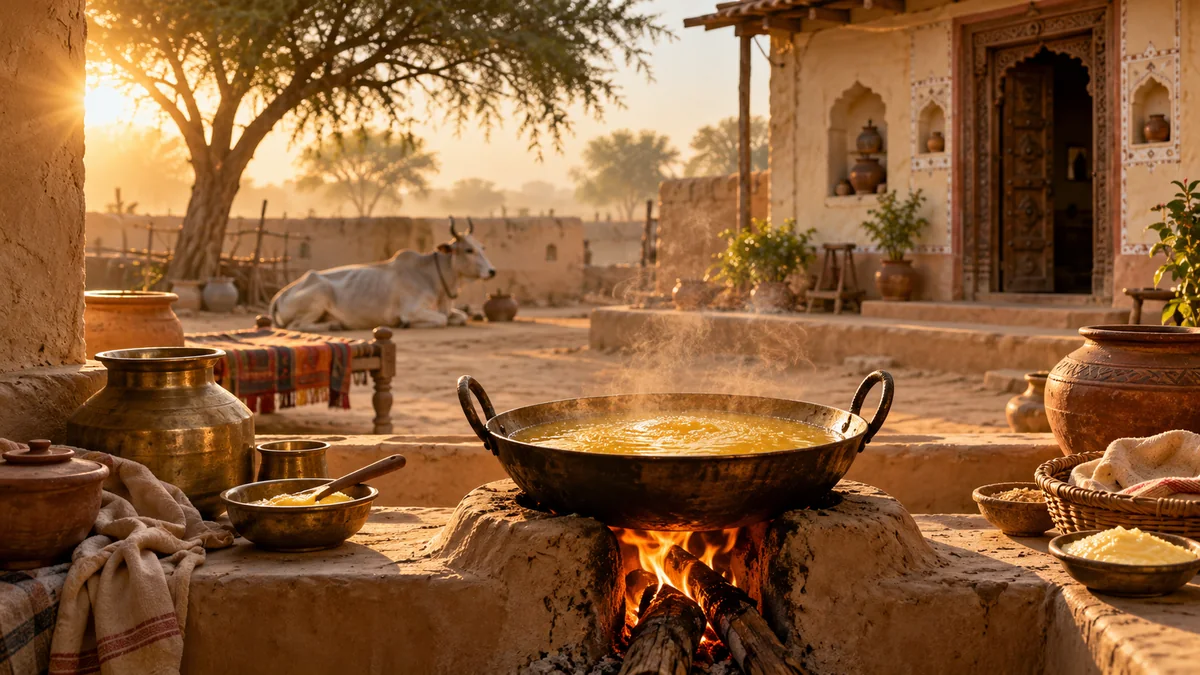
Mhara's village ghee is made in the kitchens of households we know in one village near Pilani, Shekhawati, from the milk of their own cows and buffaloes. We collect it, check it, jar it in glass and ship it to you, with nothing added.
Most pages that sell village ghee online show a cow, a clay pot and a few warm words, and stop there. Here is the long version for ours. Mhara ghee comes from one village near Pilani, in Jhunjhunu district of Shekhawati, Rajasthan. It is made in the kitchens of households we know, from the milk of their own cows and buffaloes. We collect it, check it, put it in glass jars and send it to you. That is the whole chain, and this page walks through it.
The village and the land around it
Shekhawati is dry country. The soil is sandy, the summers go past 40 °C, and in December the nights drop to 4 or 5 °C. Most families here farm a little and keep animals. In the kharif season the fields are bajra and guar. In winter, if there has been enough water, they turn yellow with mustard and green with chana.
Animals are part of the household here, not a separate business. A family may keep a few cows or buffaloes, tied in the courtyard or in a shed next to the house. They are fed on what the land gives: dry bajra stalks for most of the year, green fodder after the rains, and khal, the oilcake left after pressing mustard. You can see more of the place on our our village page.
Why gaon ka ghee is different from dairy ghee
In a village home, ghee was never a product. It was what you did with milk you could not drink that day. Milk that was not drunk or sold was set into curd, the curd was churned for makkhan and chaach, and the makkhan became ghee that would keep for months. The chaach went with lunch. Nothing was wasted.
That habit is why ghar ka ghee in Rajasthan is usually made from curd, not straight from cream. The milk is not separated by a machine. It goes into the curd whole. We explain that method step by step in what is bilona ghee, and we are clear about which of our jars is made that way and which is made from malai in curd vs cream ghee.
A morning in the ghee season
The work starts the evening before. Milk from the evening milking is boiled, allowed to cool until it is just warm to the finger, and set with a spoon of curd in a clay handi or a steel pot. It is covered and left in a corner of the kitchen overnight. In winter it sits a little closer to the warm chulha so it sets properly.
Before sunrise, the curd is churned. The bilona is a wooden churn stick with a rope wound round it. Pull one end, then the other, and the stick spins in the curd. It is a steady, tiring rhythm, and in most houses here it is done by the women of the house while the rest of the family is still waking up. After a while, small white lumps of makkhan start to float up. They are gathered by hand, and what is left behind is chaach.
Later in the day, the makkhan goes into a heavy kadhai on a low flame. It foams, goes quiet, and the milk solids slowly sink and turn brown. The cook goes by smell more than by clock. When the ghee turns clear and the aroma turns nutty, the kadhai comes off the fire and the ghee is strained. We have written the whole morning out, hour by hour, on our morning.
Village ghee online: from the household to your door
Mhara does not run a dairy or a factory. We work with households in the village whose kitchens and animals we know. Here is what happens between their kadhai and your kitchen:
- Collect. We collect the ghee from each household once it has cooled.
- Check. Before anything goes into a jar, we check it the way any village kitchen would, by smell, taste, colour and how it sets. A batch that does not smell or taste right does not go into a Mhara jar.
- Jar. The ghee goes into glass jars and is sealed. Nothing is added. No preservative, no colour, no flavour.
- Ship. We send it across India with free delivery. If a jar reaches you broken, we ship a new one free. That promise is written up on our guarantee page.
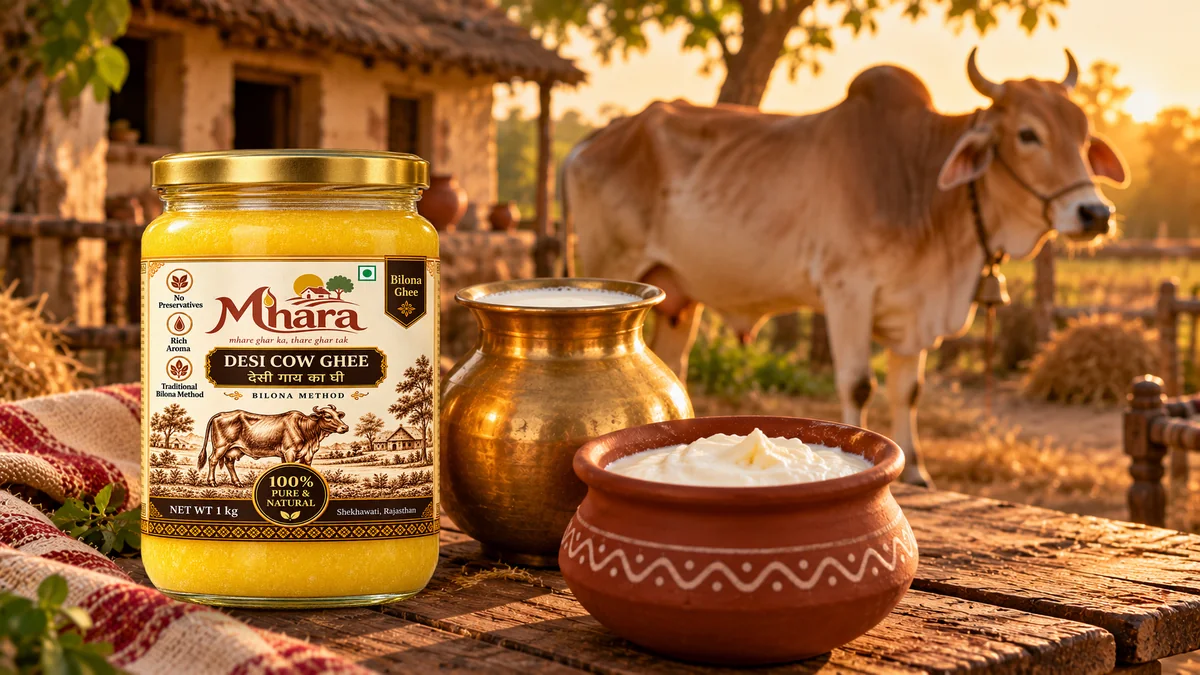
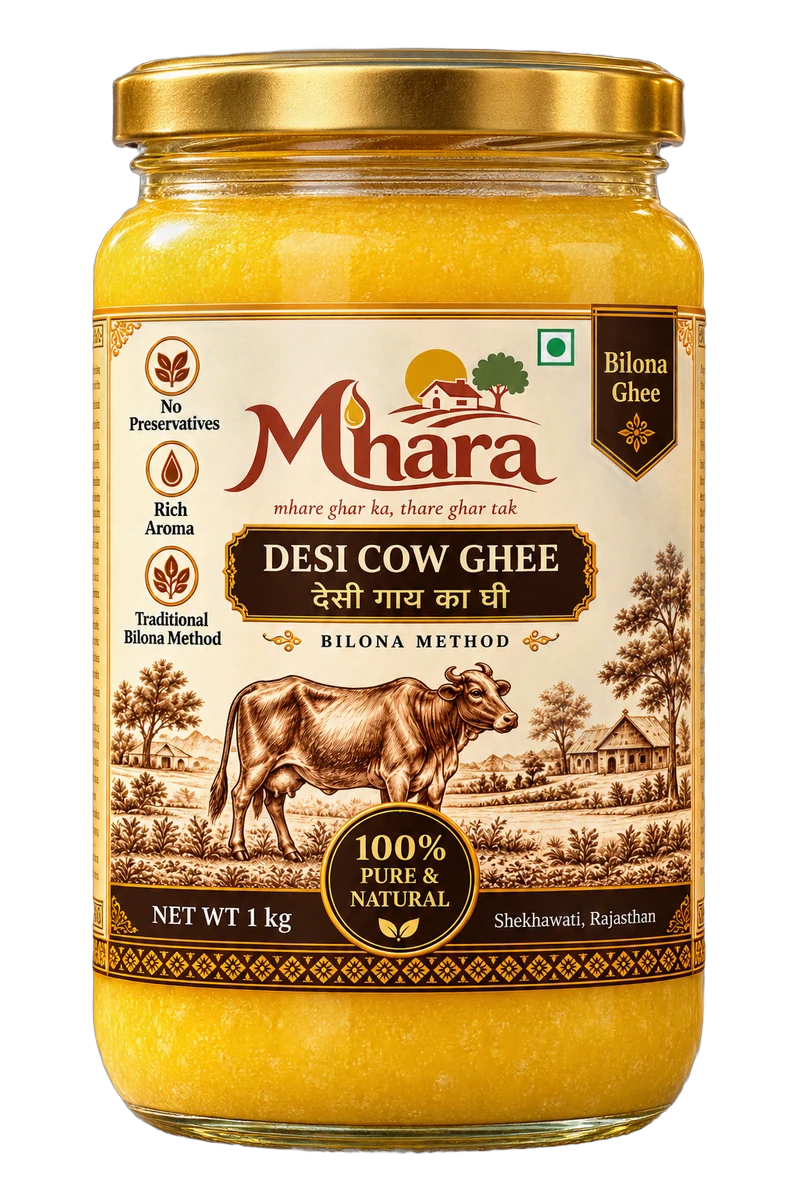
The cow ghee you see above is our Desi Cow Bilona Ghee, made from whole-milk curd and churned with a bilona. Our buffalo ghee is made the same way from buffalo milk. Our danedar ghee is made from the malai of desi cow milk, set into curd and churned. It comes from the same kind of kitchens, but it is not whole-milk bilona ghee, and we label it honestly.
Why village ghee changes a little from batch to batch
If you have bought from us more than once, you may have noticed that one jar was a little more yellow, or set a little harder, than the last. That is normal for ghee made in small household batches, and it is worth knowing why.
- Feed and season. Cow ghee gets its yellow colour from beta-carotene in green fodder. After the monsoon, when there is green fodder, the ghee comes out deeper yellow. In the dry months it is paler.
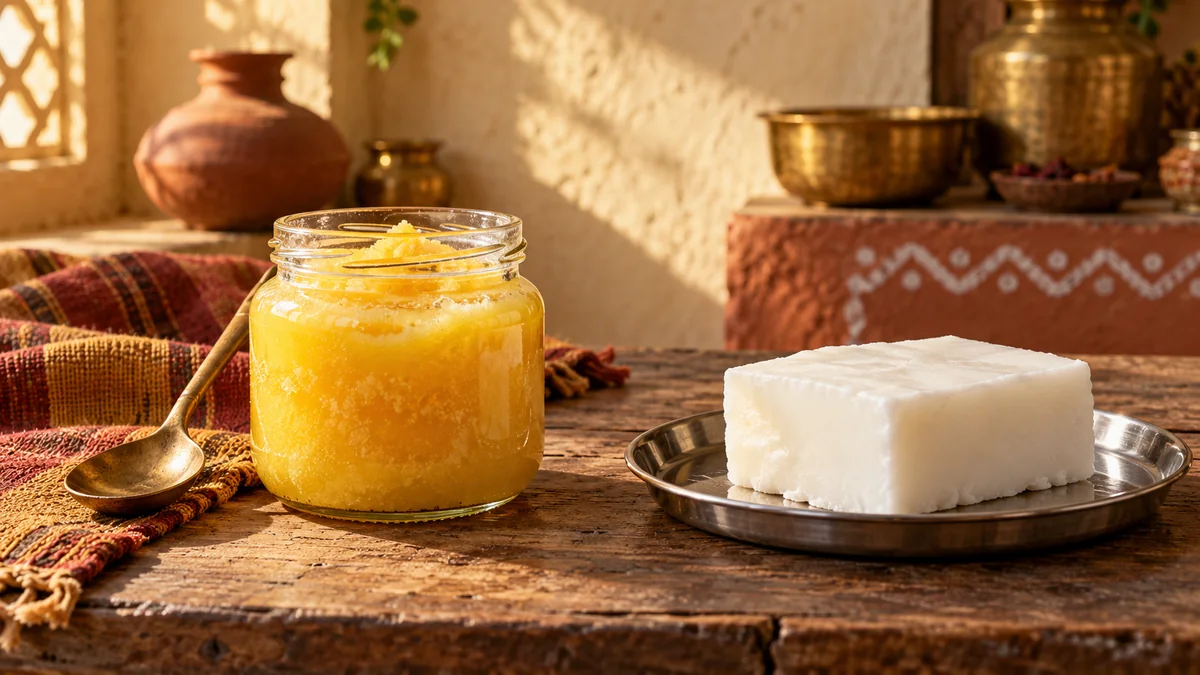
- Weather. Ghee that cools slowly on a mild day sets grainy. Ghee that cools fast on a cold night or in a cold van sets smoother. We explain the science in why ghee solidifies in winter.
- The kitchen. Every cook takes the kadhai off the flame at a slightly different moment. A few seconds more gives a deeper, toastier aroma.
- The animal. Cow and buffalo ghee are very different, and even between cows there are small differences in the milk.
A dairy blends huge batches so every jar is the same. A village cannot do that, and we do not try to. The ghee is still the same ghee, made the same way.
What "village ghee" on a label can and can't tell you
Words like village ghee, homemade ghee, ghar ka ghee and Rajasthani desi ghee are not standards. Nobody checks them. Anyone can print them on a jar. So when you are buying, look past the word and ask four plain questions:
- Which village or area does it come from?
- Who makes it: households, a small unit, or a dairy?
- Is it made from whole-milk curd, from malai, or from cream?
- Does the seller show an FSSAI licence number on the label or page?
A seller who really works with a village will answer all four without fuss. We have a longer checklist in buy desi ghee online.
What we can't promise
Honesty also means saying what we can't do. We can't make unlimited ghee, because the village has only so many animals, and some seasons give less milk than others. We can't promise every jar will look exactly like the last one. And we can't promise next-day delivery to every pin code in India, because the ghee starts its trip from a village, not a city warehouse.
What we can promise is that the ghee in a Mhara jar was made in a kitchen in our village, in the way we have described here, and that if we ever change how something is made, this page will say so.
Questions people ask
Where does Mhara ghee come from?
From one village near Pilani in Jhunjhunu district, Shekhawati, Rajasthan. It is made in the kitchens of households we know, from the milk of their own cows and buffaloes, and then collected, checked and jarred by us.
Is village ghee better than dairy ghee?
It is different. Village ghee in Rajasthan is usually made from curd in small batches over a low flame, which gives a deeper aroma. Dairy ghee is made from cream in large batches and is very consistent. Both are real ghee.
Why does my village ghee look different from the last jar?
Small household batches change a little with the season, the feed and the weather. Cow ghee is more yellow after the monsoon when the animals eat green fodder, and ghee that cools slowly sets more grainy. The ghee itself is made the same way.
Is homemade ghee sold online really homemade?
Words like homemade, village and ghar ka ghee are not checked by anyone. Ask the seller where it comes from, who makes it, whether it is made from curd, malai or cream, and look for an FSSAI licence number.
Is anything added to Mhara ghee?
No. The ghee goes into glass jars as it comes from the kadhai, with no preservative, colour or flavour added.