
Cow ghee price 1kg: why bilona ghee costs what it does
Bilona cow ghee costs more than ordinary ghee mainly because one kilo needs about 25 to 30 litres of desi cow milk, plus an overnight set, hand churning and a slow flame. Dairy ghee made from separated cream needs far less milk per kilo, so it can be priced much lower.
The cow ghee price 1kg you see online can range from what looks cheap to what looks like too much, for jars that all say "desi". Most of that gap comes down to one thing: how much milk went into the kilo. Bilona ghee made from whole-milk curd takes about 25 to 30 litres of desi cow milk per kilo. Below is the maths, the other costs that sit on top of it, and our own prices, so you can judge any jar for yourself.
Cow ghee price 1kg: what our jars cost today
These prices update on their own when they change, and delivery is free across India on all of them.
- Desi Cow Bilona Ghee (whole-milk curd, bilona churned): 500 ml ₹1,099, 1 litre ₹1,999, 2 litre ₹3,899, 5 litre ₹9,499
- Desi Cow Danedar Ghee (malai set into curd, churned): 1 kg the price on the jar page, 500 g the price on the jar page, 2 kg the price on the jar page, 5 kg the price on the jar page
- Desi Buffalo Ghee (whole-milk curd, bilona churned): 500 ml ₹1,049, 1 litre ₹1,899, 2 litre ₹3,699, 5 litre ₹8,999
The rest of this page explains why the bilona cow jar sits where it does, and why the other two are priced differently.
The milk maths per kilo
Cow milk is mostly water. Only a small share of it is fat, and ghee is almost nothing but fat. So to get one kilo of ghee you need a lot of milk to begin with.
On top of that, the bilona method does not catch every drop of fat. When curd is churned, the makkhan floats up and is lifted out, but some fat stays behind in the chaach. Then the makkhan itself still holds water and milk solids. On the low flame the water cooks off, the solids settle as the brown residue at the bottom of the kadhai, and only the clear ghee is strained into the jar. Each step leaves a little behind.
That is how you end up at about 25 to 30 litres of desi cow milk for one kilo of bilona ghee. You can do the sum yourself. Take what a litre of cow milk costs in your town, and multiply it by 25, then by 30. That range is the cost of the milk alone, before anyone has set the curd, churned it, lit a flame or bought a jar.
What else goes into the price
Milk is the big number, but it is not the only one.
- Time. The milk is boiled and set the evening before. The curd is churned before sunrise. The makkhan is cooked slowly later. Nobody can hurry these steps without spoiling the ghee.
- Hands. The churning is physical work, done every morning in the season. The cooking needs someone standing at the kadhai, watching the colour and smell.
- Fuel. A low flame for a long time still burns fuel, whether that is gas, wood or upla.
- Losses. The chaach is drunk at home or given away. It has very little sale value. The residue at the bottom of the kadhai is eaten in the house, not sold.
- The glass jar. Glass costs more than plastic, weighs more to ship and can break. We use it because ghee keeps better in it and does not pick up any smell.
- Delivery and breakage. We ship free across India, and if a jar arrives broken we send a new one free. Both of those costs are inside the price. The promise is on our guarantee page.
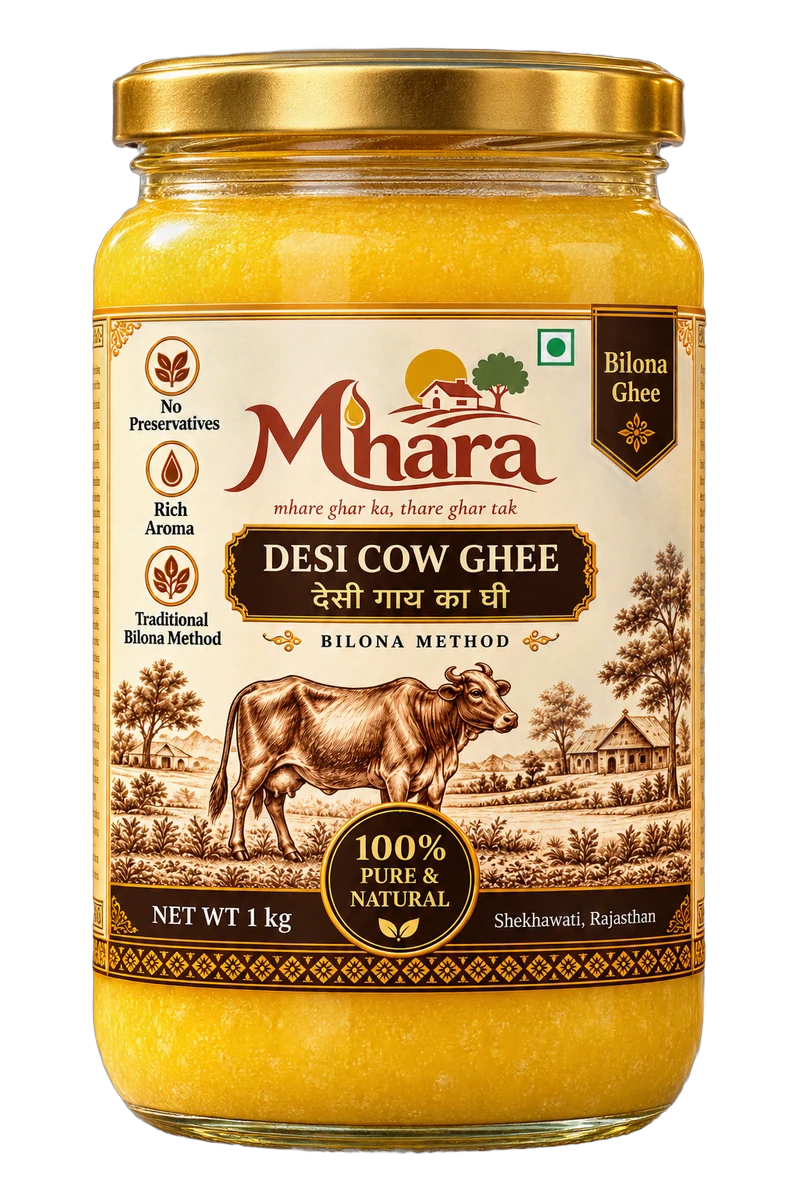
Why bilona ghee is expensive and dairy ghee is not
Dairy ghee is real ghee, and there is a sound reason it costs less. A dairy runs its milk through a separator that pulls out the cream very efficiently. It does not lose much fat to chaach, because there is no chaach. And the skimmed milk left behind goes on to be sold as packet milk, curd, paneer or powder. So the dairy does not have to load the full cost of all that milk onto the ghee. Add machines, steam-heated vessels and batches of hundreds of kilos, and the cost per kilo falls a long way.
We compare the two methods point by point in bilona ghee vs regular ghee.
Why our danedar costs less than our bilona
The same logic applies to our own jars. Our danedar ghee is made from the malai of desi cow milk, set into curd and churned. The milk under the malai still gets used, so the ghee does not carry the cost of every litre on its own. It is curd-based and slow-cooked, but it is not whole-milk bilona ghee, and its price reflects that. We explain the three methods in curd vs cream ghee.
Why buffalo ghee sits where it does
Buffalo milk is much richer in fat than cow milk, so fewer litres go into a kilo of buffalo ghee, even though it is made the same bilona way. That is the main reason buffalo ghee is usually priced a little below cow bilona ghee. There is more on this in buffalo ghee price.
What a very cheap "bilona" price usually means
We can't tell you what is inside a jar we did not make, and we are not going to guess about anyone's ghee. But the milk maths has to work somewhere. If a jar says whole-milk bilona cow ghee and its price per kilo is below what 25 litres of milk would cost in your town, it is fair to ask how. There are a few ordinary explanations:
- It is made from cream or malai, not whole-milk curd. That is still real ghee. It just is not whole-milk bilona ghee, and the label should say so.
- The word bilona is being used loosely. There is no home test that shows whether ghee was churned from curd, so the word is easy to print.
- It is mixed with something else. This is the one to worry about, and price alone can't prove it either way.
If purity is the concern, read how to check purity of ghee at home, which covers the kitchen tests and what each one can and cannot show.
How to compare desi ghee prices fairly
Price comparisons only mean something when you compare like with like. Before you decide that one jar is too dear or another is a bargain, check these:
- Per kilo. Convert every price to one kilo. A 500 g jar and a 1 kg jar are easy to confuse on a phone screen.
- Same animal. Desi cow, mixed cow, buffalo and blended ghee are priced differently for good reasons.
- Same method. Whole-milk curd, malai, or cream. If the page does not say, you are not comparing like with like.
- Delivery included or not. A low price with a delivery charge added at checkout can end up higher than a free-delivery price.
- Jar. Glass and plastic cost different amounts to pack and ship.
- Pack date. Fresh stock and old stock should not be priced the same.
Which size to buy
Buy the size your family will finish in a few months. Ghee keeps well with the lid shut and a dry spoon, but there is no point keeping a big jar open for a year. Our how to store ghee guide covers the details. If you cook a lot of tadka and parathas, the larger danedar packs make sense for the kadhai, with a smaller Desi Cow Bilona Ghee jar kept for the table. That way you pay the bilona price only for the spoon that goes on hot roti and dal, where you can actually taste it.
Questions people ask
Why is bilona ghee so expensive?
About 25 to 30 litres of desi cow milk go into one kilo of bilona ghee, because some fat stays in the chaach and water and milk solids cook off. Add the overnight setting, churning, slow cooking and a glass jar, and the cost per kilo is high.
How many litres of milk make 1 kg of desi cow ghee?
For whole-milk bilona ghee, about 25 to 30 litres of desi cow milk go into one kilo. Ghee made from separated cream in a dairy needs fewer litres because the separator recovers the fat more completely.
Why is dairy ghee cheaper than bilona ghee?
A dairy separates the cream by machine, loses little fat, and sells the skimmed milk as other products, so the ghee does not carry the full cost of the milk. Large batches and machines bring the cost per kilo down further. It is real ghee, made a different way.
Is cheap bilona ghee fake?
Not necessarily, and price alone can't prove it. A low price may mean the ghee was made from cream or malai rather than whole-milk curd, or that the word bilona is used loosely. If the price per kilo is below the cost of 25 litres of milk, it is fair to ask the seller how they make it.
Why is buffalo ghee cheaper than cow bilona ghee?
Buffalo milk has much more fat than cow milk, so fewer litres are needed for a kilo of ghee even when it is made the same bilona way. That usually puts buffalo ghee a little below cow bilona ghee per kilo.