
Bilona ghee vs regular ghee: 8 real differences
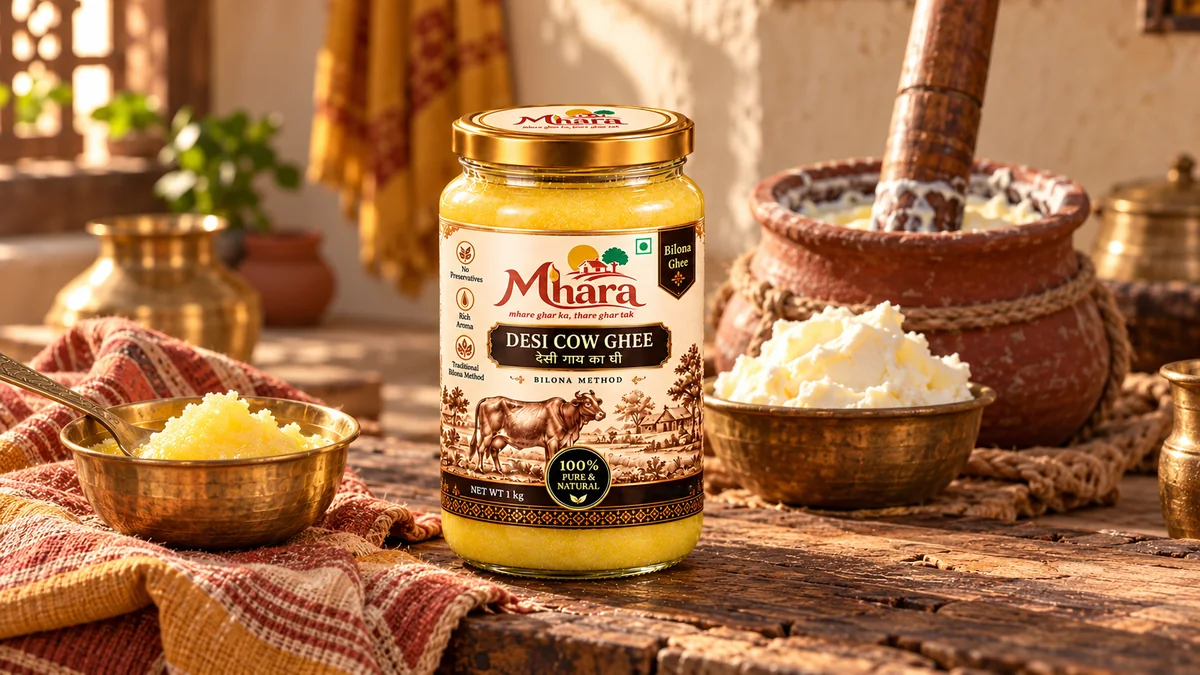
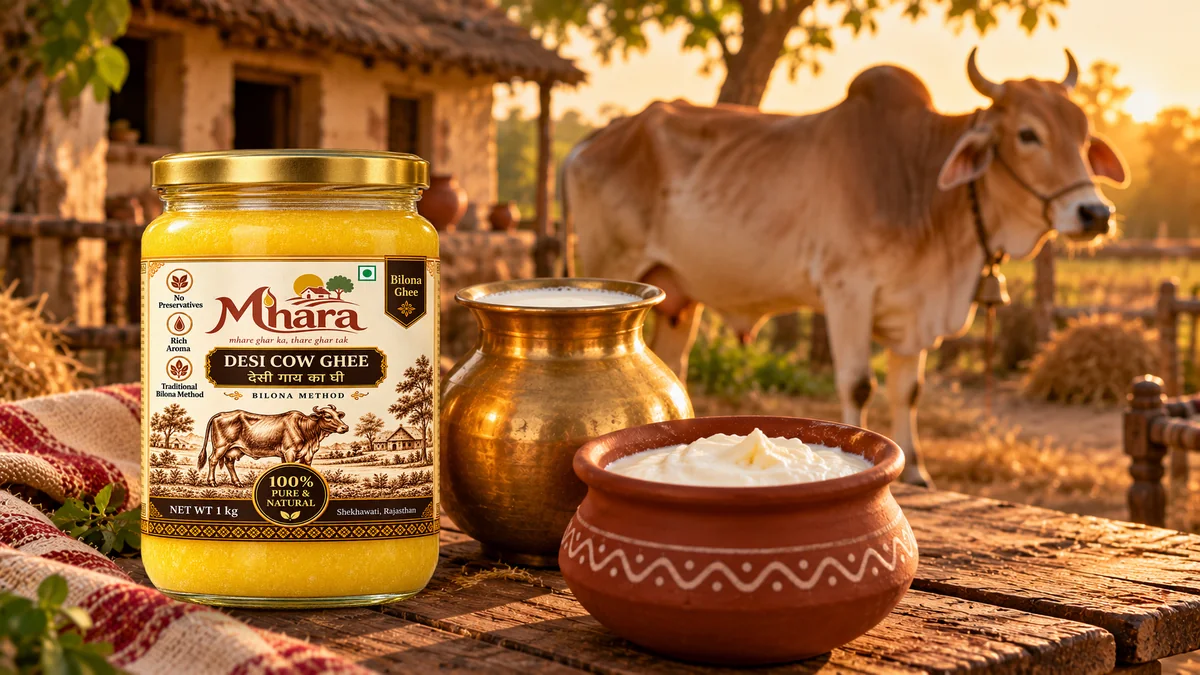
Bilona ghee is made from whole-milk curd churned into makkhan and cooked slowly, while regular dairy ghee is usually made from cream or butter in large batches. Both are real ghee. Bilona takes far more milk and time per kilo, so it smells deeper and costs more.
When people compare bilona ghee vs regular ghee, they usually mean one thing: is the expensive jar really different from the one at the kirana shop, or is it the same ghee with a better story? It is different, in a few ways you can taste and a few ways you can only see in the kitchen where it is made. We make bilona ghee in our village near Pilani, so here is the honest comparison, including the places where regular ghee does perfectly well.
What we mean by regular ghee
By regular ghee we mean the ghee most of India buys every month: dairy ghee made in large plants from cream or from butter. It is real ghee. It is made from milk fat, it is sold under an FSSAI licence, and it has to meet the same standards for ghee as any other jar. Nothing we say below takes that away.
The difference is in the road the milk fat takes before it becomes ghee. Bilona ghee goes milk, curd, makkhan, ghee. Regular dairy ghee usually goes milk, cream, ghee, sometimes with a butter step in between. That one change at the start leads to most of the other differences below. If you want the full step-by-step of our side, we have written up what is bilona ghee separately.
Bilona ghee vs regular ghee: the 8 differences at a glance
- Starting material. Bilona starts from curd made with whole milk. Regular ghee starts from cream or butter.
- Churning. Bilona curd is churned with a wooden bilona until makkhan rises. Dairy cream is either churned in large machines or not churned at all.
- Flame and cooking time. Bilona makkhan is melted slowly on a low flame in a kadhai. Dairies heat cream or butter in big steel vessels, faster and under control.
- Aroma. Curd-churned ghee has a deeper, nutty, slightly tangy smell. Cream ghee smells milder and sweeter.
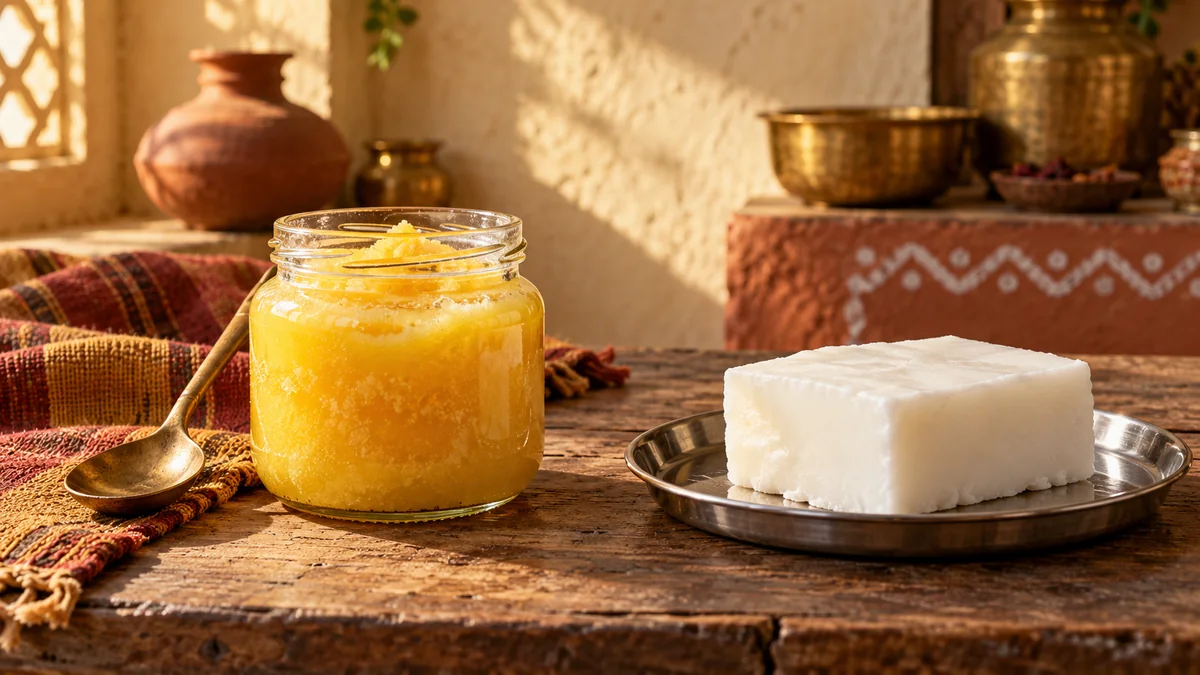
- Texture. Both can set grainy or smooth. Texture depends more on cooling than on method.
- Milk per kilo. Bilona needs about 25 to 30 litres of milk for a kilo of ghee. The cream route needs noticeably less.
- Price. Because of the milk, the time and the hand work, bilona costs a good deal more.
- Batch size. A village household makes a few kilos at a time. A dairy makes hundreds of kilos in a run.
Now the detail behind each one.
How each one is made: curd, churn and flame
1. Curd or cream
In our village, the milk is boiled, cooled to warm, and set with a little of yesterday's curd. By morning it is thick dahi. The whole milk goes into the curd, fat and all. Nothing is skimmed off first.
A dairy works the other way. The milk goes through a separator that spins the cream out of it. The cream goes to the ghee section and the skimmed milk goes on to become packet milk, milk powder or paneer. That is efficient, and it is a big reason regular ghee can be sold at the price it is. We go through the three common methods side by side in curd vs cream ghee.
2. Churning
The curd is churned with a wooden bilona, back and forth with a rope, until lumps of white makkhan float up and the rest turns into chaach. In winter this is done before sunrise, when the curd is cool and the makkhan comes together well. Some makers now fix a small motor to the same wooden churn. Whether by hand or with a motor, the point is the same: the fat is pulled out of curd, not out of fresh cream.
A dairy may churn cream into butter in a big steel churn and then melt the butter. Or it may use the direct cream method, where cream is heated straight into ghee with no churning at all. Both give ghee. Neither involves curd.
3. The flame
Our makkhan goes into an iron kadhai on a low flame. It foams, goes quiet, and the milk solids slowly settle and brown at the bottom. The cook watches the colour and the smell and takes it off at the right moment, then strains it. It is slow, and you cannot hurry it without burning the bottom.
A dairy heats its cream or butter in large steam-heated vessels where temperature and time are set and repeated, batch after batch. That gives a very even product. It also gives less of the browned, toasty note that comes from a kadhai over a flame.
What you notice in the kitchen: aroma and texture
4. Aroma
This is the difference most people notice first. Curd that has set overnight has a slight sourness. When its makkhan is cooked into ghee, that turns into a deep, nutty smell that people here call sondhi. Open a jar of bilona cow ghee next to a jar of cream ghee and the bilona jar usually smells stronger and rounder.
Cream ghee smells clean, milky and mild. Some people prefer it, especially for sweets where they do not want the ghee to take over. That is a matter of taste, not quality.
5. Texture
People often expect bilona ghee to be grainy and dairy ghee to be smooth. It does not work that way. Any ghee that cools slowly forms grains, and any ghee that cools fast in a fridge or a cold truck sets smooth. Plenty of dairy ghee is sold as danedar. So texture tells you how the jar cooled, not how the ghee was made.
Why the price is so far apart
6. Milk per kilo
Cow milk is only a few percent fat to begin with, and when curd is churned, the makkhan does not carry away every drop of it. Some stays behind in the chaach. That is why our site says about 25 to 30 litres of desi cow milk go into one kilo of bilona ghee. A separator in a dairy recovers the fat far more completely, so the cream route needs fewer litres for the same kilo.
7. Price
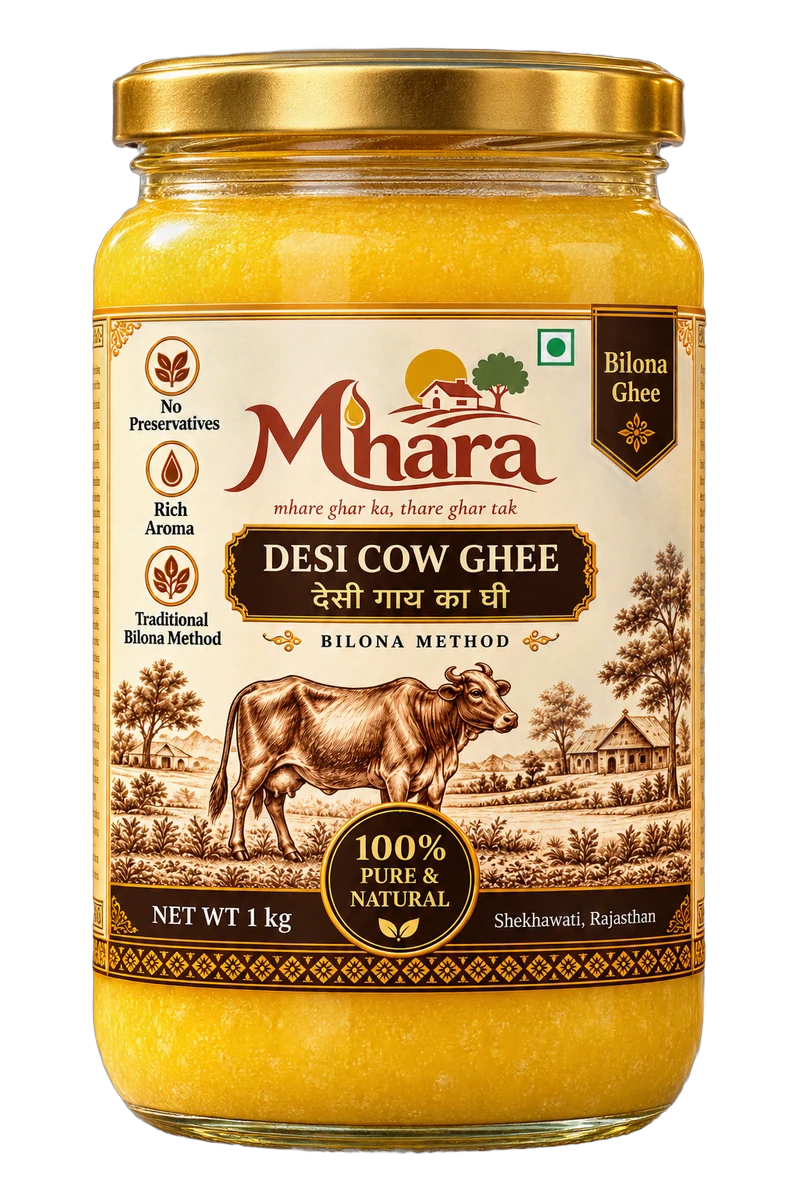
Put the milk together with the overnight wait, the churning, the slow flame and the glass jar, and bilona ghee costs more to make. Our 1 litre jar of Desi Cow Bilona Ghee is ₹1,999 and the 500 ml jar is ₹1,099, delivered free. We break that number down in our cow ghee price article, with the milk maths per kilo.
8. Batch size
A household with a few cows makes a few kilos of ghee at a time, depending on the season and how much milk the animals give. A dairy runs hundreds of kilos in one go. Small batches mean the ghee varies a little: a bit more yellow after the monsoon when the cows eat green fodder, a bit paler in summer. Big batches mean every jar is the same. Neither is wrong. It depends on what you want from your ghee.
Is regular ghee bad ghee?
No. A properly made dairy ghee is pure milk fat and does its job well in the kitchen. Millions of homes have cooked with it for decades. If someone tells you all regular ghee is fake, they are selling you something.
The real problem is a different one: jars that call themselves bilona but are made from cream, or ghee that has been mixed with something else. The word bilona on a label describes a method. No home test can tell you whether a jar was churned from curd, so you have to trust the maker, and it helps when the maker tells you plainly what they do. Our how to check purity of ghee at home guide covers what the kitchen tests can and cannot tell you.
In the same spirit, here is ours. Our Desi Cow Bilona Ghee and our buffalo ghee are made from whole-milk curd, churned with a bilona. Our danedar ghee is made from malai of desi cow milk, set into curd, churned and slow-cooked. It is curd-based, but it is not whole-milk bilona ghee, and we do not sell it as one.
Which one should you buy?
- For everyday tadka and cooking in bulk, a good dairy ghee or a malai-based danedar ghee is sensible. You are frying in it, and the aroma matters less.
- For a spoon on hot roti, dal or khichdi, where you actually taste the ghee, bilona is where the difference shows.
- For sweets, it depends on the sweet. Many homes here use buffalo ghee for laddoo and halwa because it is rich and white.
Many families keep two jars, a bigger one for the kadhai and a smaller bilona jar for the table. That is what a lot of homes in our own village do too.
Questions people ask
Is bilona ghee better than regular ghee?
It is different rather than simply better. Bilona ghee has a deeper, nutty aroma because it comes from curd, while regular dairy ghee is milder. For a spoon on roti many people prefer bilona, and for everyday frying a good dairy ghee does the job well.
Is regular dairy ghee fake?
No. Properly made dairy ghee is pure milk fat made from cream or butter and sold under an FSSAI licence. The problem is mislabelled or mixed ghee, not dairy ghee as such.
Why does bilona ghee cost so much more?
About 25 to 30 litres of milk go into one kilo of bilona cow ghee, because some fat stays behind in the chaach when curd is churned. Add the overnight setting, churning and slow cooking, and the cost per kilo is much higher than ghee made from separated cream.
Can I tell bilona ghee from regular ghee by its texture?
Not reliably. Both can set grainy or smooth depending on how slowly the jar cooled. Aroma is a better hint, and an honest description of the method from the maker matters most.
Is all curd-based ghee bilona ghee?
Not quite. Bilona in the traditional sense means whole-milk curd churned into makkhan. Ghee made from malai that is set into curd and churned is curd-based too, but it is not whole-milk bilona ghee, and a fair label says so.