
Why does ghee solidify in winter? (And how to melt it safely)
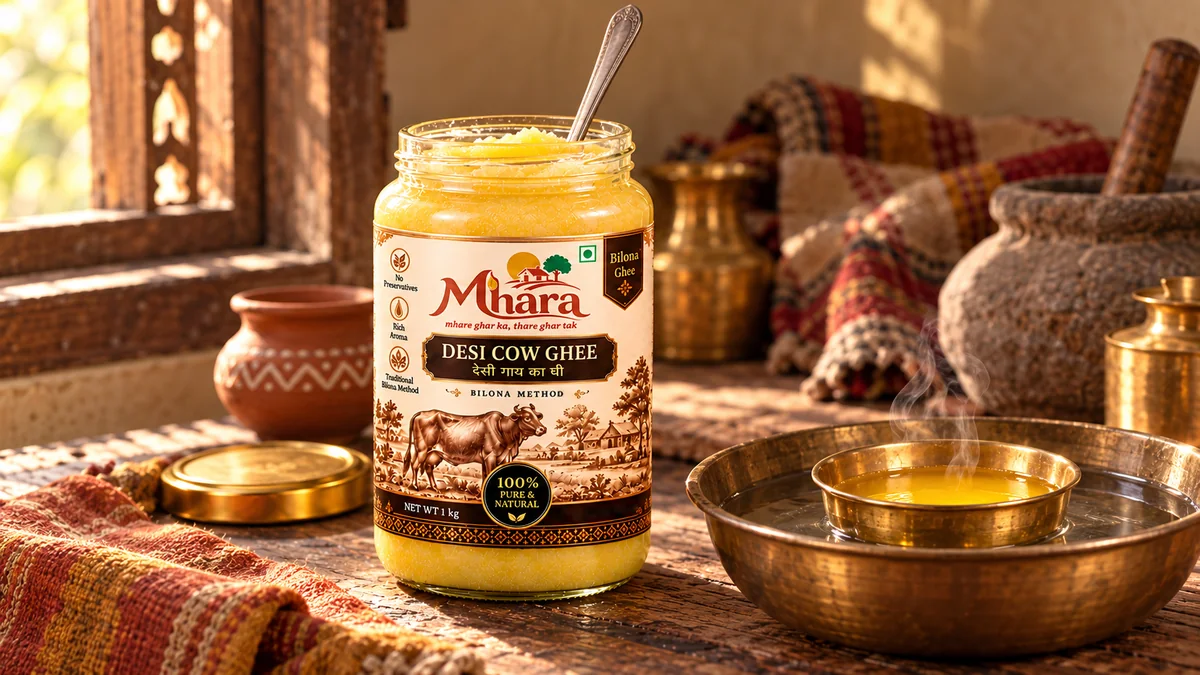
Ghee turns solid in winter because it is almost all milk fat, and a large part of that fat sets once the room drops below about 20–25 °C. It has not gone bad. Stand the jar in warm water for a few minutes and it will pour again.
Every year, sometime in late November, the first message arrives on our WhatsApp: "The ghee has gone hard. Is it spoilt?" It is the most common question we get, so here is the full answer on why ghee solidifies in winter, from the kitchen where the ghee is made.
Why ghee solidifies in winter: what happens inside the jar
Ghee is about 99% fat. But milk fat is not one fat. It is a mix of hundreds of different fats, and each one has its own melting point. Some stay liquid even in a fridge. Others need close to body heat before they melt.
In May, our kitchen in the village sits at 35 °C or more, and every fat in the jar is liquid. The ghee is clear and golden. By December the nights in Shekhawati drop to 4 or 5 °C. The same jar goes cloudy first, then pale, then firm enough to hold a spoon upright.
Nothing has gone into the jar and nothing has come out. The fats have only sorted themselves by temperature. The ones that set first form the solid part. The ones that stay liquid collect around them, which is why a half-set jar often has a thin layer of liquid ghee on top. You can stir it back in or leave it. Both are fine.
The jar does not set all at once either. Glass loses heat fastest at the bottom and along the sides, so that is where the first pale ring appears, while the centre stays soft a little longer. On a really cold night the whole jar has caught up by morning.
Why ghee sets but mustard oil does not
Mustard oil and groundnut oil sit on the same shelf as the ghee and stay runny all winter. The difference is the kind of fat. Most of the fat in ghee is saturated. Its long, straight chains pack together neatly as they cool, a bit like bricks in a stack, and that packing is what makes a solid. Most of the fat in mustard or groundnut oil is unsaturated. Those chains have bends in them, they cannot pack tightly, and so the oil stays liquid even on a cold night.
Coconut oil is the one people notice. It is also mostly saturated fat, and in a North Indian winter it turns white and solid in the bottle for the same reason ghee does. So a fat that sets in the cold is not doing anything strange. It simply has a lot of saturated fat in it.
Why some ghee sets grainy and some sets smooth
The texture depends on how fast the ghee cools. When it cools slowly, the fat crystals have time to grow big enough to see, and you get grains. When it cools fast, in a fridge or a cold delivery van, you get thousands of tiny crystals and a smooth, buttery paste.
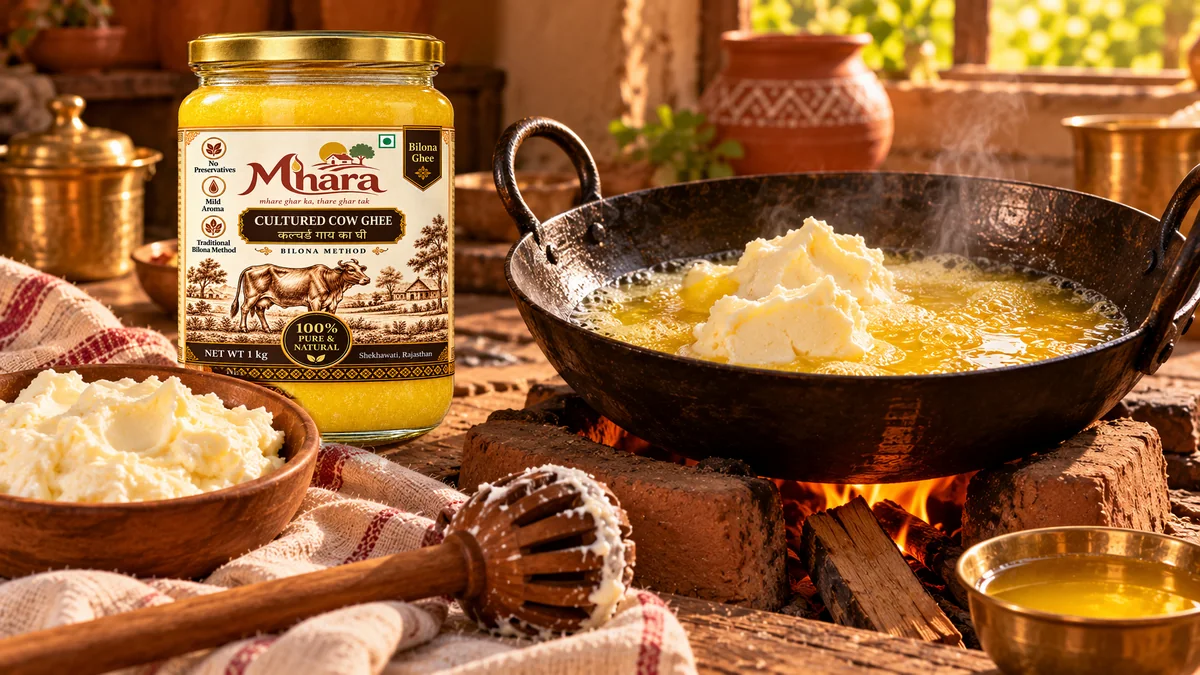
It is the same ghee either way. Taste, aroma and quality do not change. Our danedar ghee is cooled slowly on purpose, and that is where its name and its grains come from. Our Desi Cow Danedar Ghee is made from the malai of desi cow milk, set into curd, churned and slow-cooked, then left to set in its own time.
One thing surprises people. If a grainy jar melts completely in summer and then cools quickly, it can set smooth the next time. The grains come back only when it cools slowly again.
Cow ghee, buffalo ghee and the cold
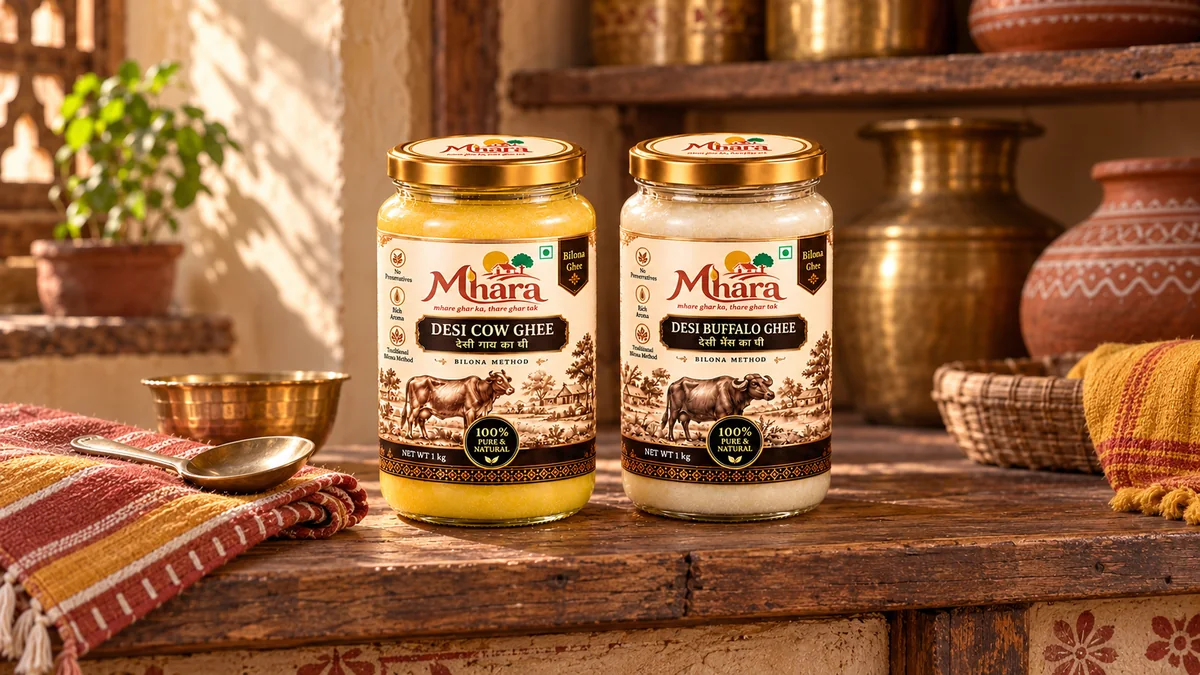
If you keep both, you will notice buffalo ghee sets earlier and harder, and it stays white while cow ghee is yellow. Cow milk carries beta-carotene, the same pigment that colours carrots, and it passes into the ghee. Buffalo convert it to vitamin A, so their ghee comes out ivory.
Buffalo milk fat also has more of the fats that set at higher temperatures. So on a cool morning a jar of buffalo ghee can be firm while the cow ghee next to it is still soft. We compare the two in detail in cow ghee vs buffalo ghee.
How to melt solid ghee without cracking the jar
- Fill a bowl with warm water. It should feel hot on your hand but not be boiling, around 50–60 °C.
- Loosen the lid and stand the jar in the bowl so the water comes about halfway up.
- Leave it for 3 to 5 minutes, then stir with a dry spoon.
Three things to avoid. Don't put a cold glass jar straight into boiling water or on the gas, because a sudden jump in heat can crack glass. Don't microwave it with the metal lid on. And don't melt the whole jar every morning if you only need a spoon.
If you need a whole jar liquid, for laddoo or halwa, give it longer in the bath and top up with warm water once as it cools. A 1 litre jar of hard ghee can take 15 minutes or more. Keep the water below the lid so none of it gets inside.
Hard ghee is not spoilt ghee
Cold does not spoil ghee. Water and air do. Here are the real warning signs:
- A sour or rancid smell, a bit like old cooking oil or paint
- A bitter or soapy taste
- Mould, or dark spots on the surface
These almost always start from a wet spoon or a lid left open near the stove, where steam gets in. If your ghee smells like ghee, it is fine, whether it is hard, soft or half and half. We go through the full routine in how to store ghee.
Does solid ghee mean pure ghee?
It tells you a little, not a lot. Ghee that has been mixed with refined oil tends to stay soft or runny in weather that would set pure ghee hard, so a jar that sets well is a good sign. But vanaspati (hydrogenated fat) also sets hard, so setting alone cannot prove a jar is pure.
If purity is your worry, our 5 home tests to tell pure ghee from fake are more useful, and that article also explains why only a lab test can settle the question for sure.
Should you keep ghee in the fridge?
There is no need, and in winter the fridge only makes the problem worse by turning the ghee rock hard. With the lid closed and a dry spoon, ghee keeps for months at room temperature, which is how village kitchens have always kept it. If you live somewhere hot and humid and a jar lasts you a long time, the fridge is fine. Take out what you need a little before you cook.
Questions people ask
My ghee has turned hard and white. Has it gone bad?
No. Ghee sets when the room gets cold, and it can turn pale or white when it does. Check the smell. If it smells like ghee, it is fine. A sour or rancid smell is the real sign of spoilt ghee.
Why is there a liquid layer on top of my solid ghee?
Milk fat is a mix of fats with different melting points. In mild cold, the ones that set first sink and the ones that stay liquid rise. Stir it back in or leave it. It is the same ghee.
Can I microwave ghee in its glass jar?
Not with the metal lid on, and not straight from a cold room. A warm water bath for 3 to 5 minutes is safer for the glass and melts it evenly.
Should ghee be kept in the fridge?
It is not needed. Kept closed and used with a dry spoon, ghee lasts for months at room temperature. The fridge just makes it very hard to scoop.
Does ghee that sets in winter mean it is pure?
It is a good sign but not proof. Ghee blended with refined oil tends to stay softer in the cold, but vanaspati also sets hard. A lab test is the only sure check.
Why does buffalo ghee set harder than cow ghee?
Buffalo milk fat has more of the fats that set at higher temperatures, so buffalo ghee goes firm sooner. It is also white because buffalo turn the yellow beta-carotene in their feed into vitamin A.