
How to buy desi ghee online: a buyer's checklist
Before you buy desi ghee online, check eight things: the FSSAI licence and label, how the ghee is made, where the milk comes from, the jar, the pack date, whether the price makes sense for the milk used, the delivery and breakage terms, and genuine reviews. A good seller answers all of these plainly.
When you buy desi ghee online, you cannot smell the jar, rub a drop between your fingers or ask the person who made it. All you have is a product page, a photo and a label you may only see after the parcel arrives. So you need a different set of checks. This is the checklist we would give a friend. We sell ghee ourselves, so read it with that in mind, and use every point on us as well.
1. Before you buy desi ghee online, find the FSSAI licence
Every food business in India that sells packed food needs an FSSAI licence or registration, and the 14-digit number has to be printed on the label next to the FSSAI logo. A serious seller also shows it on the website. If you cannot find it anywhere, that tells you something.
You can look up the number on FSSAI's FoSCoS website to see whose name it is in and what kind of business it covers. It takes two minutes. Beyond the licence, a proper label should show:
- The product name, and whether it is cow ghee, buffalo ghee or a mix
- Net quantity
- Date of packing or manufacture, and a best-before date
- A batch or lot number
- The name and address of the maker or packer
A licence does not make ghee good. It means the business is registered and can be held to account. That alone is reason enough to check it.
2. Is the method stated plainly?
Desi ghee in India is made in three common ways: from curd churned into makkhan, from malai or cream, or from cream or butter heated directly in a dairy. All three can give you pure ghee. They differ in taste, aroma, effort and price. We explain the difference in curd vs cream ghee.
What you want is a seller who tells you plainly which method they use. "Bilona" should mean curd set from whole milk and churned into makkhan, as we describe in what is bilona ghee. If a page uses the word bilona but the rest of the description is vague, ask. A good seller answers that question without trouble.
We hold ourselves to this too. Our cow bilona ghee is made from whole desi cow milk set into curd and churned with a wooden bilona. Our danedar ghee is made from the malai of desi cow milk, set into curd and churned, and we say clearly that it is not whole-milk bilona ghee.
3. Where the milk comes from
"Pure desi ghee" on a label tells you very little about the milk. Look for answers to simple questions. Cow, buffalo or mixed? Desi cows or crossbred? Which region? Is it collected from a large dairy network, or from a small number of known households?
None of these makes one ghee automatically better than another. But a seller who knows where the milk comes from and is willing to say so is more likely to know what is in the jar. Ours comes from households in our village near Pilani, in Jhunjhunu district, and we write about them on our village page.
You will also see the word A2 on some ghee. A1 and A2 are types of a protein found in milk. Ghee is about 99% fat with almost no milk solids left after clarifying, so ask the seller what an A2 label on ghee is meant to tell you before you pay more for it.
4. Glass jar or plastic
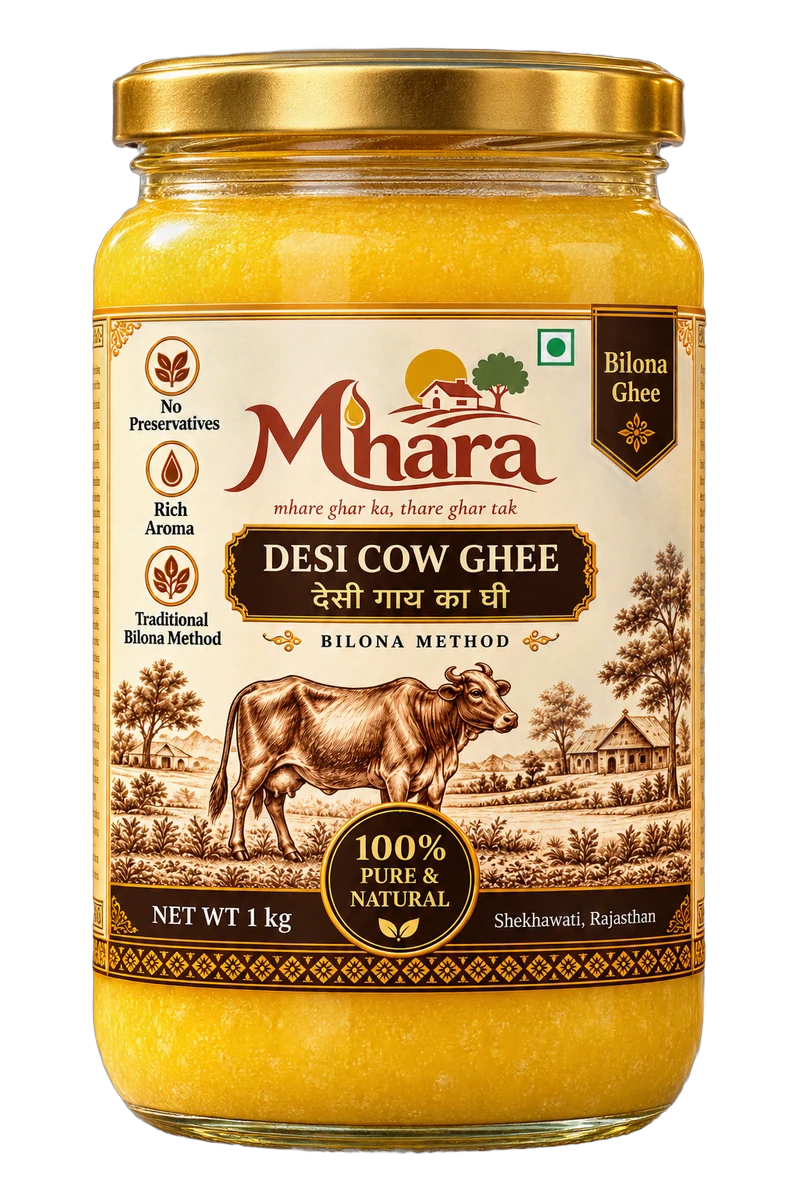
Most ghee online comes in glass jars, plastic jars or tins. Food-grade plastic is legal and safe to use, and it is lighter and cheaper to ship. We still prefer ghee in a glass jar, for a few plain reasons. Glass does not take on smells. You can see the colour and texture of the ghee before you open it. It is easy to wash and reuse in the kitchen.
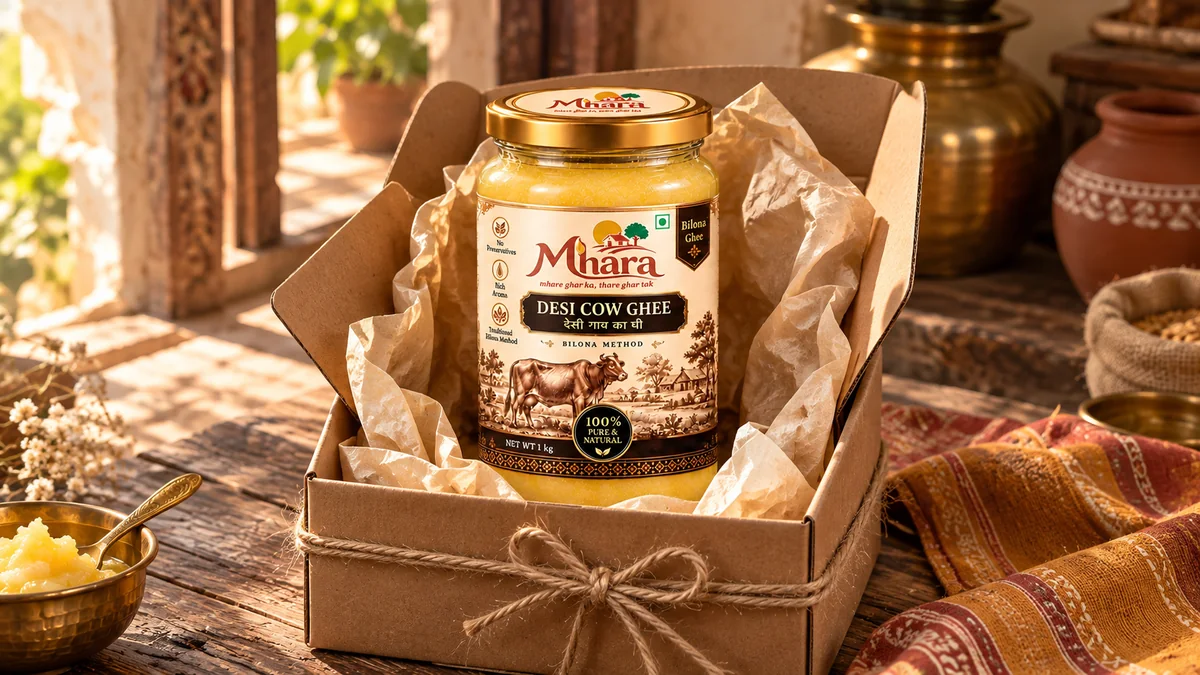
The downside of glass is breakage in transit, which is why the next point matters. If you choose glass, check how it will be packed and what happens if it breaks.
5. Pack date and how fast you will use it
Ghee keeps for months when it is closed and handled with a dry spoon, but fresher is still better. A pack date within the last few weeks is a good sign that the stock is moving. Be careful with heavy discounts on large packs close to their best-before date.
Buy a size you will finish comfortably. For a family that cooks with ghee every day, a 1 litre jar of desi cow ghee is often the easiest size. For a small household, or if you are trying a brand for the first time, 500 ml is safer. Our how to store ghee guide explains how to keep a big jar fresh.
6. Does the price make sense?
This is the check most people skip. Ghee is made from milk, and milk has a price. Our cow bilona ghee takes about 25 to 30 litres of whole milk for one kilo. Multiply that by what milk costs where you live, add the work of churning by hand, the jar and the shipping, and you get a rough floor below which real bilona ghee cannot be sold for long.
Cream-based ghee takes less work, so it can fairly cost less. Buffalo milk is richer, so buffalo ghee takes fewer litres per kilo and usually costs less than cow bilona ghee. If a jar labelled bilona is priced far below what the milk alone would cost, ask how.
For comparison, these are our current prices: cow bilona ghee ₹1,999 for 1 litre and ₹1,099 for 500 ml, danedar ghee the price on the jar page for 1 kg, and buffalo ghee ₹1,899 for 1 litre. We break down where the money goes in cow ghee price.
7. Delivery, breakage and returns
Read the delivery and returns pages before you order, not after. Look for:
- Whether delivery is free or charged, and to which pin codes
- What happens if a glass jar arrives broken, and how you report it
- Whether opened food can be returned. Most sellers do not take back opened food, and that is fair, but the policy should say so clearly
- A phone number or WhatsApp you can actually reach
Our own terms are simple. Delivery is free across India. If a jar reaches you broken, we send a new one free, and the details are on our guarantee page.
8. Reviews, and what to check when the jar arrives
Reviews help when they come from verified buyers and say something specific: how the ghee smelled, how it set in winter, how it was packed. A page full of five-star reviews that all sound the same is less useful than a mix of ratings with real details. Look at the dates too. Recent reviews tell you about recent batches.
When your shudh desi ghee arrives, open it and smell it first. Good ghee smells clean, rich and a little nutty, never sour or like old oil. Taste a little on a warm roti. If you want to go further, our 5 home tests to tell pure ghee from fake are a good start. Keep in mind that home tests can raise doubts but cannot prove purity. Only a lab can settle that.
If a seller passes all eight checks, you can order with some confidence. If they fail two or three, keep looking. There are many honest small makers selling good ghee online, and they are usually happy to answer a question before you buy.
Questions people ask
How do I know if ghee sold online is pure?
Check the FSSAI licence, a clear method and milk source, and a price that makes sense for the milk used. When it arrives, smell and taste it. Home tests can raise doubts, but only a lab test can confirm purity.
Where can I find the FSSAI number for a ghee brand?
It should be printed on the label next to the FSSAI logo as a 14-digit number, and a good seller also shows it on the website. You can look it up on FSSAI's FoSCoS website to see who holds it.
Is ghee in a glass jar better than plastic?
Food-grade plastic is safe and lighter to ship. Glass does not take on smells, lets you see the ghee and is easy to reuse, but it can break in transit, so check the seller's breakage promise.
Why is bilona ghee more expensive?
Bilona cow ghee is made from whole milk set into curd and churned by hand, and it takes about 25 to 30 litres of milk for one kilo. The milk and the labour set a floor on what it can honestly cost.
Which size of desi ghee should I buy online?
Buy a size you will finish in a few months. A 1 litre jar suits a family that cooks with ghee daily; 500 ml is better for a small household or for trying a new brand.
What should I do if my ghee jar arrives broken?
Take photos or a short video while opening the parcel and contact the seller straight away. Check their policy before ordering. At Mhara, a broken jar is replaced free.