
How much ghee per day is sensible?
For most healthy adults, 1 to 2 teaspoons of ghee a day (about 5 to 10 g) is a sensible everyday amount, as long as it fits within your total fat for the day. The ICMR-NIN guidelines ask us to keep all added fats and oils modest, so count the oil in your sabzi too.
There is no single right number for how much ghee per day a person should eat, but there is a sensible everyday range, and we would rather give it to you straight than sell you more ghee than you need. For most healthy adults, 1 to 2 teaspoons a day is a sensible everyday amount, as long as it fits inside the total fat you eat that day. The rest of this page explains what that means in a real Indian kitchen.
How much ghee per day for a healthy adult
One or two teaspoons. That is roughly 5 to 10 grams, enough to put a little on two or three rotis or to make the tadka for a family's dal. It is the amount many households already use without thinking about it.
This is a common, practical figure, not a medical prescription. Nobody can give one number that suits a farmer who walks the fields all day and an office worker who sits for nine hours. Age, body size, how active you are and any health conditions all change the picture. What matters more than the ghee alone is the total fat on your plate across the whole day.
What the ICMR-NIN guidelines say about fats and oils
The Dietary Guidelines for Indians published in 2024 by ICMR and the National Institute of Nutrition are the best general reference we know of for Indian homes. On fats, they say a few clear things:
- Keep visible fats and oils, meaning the oil, ghee and butter you add while cooking or at the table, to a modest amount. For a typical adult, the visible fats and oils in their sample diets come to roughly 20 to 30 grams a day, all of them together.
- The amount goes up and down with how active you are. Their tables give a little more for people doing moderate physical work than for people who sit most of the day.
- Limit saturated fat from butter and ghee, and avoid partially hydrogenated oils such as vanaspati.
- Get part of your fat from whole foods like nuts, oilseeds and milk, not only from the bottle and the jar.
Put simply, ghee is part of that daily fat, not something extra on top of it. If the whole budget is somewhere between 20 and 30 grams, and a teaspoon of ghee is about 5 grams, then two teaspoons take up a third to half of it. The rest goes on the oil in your sabzi, dal and anything fried.
Count every fat in the day, not only the ghee
This is where most of us go wrong. We measure the ghee carefully and forget everything else. Here is a rough, ordinary day for one adult. The numbers are only illustrations, your kitchen will differ:
- Ghee on two rotis at lunch: about 1 teaspoon
- Your share of oil in the morning sabzi and the evening sabzi: often 2 to 3 teaspoons
- Tadka in the dal: another half to 1 teaspoon each
- A paratha at breakfast, or pakoras with evening chai: easily 2 to 3 teaspoons more
- Biscuits, namkeen and mithai: fat you never see, but it counts
Add that up and many days are already past the guideline before anyone has eaten a laddoo. The answer is not to give up ghee. It is to choose where your fat goes. If you love ghee on roti, use a lighter hand with oil in the sabzi. If there is a fried snack in the evening, skip the extra spoon at dinner.
Ghee on roti, in dal, in tadka: getting the most from a little
Ghee has a strong aroma, so a small amount goes a long way if you use it at the right moment. A few ways we do it at home:
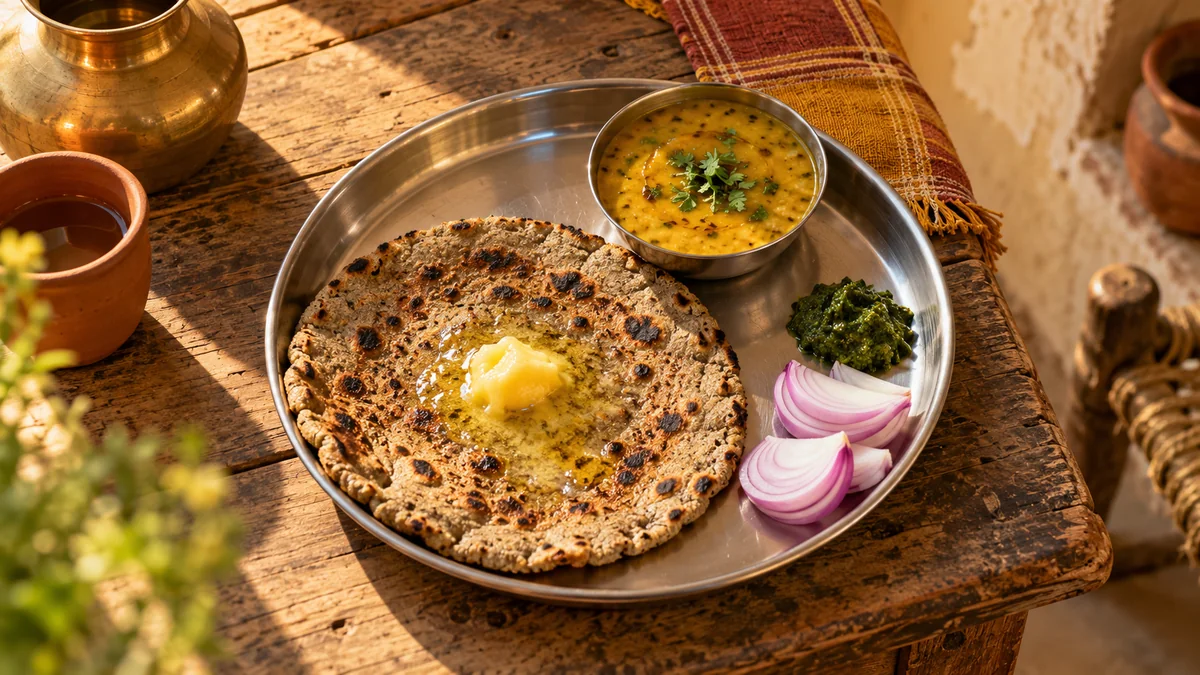
- On roti: brush or spread a thin layer while the roti is hot. Half a teaspoon is enough for one or two.
- In dal: a teaspoon of ghee in the tadka with jeera and hing, or a few drops on top just before serving, gives the whole pot its smell.
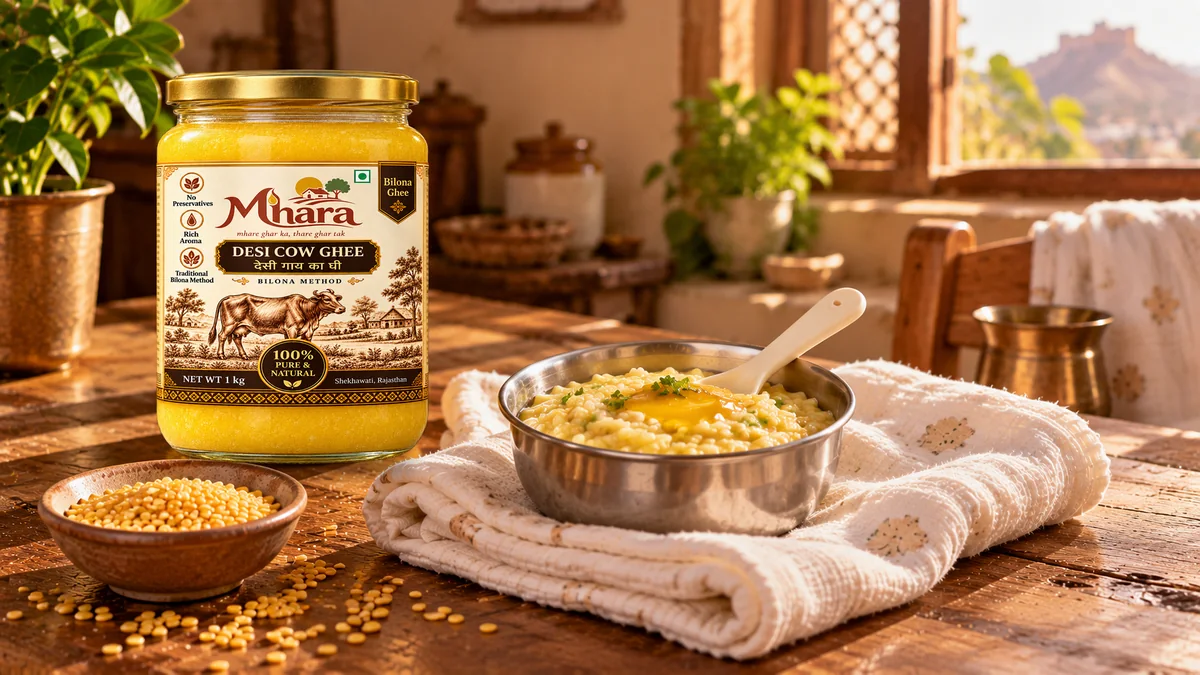
- In khichdi: one teaspoon on top at the table is the old way, and it is enough.
- For cooking: if you cook a sabzi in ghee, count it as your fat for that dish. Do not add oil and ghee both.
Ghee also handles heat well, so it suits tadka and roasting. We cover that in our page on ghee smoke point.
Is ghee healthy daily? What we can honestly say
Ghee is about 99% milk fat. It carries the fat-soluble vitamins A, D, E and K that are naturally present in milk fat, and it has almost no lactose left after clarifying. It is a traditional fat that Indian families have eaten every day for a very long time, usually alongside a lot of physical work.
It is also mostly saturated fat, and that is why the ICMR-NIN guidelines ask us to limit it rather than avoid it or eat it freely. Research on dairy fat is mixed, and we are not going to pick out the studies that suit a ghee seller. What we can say is that a moderate amount of ghee within a balanced diet is how most traditional kitchens have used it, and that more is not better.
If you are comparing ghee with other fats, it is very different from vanaspati, which is hydrogenated vegetable fat. We explain that in desi ghee vs vanaspati.
Children, elders, pregnancy, heart and diabetes: ask your doctor
Everything above is for healthy adults. Please talk to your doctor or a qualified dietitian before deciding on an amount if any of these apply to you or the person you are cooking for:
- Heart disease, high cholesterol or high blood pressure
- Diabetes or pre-diabetes
- Pregnancy or breastfeeding
- Young children, whose needs change fast with age
- Older family members, especially with any long-term illness or medicines
- Any liver, kidney or digestive condition
In our village, grandmothers often give an extra spoon of ghee to children and to new mothers. That comes from a time when food was scarce and work was hard. Today's needs can be different, and a doctor who knows your family's health is the right person to set the amount.
Village habits and city habits
Our older neighbours eat ghee every day, and some eat more than the amounts on this page. They also walk to the fields, carry fodder, churn curd by hand and rarely sit for long. Food habits came with a way of life.
If your day is mostly a chair, a screen and a car, the old village amount is not your amount. Keep the taste of ghee in your food, use it where it matters most to you, and keep the total small. That is the balance the guidelines point to as well.
The same thinking applies to things like ghee in warm milk at night. If you add that habit, count it. We look at that tradition separately in ghee in milk at night, and at buffalo ghee in is buffalo ghee good for health.
Making a small amount count
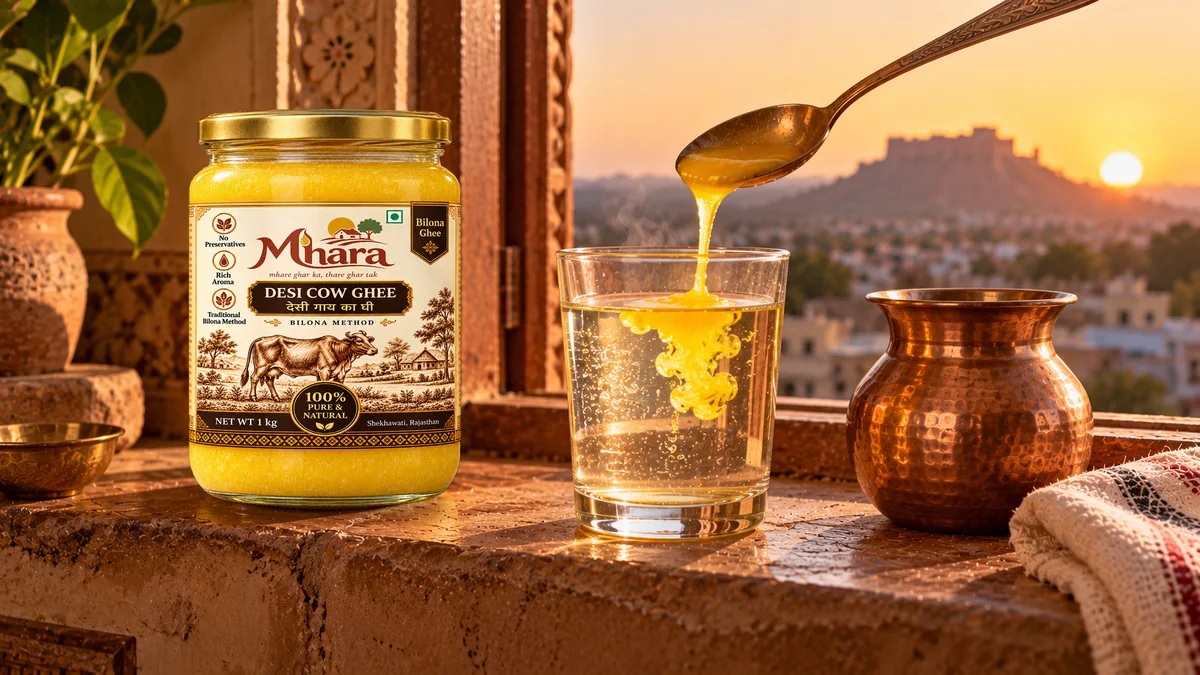
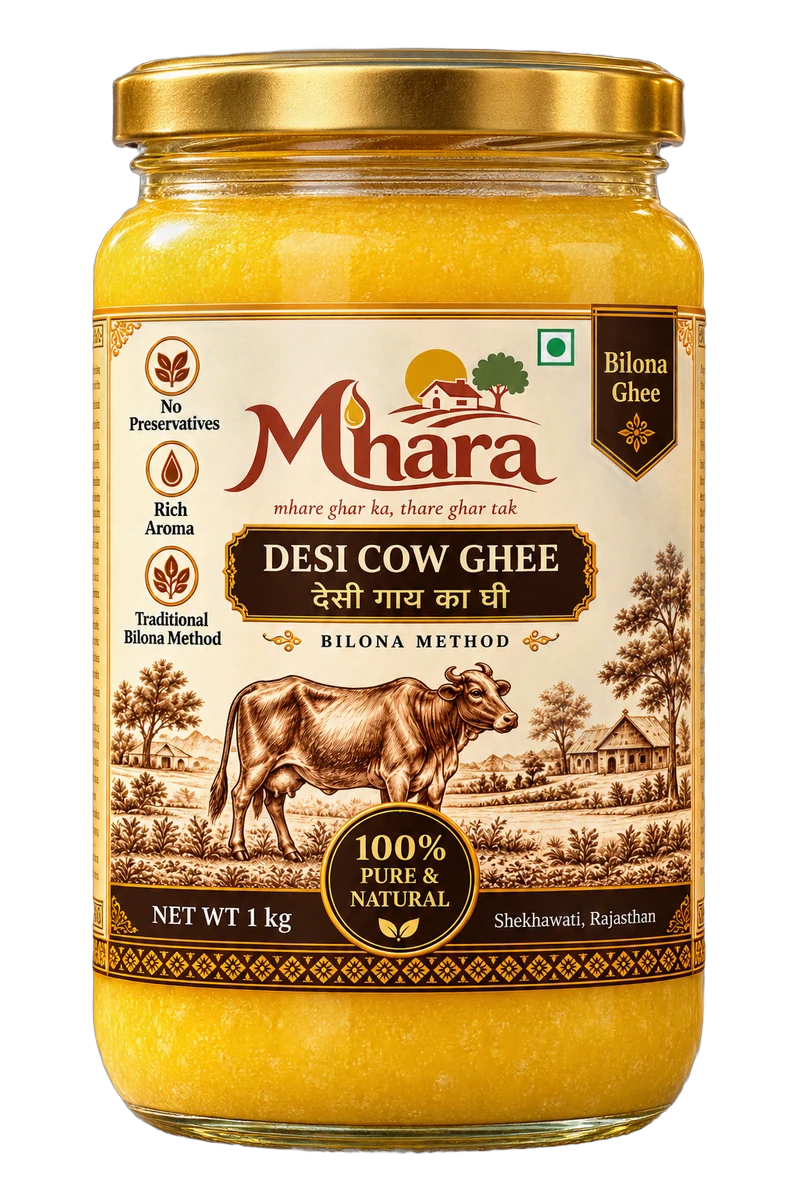
When you eat less of something, it makes sense for that little to be good. A ghee with real aroma lets you use a smaller spoon and still taste it. Our Desi Cow Bilona Ghee is made from whole desi cow milk set to curd and churned by hand, and its smell carries well on a hot roti or in a tadka. One jar, used a teaspoon or two at a time, lasts a family a good while.
Questions people ask
Is 1 teaspoon of ghee a day enough?
For many healthy adults, 1 to 2 teaspoons a day is a common, sensible amount. What matters more is that it fits inside your total fat for the day, including the oil in your cooking.
Is it healthy to eat ghee every day?
Many Indian families eat a little ghee daily as part of a balanced diet. It is mostly saturated fat, so the ICMR-NIN guidelines advise limiting it, not eating it freely. If you have a health condition, ask your doctor.
How much ghee is in one teaspoon?
A level teaspoon of ghee is roughly 5 grams. A heaped spoon or a serving spoon can be two or three times that, so use a real teaspoon if you are keeping count.
Can I eat ghee on roti every day?
Yes, a thin layer on hot roti is one of the best ways to enjoy a small amount. Keep it to a teaspoon or so for the meal and go lighter on oil in the sabzi.
How much fat do the ICMR-NIN guidelines allow per day?
They do not give one number for everyone. For a typical adult, the visible fats and oils in their sample diets come to roughly 20 to 30 grams a day, depending on how active you are. Ghee counts inside that amount.
How much ghee should children or people with diabetes eat?
That depends on age, health and medicines, so it is a question for your doctor or dietitian. Do not go by a general figure from the internet for children, pregnancy, heart disease or diabetes.