Desi ghee benefits: what is true, what is hype, who should go easy
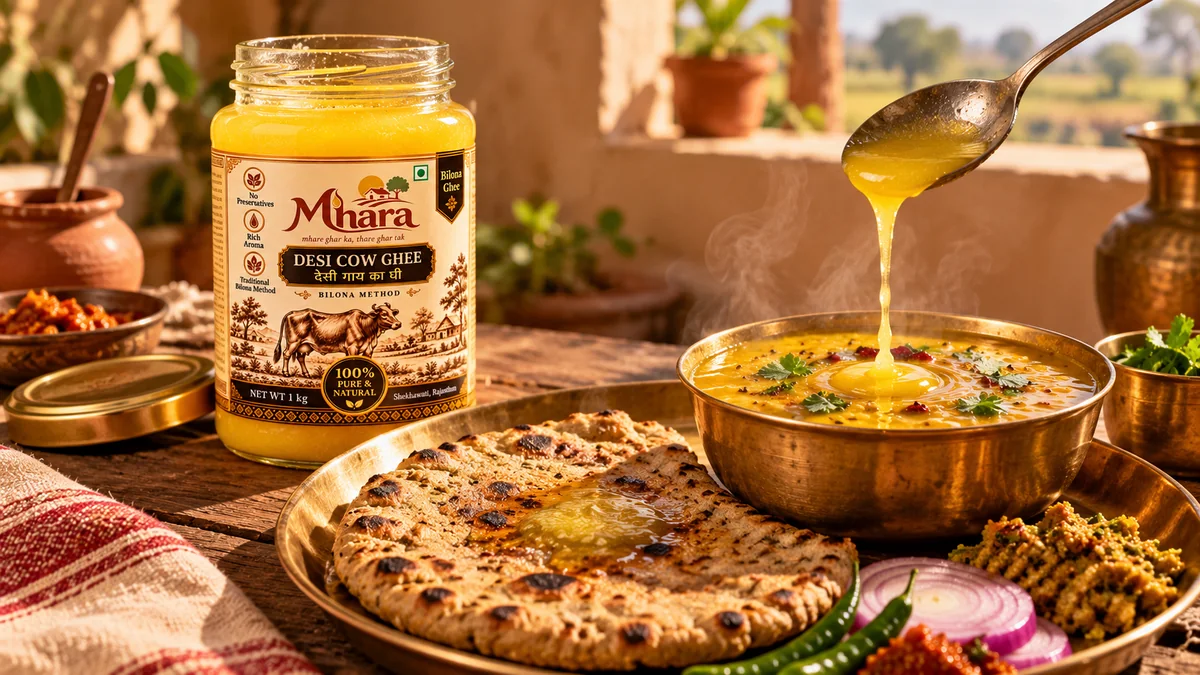
Desi ghee benefits are real but modest: it helps your body absorb fat-soluble vitamins, makes simple food satisfying, handles tadka heat well and has almost no lactose. It is also mostly saturated fat, so the benefit lies in a teaspoon or two a day, not in more.
Elders in our village like to say the old people lived into their nineties because of desi ghee. Maybe. They also walked to the fields every morning, worked with their hands all day and never bought a packet of namkeen. We make and sell ghee, so you might expect us to list a hundred desi ghee benefits and stop there. We would rather sort them honestly: what has good evidence behind it, what is tradition, what is internet hype, and who should go easy.
Our elders simply call it ghee khane ke fayde, and they say it with total confidence. Some of that confidence is earned. Some of it belongs to a life of hard physical work that most of us no longer live.
What is actually in a spoon of desi ghee
Ghee is makkhan with the water and milk solids cooked out. What is left is about 99% milk fat. A level teaspoon weighs roughly 5 g and gives about 45 kcal, the same as any fat, because fat carries about 9 kcal per gram. Cow ghee and buffalo ghee are almost identical on this count.
Roughly 60 to 65% of that fat is saturated. Most of the rest is monounsaturated, with a little polyunsaturated fat. Ghee also carries the fat-soluble vitamins A, D, E and K that are naturally present in milk fat, small amounts of short-chain fats such as butyric acid, and some dietary cholesterol, as every animal fat does.
Desi ghee benefits backed by good evidence
These are the ones we are comfortable stating plainly.
- It helps you absorb fat-soluble nutrients. Vitamins A, D, E and K, and the carotenoids in carrots, palak and tomatoes, need some fat in the meal to be absorbed well. A teaspoon of ghee in the sabzi or on the dal does that job. Any fat can do it. Ghee does it with flavour.
- It makes simple food satisfying. A little ghee on a bajra roti or in moong dal khichdi makes a plain meal feel complete. Fat slows down how fast the stomach empties, so you stay full a little longer. For many people that means fewer biscuits at four o'clock.
- It takes heat well. The milk solids that burn in butter are strained out of ghee, which gives it a smoke point usually quoted at around 250 °C. It suits tadka and tawa cooking without breaking down quickly.
- It has almost no lactose or casein. Clarifying removes nearly all the milk sugar and milk protein. Many people who feel uncomfortable after a glass of milk eat ghee without trouble. Traces can remain, so anyone with a true milk allergy should check with a doctor first.
Benefits that are possible but not proven
Here the honest word is "maybe".
- Butyrate and the gut. Ghee contains butyric acid, a fat that the cells lining the colon use as fuel. It sounds wonderful. But the amount in a teaspoon is small, and most of the butyrate in your gut is made right there by bacteria feeding on fibre. Dal, sabzi, bajra and fruit do more for this than ghee does.
- CLA. Milk fat, especially from animals that graze on green fodder, has small amounts of conjugated linoleic acid. Most research on CLA uses supplements at doses far above what food gives, and the effects seen in people have been small and inconsistent.
- Smooth digestion. Many families find that a little ghee with meals keeps the bowels regular. That fits with how fat works in the gut, but good human studies on ghee itself are few.
What Ayurveda and tradition say
We keep this separate because it is a different kind of knowledge. In Ayurveda, ghee (ghrita) is held in very high regard among fats. It is described as nourishing, good for digestion when taken in the right amount, cooling and calming, and an excellent carrier for herbs, which is why many classical preparations are made in ghee. In Shekhawati homes, grandmothers give ghee to new mothers, to children in winter and to anyone getting back on their feet after an illness.
We respect this, and our own kitchen runs on much of it. But "tradition says" is not the same as "research shows", and we will not dress one up as the other. Some of these beliefs may hold up in time. Most have simply never been tested properly.
Where the hype starts
Be wary of any post or reel that says ghee will:
- burn belly fat or "melt" weight
- boost immunity by some fixed percentage
- lower cholesterol, cure arthritis or fix the thyroid
- work like a medicine if taken on an empty stomach
No food burns fat. Ghee is a nourishing fat that carries calories, and claims of cures turn a good food into a false promise. We look at the weight question properly in ghee for weight loss.
Side effects of ghee, and who should go easy
The main side effect of ghee is simply too much fat and too many calories. Because it is mostly saturated fat, eating a lot of it can raise LDL cholesterol in many people. The WHO advises keeping saturated fat below 10% of the day's energy, and the ICMR-NIN Dietary Guidelines for Indians ask us to limit total visible fat (the oil, ghee and butter we add) and to go easy on saturated fat from ghee and butter.
Please talk to your doctor before making ghee a daily habit if you have:
- heart disease, high LDL cholesterol, or a strong family history of either
- a weight-loss target set by your doctor
- gallstones or any gallbladder trouble
- diabetes, fatty liver or kidney disease
Pregnancy and young children need specific advice too. We have written a longer, honest piece on whether ghee is bad for cholesterol.
Is ghee healthy every day? How much brings the benefits
For most healthy adults, 1 to 2 teaspoons a day, about 5 to 10 g, is a sensible amount, counted inside the day's total fat. The real desi ghee benefits, better absorption and more satisfying food, come from that small amount. The benefits of eating ghee daily do not grow with a third and fourth spoon. Only the calories do. Our full guide is how much ghee per day.
If you like a glass of warm milk with ghee before bed, count that spoon too. We wrote about that old habit in ghee in milk at night.
Does the type of ghee change the benefits?
For nutrition, less than people think. Cow and buffalo ghee give the same calories per spoon. Cow ghee is yellow from the beta-carotene in green fodder and has more aroma. Buffalo ghee is white, milder and creamier. We compare them in detail in cow ghee vs buffalo ghee. Most of the cow ghee benefits you read about are simply desi ghee benefits, whichever animal the milk came from.
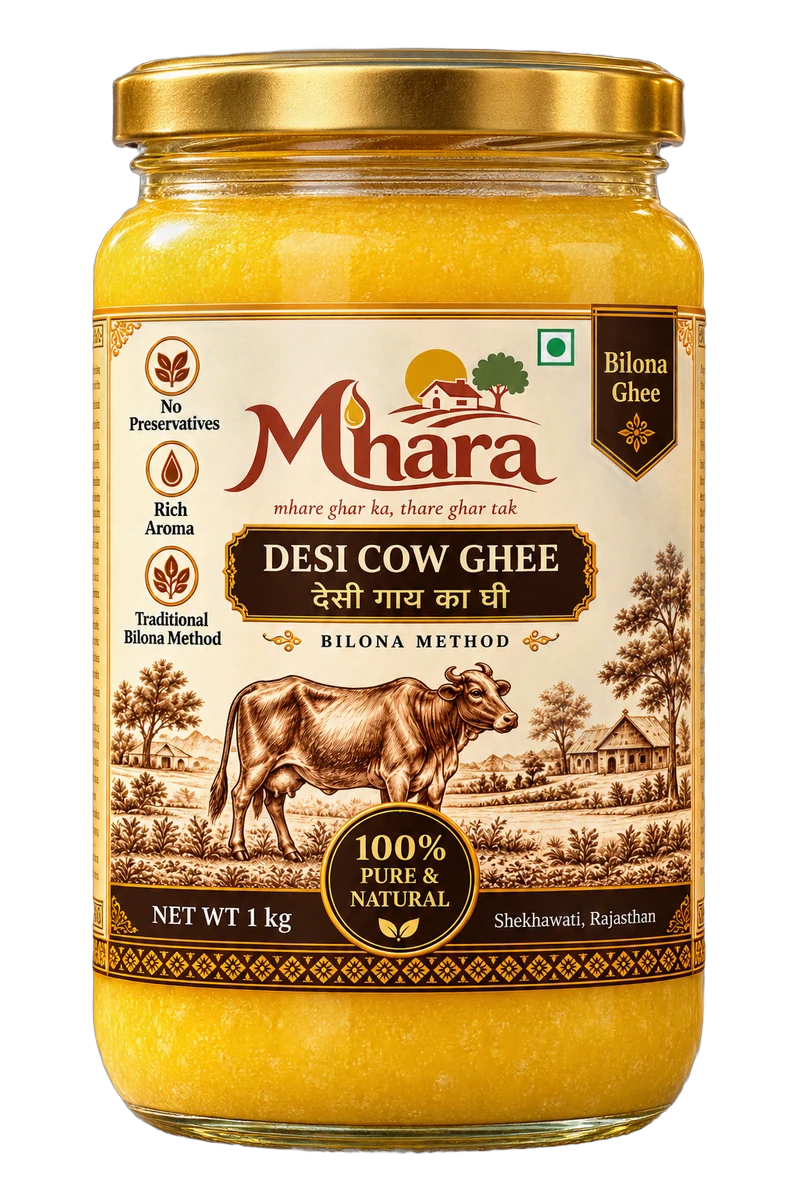
Where the method shows is in the taste. Our Desi Cow Bilona Ghee is made from whole desi cow milk set into curd, churned with a wooden bilona and cooked slowly. Its aroma is strong, so a small spoon is enough. When you are keeping to a teaspoon or two, that is exactly what you want from a jar.
This is general information from a ghee-making family, not medical advice.
Questions people ask
What are the main benefits of desi ghee?
Desi ghee helps your body absorb fat-soluble vitamins and carotenoids from food, makes simple meals more satisfying, handles tadka heat well and has almost no lactose. These benefits come from a small amount, about 1 to 2 teaspoons a day, not from eating more.
Is it good to eat ghee every day?
For most healthy adults, a teaspoon or two of ghee a day within a balanced diet is fine. Ghee is mostly saturated fat, so the ICMR-NIN guidelines advise limiting it. If you have heart disease, high cholesterol or diabetes, ask your doctor first.
What are the side effects of eating too much ghee?
Too much ghee means too many calories, which leads to weight gain, and a lot of saturated fat, which can raise LDL cholesterol in many people. Some people also feel heavy, nauseous or get loose stools after a large amount of fat at once.
Is cow ghee better than buffalo ghee for health?
Nutritionally they are close. Both are about 99% fat and give the same calories per spoon. Cow ghee is yellow and more aromatic, buffalo ghee is white and creamier. Choose by taste and use, and keep the amount small whichever one you pick.
Can lactose-intolerant people eat ghee?
Many can, because making ghee removes almost all the lactose and milk protein. Small traces can remain, so people with severe lactose intolerance or a true milk allergy should try a very small amount first, or check with their doctor.
Does ghee boost immunity?
Ayurveda values ghee as nourishing, and it carries vitamins A, D and E, which the body needs. But there is no good evidence that ghee on its own boosts immunity. A balanced diet, enough sleep and daily activity matter far more than any single food.