
Ghee for hair: a winter mask for dry ends, and the myths

Ghee for hair works best as a simple pre-wash mask: a teaspoon or two of warm ghee on dry, frizzy lengths and ends for 30 to 60 minutes softens them and adds shine. There is no evidence that ghee grows hair, stops hair fall or reverses greying.
Our winters in Shekhawati are dry in a way that city people find hard to believe. The air is cold, the wind carries dust off the fields, and by December everyone's hair feels like jute rope at the ends. In many Shekhawati homes, women sit in the sun on the chhat on a Sunday afternoon with a katori of warm ghee and work it into each other's plaits before the weekly hair wash.
So yes, we use ghee for hair, and we like it. But scroll online and you will read that ghee grows thick hair, stops hair fall and turns grey hair black. We make ghee, and we still have to tell you plainly: it does none of those things. Here is what it really does, how to use it, and when to skip it.
Is ghee for hair actually good?
For dry, rough, frizzy hair, ghee can help, in the same simple way most oils and fats do. The hair you can see is not living tissue. Its outer layer, the cuticle, is made of tiny overlapping scales. When hair is dry or damaged, those scales lift, the strands rub against each other, and hair looks dull and tangles easily.
A fat like ghee coats the strand, smooths those scales down and reduces friction. The result is hair that feels softer, combs more easily and has a little more shine after washing. Ghee has not been studied much for hair on its own, but this coating effect is well understood for oils in general, and ghee behaves like a rich, soft fat.
What ghee does for your hair stays on the surface. It cannot repair split ends, which only a trim fixes, and it does not feed the roots from outside.
What ghee cannot do: growth, hair fall and grey hair
This is the part most posts skip. There is no good evidence that putting ghee on your scalp:
- makes hair grow faster or thicker
- stops hair fall
- prevents or reverses greying
Hair growth happens deep in the follicle and depends on genes, hormones, nutrition and overall health. If you are losing more hair than usual, the reasons are often things like thyroid problems, low iron, PCOS, stress, a recent illness or fever, or the months after childbirth. A dermatologist or your doctor can find the cause with a few tests. A ghee mask will not, and waiting on one can delay the help you need.
Eating a balanced diet with enough protein and iron matters more to your hair than anything you rub on it. Ghee in food is fine within sensible limits, which we cover in desi ghee benefits.
How to make a ghee hair mask
This is the way we do it at home. Keep it simple:
- Take 1 to 2 teaspoons of ghee for shoulder-length hair, a little more for long hair.
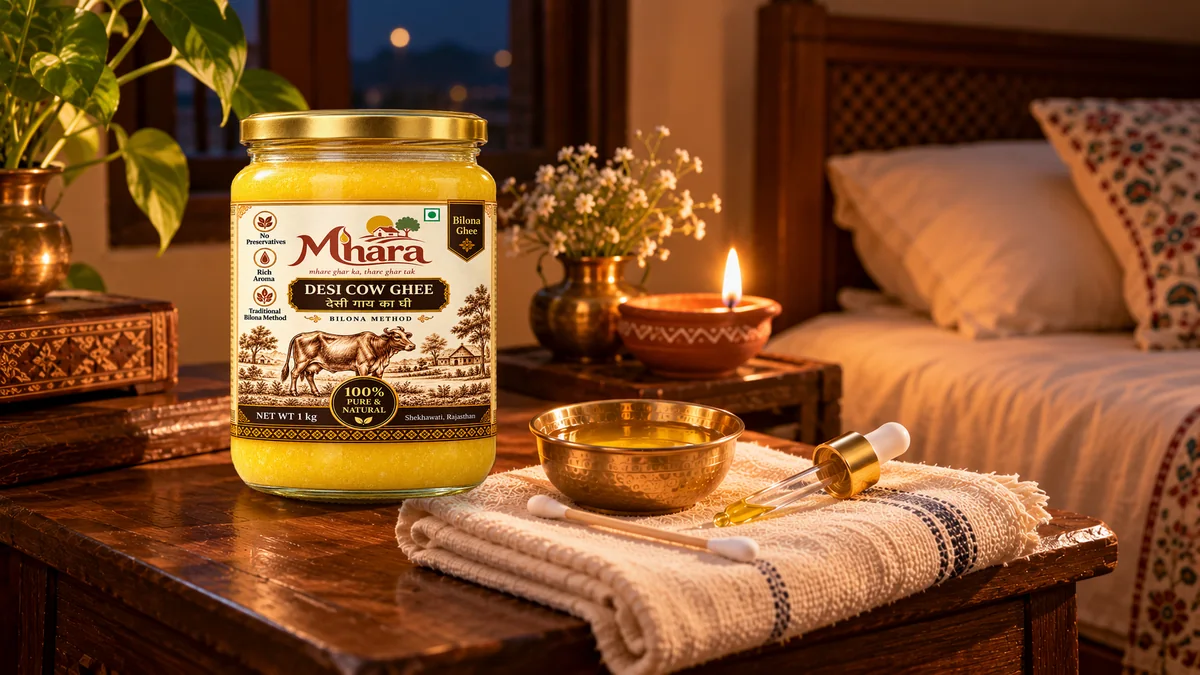
- Warm it in a small katori set in a bowl of hot water until it melts. It should feel warm on your wrist, never hot.
- Rub it between your palms and work it into the lengths and ends first, where hair is driest. Add a little to the scalp only if your scalp feels dry and tight, not flaky.
- Plait loosely or tie up the hair, and cover with an old cotton cloth. Ghee will mark pillows and dupattas.
- Leave it on for 30 to 60 minutes. Overnight is not needed and makes washing harder.
- Wash with a mild shampoo. Most people need to shampoo twice to get all the ghee out.
Once a week in winter is plenty. In summer or monsoon, when the air is humid, many people find it too heavy and do not need it at all.
Ghee for dry, frizzy hair: two easy mixes
Plain ghee works, but it is heavy and has a smell some people do not love. Two mixes we have tried:
- Ghee and coconut oil: half and half. It spreads more easily, stays softer in winter and washes out more readily than ghee alone. Good for very dry, frizzy ends.
- Ghee and aloe vera: one teaspoon of warm ghee mixed with two teaspoons of fresh aloe gel scraped from a leaf. Lighter, less greasy, and nice for lengths that feel rough after sun and wind. Do a patch test first, as some people react to aloe.
Skip mixes with lemon, raw onion juice or strong spices that you may see online. They can sting and irritate the scalp, and adding them to ghee does not make them work any better.
Ghee for dandruff and scalp: be careful
Many people reach for oils when the scalp is flaky, thinking flakes mean dryness. Often they do not. Common dandruff is linked to a yeast called Malassezia that lives on everyone's scalp and feeds on scalp oils. Adding a heavy fat like ghee to a scalp with dandruff can make the flaking and itching worse for some people.
So our honest advice:
- If your scalp has white or yellow flakes, itching or redness, do not put ghee on the scalp. Use the mask on lengths only.
- For dandruff that keeps returning, an anti-dandruff shampoo or a dermatologist will help more than any kitchen remedy.
- If you have scalp acne, boils, or any open wound, skip it completely.
- Trying ghee on the scalp for the first time? Patch test on a small spot behind the ear and wait a day.
Which ghee to use, and how to keep it clean
Use pure, fresh desi cow ghee, the same one you eat. Old ghee that smells sour will leave that smell in your hair, and ghee mixed with vanaspati has no place on your head or in your food. Not sure about yours? See how to check purity of ghee. Keep a small separate katori for beauty use so that oily fingers never go into the main jar. Our guide on ghee for skin covers using ghee on lips, heels and dry hands too.
The honest bottom line on ghee for hair
Ghee for hair is a good old winter treat for dry ends and frizz, and nothing more. It will make your plait feel softer and look a little glossier after washing. It will not change how much hair you grow or lose, and it is not for a scalp with dandruff.
If you enjoy the ritual, sitting in the winter sun with a katori of warm ghee is one of the nicer ways to spend a Sunday afternoon. For anything more serious than dry ends, a dermatologist is the right person to see.
This is general information from a ghee-making family, not medical advice.
Questions people ask
Is ghee good for hair?
Ghee can soften dry, rough and frizzy hair when used as a pre-wash mask, because it coats the strand and smooths the outer layer. It does not grow hair, stop hair fall or reverse greying, and it can worsen dandruff for some people.
Can ghee help hair growth?
There is no good evidence that ghee makes hair grow faster or thicker. Hair growth depends on genes, hormones, nutrition and health. If you are losing a lot of hair, see a doctor or dermatologist to check for causes like thyroid problems or low iron.
How long should I leave ghee in my hair?
30 to 60 minutes is enough for a ghee hair mask. Leaving it overnight does not add much benefit and makes it harder to wash out. Wash with a mild shampoo, usually twice, to remove all the ghee.
Is ghee good for dandruff?
Usually not. Common dandruff is linked to a yeast that feeds on scalp oils, so heavy fats like ghee can make flaking and itching worse for some people. Keep ghee on the lengths and use an anti-dandruff shampoo or see a dermatologist.
Can I mix ghee with coconut oil for hair?
Yes, half ghee and half coconut oil is an easy mix. It spreads more easily than ghee alone, stays softer in winter and washes out more readily. Warm it slightly and use it on dry lengths and ends before washing.
How often should I put ghee in my hair?
Once a week in dry winter months is plenty for most hair. In humid summer and monsoon weather, many people find ghee too heavy and do not need it. If your hair feels greasy or limp, use it less often.