
Cow ghee vs buffalo ghee: colour, taste, fat and price
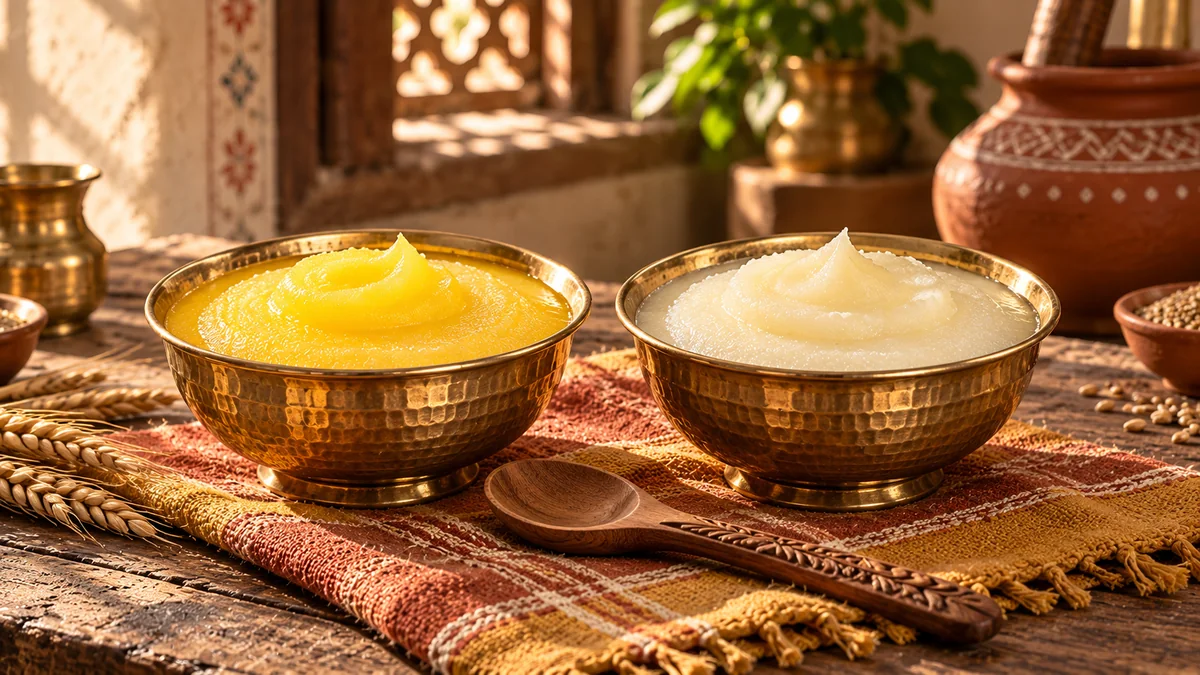
Cow ghee is yellow, lighter and more aromatic, best for daily dal, rice and roti. Buffalo ghee is white, milder and creamier, best for sweets and winter cooking. Both are about 99% fat with similar calories, and cow ghee usually costs more because it takes more milk per kilo.
Cow ghee vs buffalo ghee is an old argument in Rajasthani homes, and it usually ends with someone's grandmother saying her ghee is the right one. We make both in our village, so we have no side to take. The two differ in colour, aroma, texture, fat and price, and below we take those one factor at a time, along with which ghee suits which job in the kitchen.
Where the difference starts: the milk
Our cow bilona ghee and our buffalo ghee are made the same way: whole milk set to curd, churned with a wooden bilona, and the makkhan cooked slowly on a low flame. Everything that separates them comes from the milk.
- Cow milk is thinner, with less fat. About 25 to 30 litres of desi cow milk go into one kilo of our bilona ghee.
- Buffalo milk is thicker and carries clearly more fat. The makkhan comes up heavy on the bilona, and fewer litres go into each kilo of ghee.
- The ghee itself is about 99% fat either way. Once it is clarified, the gap in fat between the two jars is very small.
In our village many households keep both cows and buffaloes, and for ghee the milk of each is kept in its own pot. Each family knows which ghee it wants for which dish, and that habit is a good place to start.
Colour: yellow or white
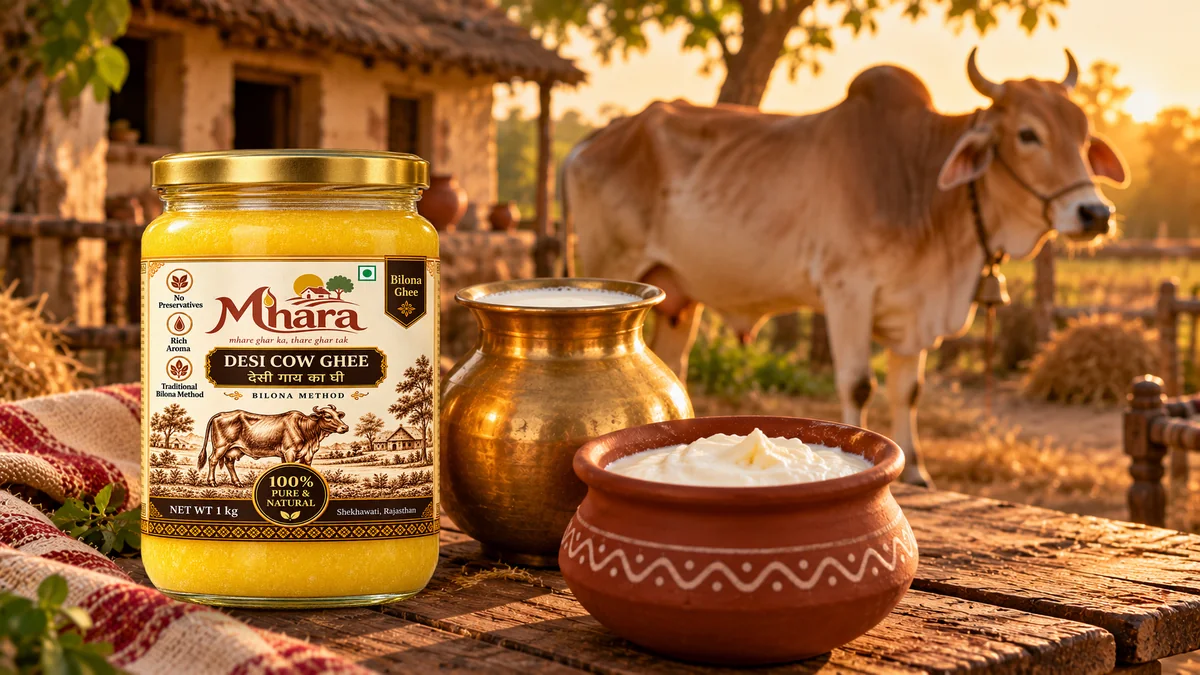
- Cow ghee is pale to deep yellow. Cows pass beta-carotene from green fodder into their milk fat, the same pigment that colours carrots. It is often deeper yellow in the months when there is more green fodder.
- Buffalo ghee is white or ivory. Buffalo convert most of the beta-carotene into vitamin A, so very little colour reaches the fat.
Neither colour is better. White ghee is not bleached and yellow ghee is not coloured. It is just what each milk gives. Don't use colour to judge purity either. Colour can be added to almost anything, and a pale cow ghee in a dry month is perfectly normal.
Aroma and taste
- Cow bilona ghee has the stronger smell, deep and nutty, what we call sondhi. Heat a spoon for tadka and the whole house knows. There is often a faint tang from the curd.
- Buffalo ghee is milder and milky, with a rounder, fuller taste. It stays in the background and lets the food lead.
Some people find cow ghee too strong. Others find buffalo ghee too plain. Your own taste is the only judge here.
Texture and how they set
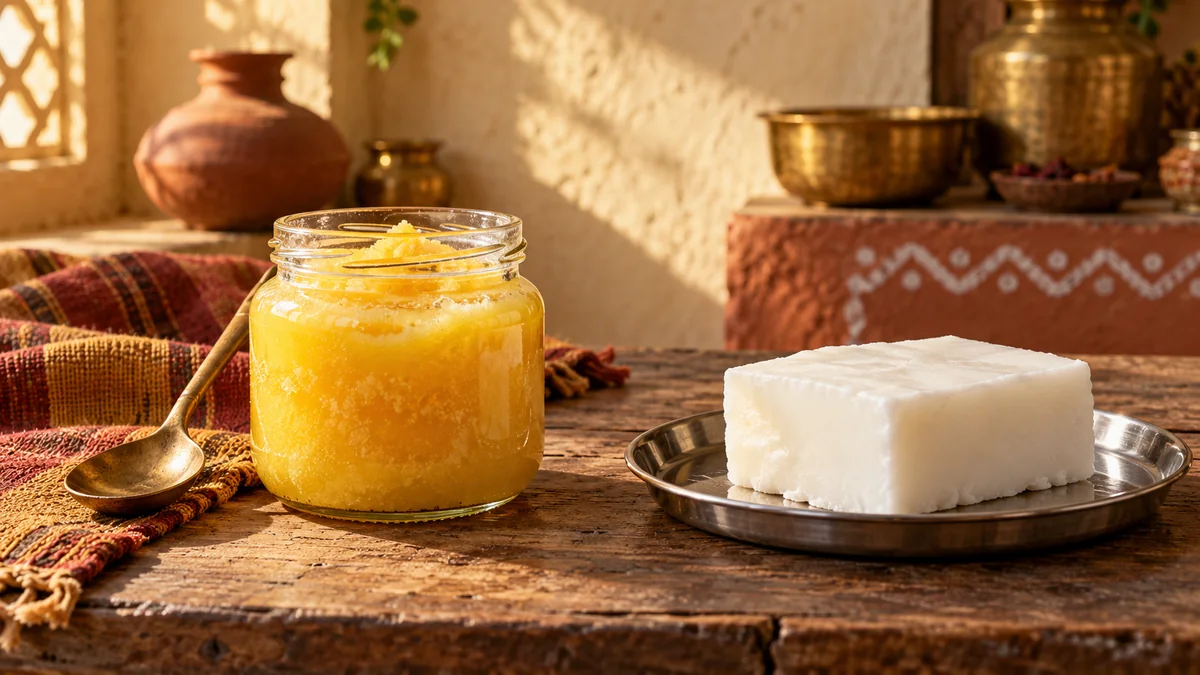
- Cow ghee stays liquid longer as the weather cools. In winter it sets soft, sometimes grainy, and is easy to scoop.
- Buffalo ghee has more of the fats that set at higher temperatures. It goes firm earlier in the season, sets thick and creamy, and on a cold morning can be hard enough to need a strong spoon.
In May and June both are liquid and look almost the same apart from colour. The difference shows only when the nights turn cool. If you keep both on the same shelf, you will see this every October: the buffalo jar turns first. We explain why in why ghee solidifies in winter, and how grains form in danedar ghee.
Which ghee is better in the kitchen
This is where the choice really gets made. Each one has jobs it does better.
- Cow ghee for dal tadka, khichdi, rice, roti and anything where you want to smell the ghee. Many homes also prefer it for elders' food, simply because it is lighter in taste.
- Buffalo ghee for laddoo, churma, besan chakki, halwa, barfi and other mithai, where you want richness and a soft, melt-in-the-mouth texture. Its white colour suits milk sweets.
- Either for parathas, puris and frying. Both have a high smoke point, around 250 °C.
You can also mix them. Some cooks use half and half in churma or halwa to get the body of buffalo ghee with the aroma of cow ghee. There is no rule against it, and it is a good way to find your own balance.
Cow ghee vs buffalo ghee price
Price follows the milk. Cow milk has less fat, so more litres go into a kilo of cow bilona ghee, which usually makes it the costlier jar. Buffalo ghee takes fewer litres, so it usually costs a little less per kilo.
Here are our live prices for 1 litre, side by side:
- Desi Cow Bilona Ghee, from whole-milk curd: ₹1,999
- Desi Cow Danedar Ghee, from malai set to curd: the price on the jar page
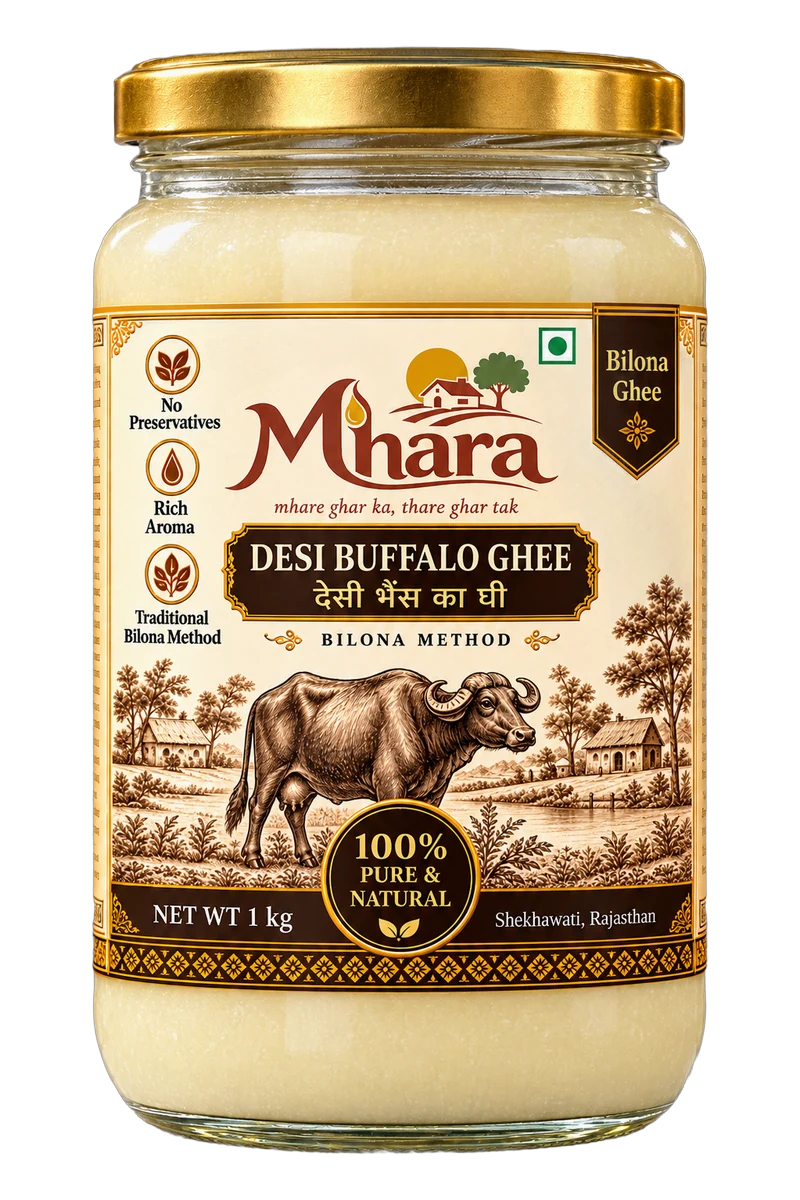
- Desi Buffalo Ghee, from whole buffalo milk curd: ₹1,899
A word on our two cow ghees, because people mix them up. The bilona jar is whole-milk ghee with the deep sondhi aroma. The danedar jar is made from the malai of desi cow milk, so it is lighter, a little sweet, and costs less. Both are cow ghee, made differently. Our guide to what is bilona ghee explains the method in full.
What about health?
We get asked this as often as anything else. Gram for gram, cow and buffalo ghee carry about the same calories, and both are mostly saturated fat. Buffalo ghee is not "unhealthy" and cow ghee is not a medicine. Both contain fat-soluble vitamins, and both have almost no lactose left once clarified.
What matters more is how much ghee you eat in a day, across all your cooking. If you have a heart condition, diabetes or high cholesterol, or are pregnant, ask your doctor what amount suits you. We cover the buffalo side honestly in is buffalo ghee good for health.
Cow or buffalo ghee: how to choose
If you want one simple rule, use this:
- If you love the smell of ghee in your dal and on your roti, choose cow bilona ghee.
- If you want an everyday cow ghee with a lighter aroma and a lower price, choose cow danedar.
- If you make sweets often or like a mild, creamy ghee, choose buffalo ghee.
- If you cook a lot of both, keep both. Many homes do.
If you are buying for the first time and can't decide, start with a small jar of each: 500 ml of cow bilona ghee at ₹1,099 and 500 ml of buffalo ghee at ₹1,049. A month of cooking will settle the question better than any article.
One practical tip if you buy both: keep them on different shelves or mark the lids. In May and June, when both jars are liquid, colour is the only quick way to tell them apart, and in a dim kitchen yellow and ivory look closer than you would think.
Questions people ask
Which ghee is better, cow or buffalo?
Neither is better overall. Cow ghee has a stronger aroma and suits daily dal, rice and roti. Buffalo ghee is milder and creamier and suits sweets and winter dishes.
Why is cow ghee yellow and buffalo ghee white?
Cows pass beta-carotene from their feed into their milk fat, which colours it yellow. Buffalo convert most of it into vitamin A, so their ghee is white or ivory.
Does buffalo ghee have more fat than cow ghee?
Buffalo milk has more fat than cow milk, but the finished ghee is about 99% fat either way. Gram for gram, the two have about the same calories.
Why is cow ghee more expensive than buffalo ghee?
Cow milk has less fat, so more litres go into each kilo of cow bilona ghee. That usually makes cow ghee the costlier jar, even though buffalo ghee comes from richer milk.
Which ghee is best for making sweets?
Many families prefer buffalo ghee for laddoo, churma, chakki and halwa because it gives a rich, soft texture and a white colour. Cow bilona ghee works too if you like its stronger aroma.