

Ghee in milk at night: what tradition says, what science says

Ghee in warm milk at night is an old Indian habit, valued in tradition and in Ayurveda for warmth and nourishment, but there is little clinical research on what it actually does. One teaspoon in a glass is the usual amount, and people with heart conditions, diabetes, or who are pregnant should ask their doctor first.
In most homes in our village, winter nights end the same way. Someone warms a pan of milk, drops in a spoon of ghee, sometimes a pinch of haldi, and hands a glass to whoever looks tired. Ghee in milk at night is one of those habits nobody remembers starting. The question that comes up about it is always the same: does it actually do anything? Tradition and research give quite different answers, and both are below, along with how to make it if you want to.
Where the habit comes from
Older people in Shekhawati describe the habit in much the same way. A glass of warm milk with ghee was what you gave a growing child, a person recovering from a fever, someone who had worked in the fields all day, or anyone on a cold December night when the temperature drops to 4 or 5 °C. It was food for strength and warmth, and in a farming household where both milk and ghee came from the family's own animals, it was also the most natural thing to hand someone.
Ayurveda counts both milk and ghee among nourishing foods, and the two are often taken together in that tradition, which is a big reason the habit is so widespread across India. Many families also add a little haldi, and the drink becomes the haldi doodh that every grandmother seems to have a version of.
Two things need to be kept apart here. That the habit is old and loved is true. That it does any specific thing for the body is a separate question, and it needs separate proof.
What people hope ghee in milk at night will do
The hopes people attach to it are usually these: sleeping better, feeling warm in winter, or "strength" in general. These are the beliefs you will hear in almost every home.
We are not going to tell you any of them is proven, because they are not. Some people feel a warm, heavy drink before bed helps them settle. That feeling is real for them. But a feeling in one person is not the same as an effect that shows up when the drink is properly tested on many people.
What science says, honestly
We looked, and we could not find good clinical trials that tested ghee in milk at night as a habit and measured what it does. Most of what you read online about it is tradition repeated, or the known properties of milk and ghee stretched into promises. Here is what can be said with confidence:
- Ghee is about 99% fat. A level teaspoon is roughly 5 grams, which is about 45 calories. Most of that fat is saturated fat.
- Milk fat carries fat-soluble vitamins. Vitamins A, D, E and K are present in milk fat, so ghee has small amounts of them. A teaspoon is not a large source of any.
- Ghee has almost no lactose. Clarifying removes nearly all milk solids. The milk you stir it into still has its lactose, of course.
- Warm milk and sleep. The idea that warm milk helps sleep is very old, but the research on it is limited and mixed. A calm bedtime routine with a warm drink may help some people relax, and that may be most of it.
- Haldi and fat. Curcumin, the main compound studied in turmeric, dissolves in fat rather than water, which is one reason haldi doodh is traditionally made with whole milk or a little ghee. That says something about how the drink is made. It does not prove the drink does anything for an illness.
So the honest answer is this. A teaspoon of ghee in a glass of warm milk is a traditional, comforting drink that most healthy adults can have in moderation. It is not a medicine, and there is little clinical evidence for the specific benefits people attach to it.
How much ghee to add
One teaspoon in a glass of milk is the usual home amount, and it is enough to taste. Some people start with half a teaspoon. There is no reason to add a tablespoon. More ghee only adds more fat and calories, and the drink gets heavy and greasy.
Remember to count it as part of your day's ghee, along with what goes on your roti and into your dal. Our guide on how much ghee per day goes through this in detail.
How to make ghee with milk at night
- Warm one glass (about 200–250 ml) of milk in a pan until it just starts to rise. Do not keep boiling it.
- Take it off the heat. Add one teaspoon of ghee and stir well.
- If you like, add a pinch of haldi, or a small piece of jaggery for sweetness. A pinch of black pepper is also common with haldi.
- Pour it into a glass, stir once more, and drink it warm, not hot.
The ghee will float as a thin golden layer on top. That is normal. Stir it in before each sip.
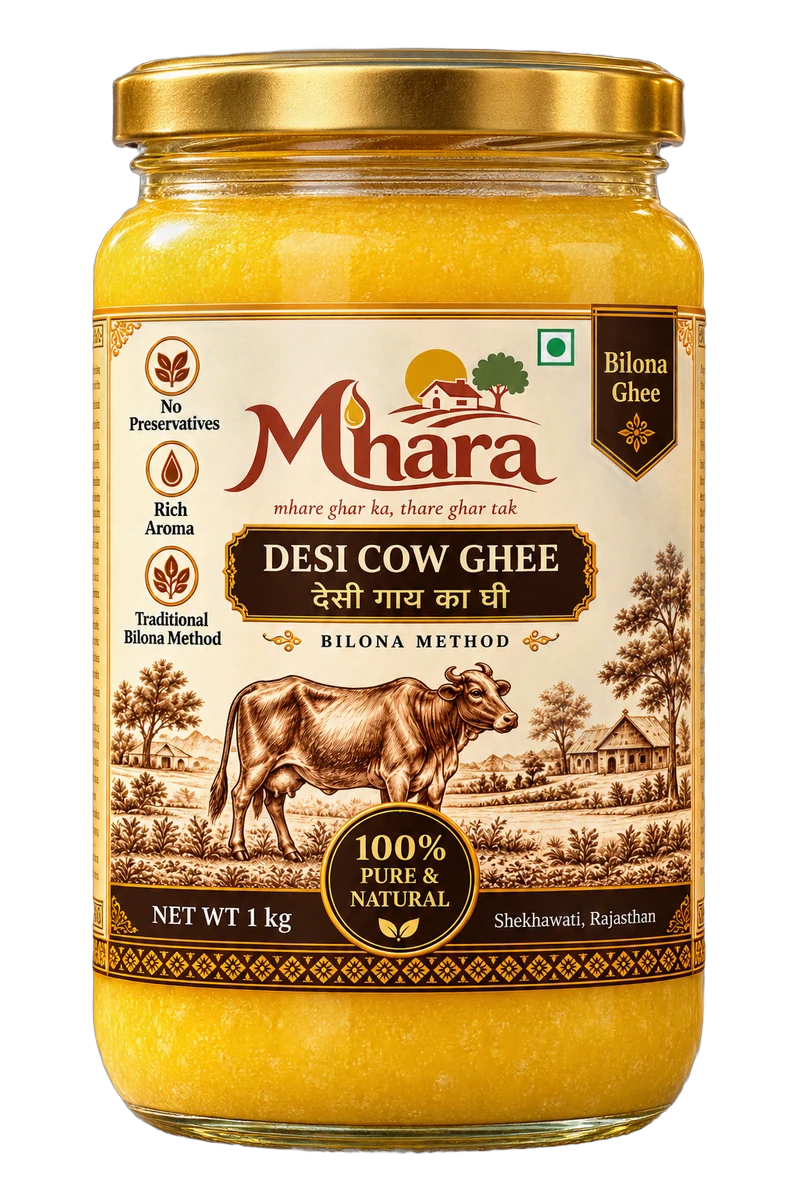
Most homes use cow ghee for this. It is lighter than buffalo ghee (the full comparison is in cow ghee vs buffalo ghee) and has a yellow colour and a nutty smell that suits milk. Our cow bilona ghee is made the old way, from whole milk set into curd and churned, as we explain in what is bilona ghee. Whatever brand you use, the ghee should smell clean and fresh. If you have doubts about a jar, our 5 home tests to tell pure ghee from fake can help.
Haldi doodh with ghee
Haldi doodh with ghee is the version most families reach for in winter or when someone has a cold. A quarter teaspoon of haldi is plenty for a glass. Too much makes the milk bitter and gritty. Mix the haldi into the warm ghee first, then pour in the milk. The haldi spreads evenly instead of floating as dry specks.
Many people drink it when they are unwell because it is warm, soothing and familiar. That comfort is reason enough to make it. Just do not treat it as a replacement for medicine or for seeing a doctor when you are ill.
Who should skip it or ask a doctor first
For most healthy adults, a teaspoon of ghee in milk is an ordinary food. But please talk to your doctor before making it a daily habit if any of these apply to you:
- You have heart disease, high cholesterol, or have been told to cut down on saturated fat.
- You have diabetes or are watching your weight. The milk, the ghee and any jaggery all add up.
- You are pregnant or breastfeeding. Elders in the family will have strong opinions, and your doctor should have the final word.
- It is for a small child. Ask your paediatrician how much milk and fat suits their age.
- Milk itself does not agree with you. Ghee has almost no lactose, but the milk does.
- You get acidity or feel uncomfortable lying down after a heavy drink. Having it an hour before bed, instead of right before sleeping, may suit you better.
Our take
We grew up with this drink and we still make it on cold nights. We like it because it is warm, simple and tastes of home. We will not tell you it fixes any health problem, because no one can honestly say that. If you enjoy it and your doctor has no objection, have a glass with a spoon of good ghee. If you do not enjoy it, you are not missing a medicine.
Questions people ask
Is it good to drink ghee in milk at night?
For most healthy adults, a teaspoon of ghee in warm milk is a normal, traditional food. There is little clinical evidence for the specific benefits people link to it, so enjoy it as a comforting drink rather than a remedy.
How much ghee should I add to a glass of milk?
One teaspoon, about 5 grams, is the usual home amount. That adds roughly 45 calories. There is no need for more, and it should count towards your total ghee for the day.
Does ghee in milk help you sleep?
Many people find a warm drink at bedtime relaxing, but research on warm milk and sleep is limited and mixed, and we found no good trials on ghee in milk specifically. A calm routine may be most of the effect.
Can I add haldi to milk with ghee?
Yes, a quarter teaspoon of haldi per glass is enough. Mix it into the warm ghee first, then add the milk so it spreads evenly. It is a traditional drink, not a substitute for medicine.
Who should avoid ghee in milk at night?
People with heart disease or high cholesterol, those with diabetes or watching their weight, pregnant or breastfeeding women, and parents of small children should ask a doctor before making it a daily habit.
Which ghee is better in milk, cow or buffalo?
Most homes use cow ghee because it is lighter and its nutty aroma suits milk. Buffalo ghee is richer and heavier. Either is fine; the amount matters more than the type.