Ghee for babies: when to start, how much, and how to add it
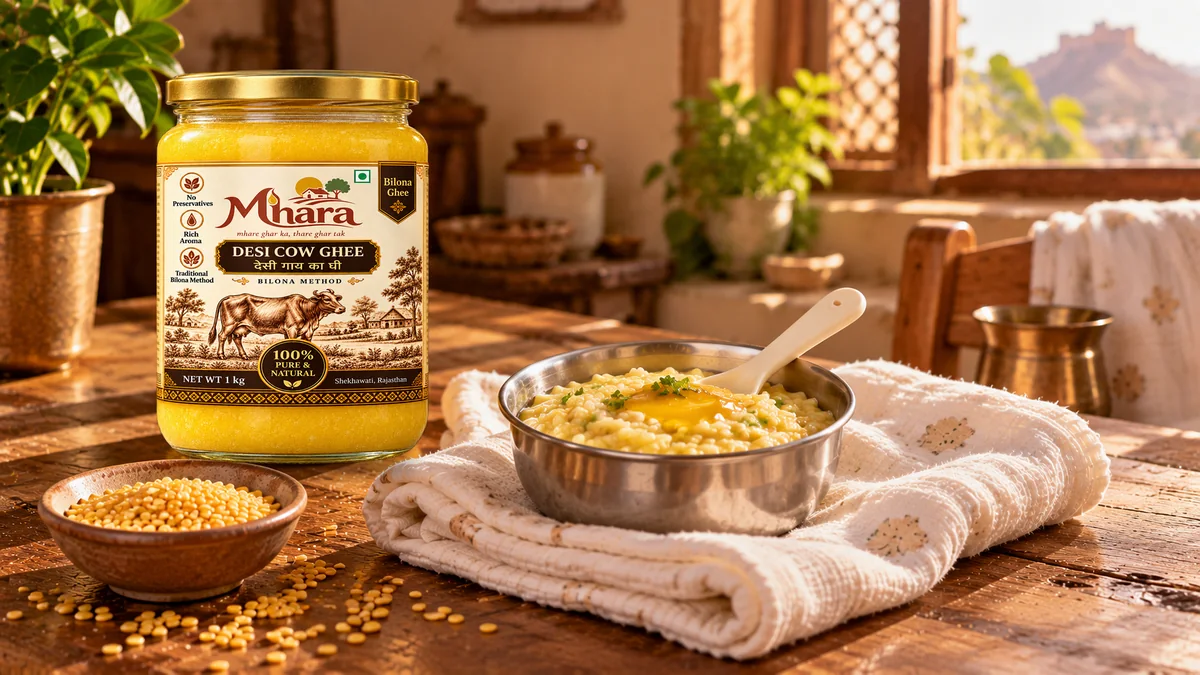
Ghee for babies should start only after your baby has begun solid food, around 6 months, and only as your paediatrician advises. Begin with a few drops stirred into warm dal-rice, khichdi or mashed vegetables, and increase slowly. Ghee is a food, not a medicine for weight gain.
In our village, a baby's first proper meal is usually a few spoons of moong dal khichdi, cooked soft and mashed. And almost always, someone older is standing over the bowl with the ghee jar and a big spoon. Elders in the village say that in their day babies got a full chammach. Many young parents now stop at three drops. Both want the same thing for the baby, and the gap between a spoon and a few drops is what this post is about.
Ghee for babies is one of the first questions new parents in India ask, usually because an elder is already holding the spoon. Here is what we do at home, what standard child-feeding guidance says, and the points where only your paediatrician can decide.
When to start ghee for babies
Not before solid food begins. For the first six months, the standard advice from WHO and Indian paediatric bodies is breast milk only, or formula where needed, with nothing else unless your doctor says so. That means no ghee, no ghutti, no water and no honey in those months.
Solids usually start at around six months, as your paediatrician advises. Some doctors are comfortable with a few drops of ghee from the first weeks of solids. Others prefer to wait until the baby is eating two or three small meals well, often around seven to nine months. Both are normal. Ask at the six-month visit and follow what your doctor says for your child.
A small but important note: many families still give honey to newborns as part of a janam ghutti. Honey should not be given to babies under one year at all, because of a rare but serious illness called infant botulism. If the family wants to keep the ritual, leave out the honey and ask your doctor before giving the baby anything at all.
How much ghee for a baby?
Very little, and slowly. A rough pattern many Indian paediatricians and dietitians suggest looks like this:
- First weeks of solids: 2 to 3 drops in one meal, mixed in well.
- Once the baby eats happily: up to about a quarter teaspoon in a meal.
- Towards one year and after: around half a teaspoon in a meal, going up to about a teaspoon by toddler age, but only if your paediatrician agrees.
These are not targets to hit. A baby's main food in the first year is still milk, and ghee is only a small part of the bowl. If your child has loose motions, vomits or seems uncomfortable after a new food, stop and ask the doctor.
Why add ghee at all? Babies have small stomachs and need a lot of energy for their size. A few drops of fat make a thin dal or khichdi more filling without making the bowl bigger, and fat helps the body use vitamins A, D, E and K. It also makes plain food smell good, which helps a fussy eater.
How to add ghee to baby food
Ghee works best stirred into warm, soft food just before serving. Some simple first foods where it fits:
- Moong dal khichdi, cooked very soft and mashed
- Thick mashed dal-rice, not thin dal water, which fills the stomach but gives little nourishment
- Mashed vegetables like lauki, pumpkin, carrot or potato
- Ragi or suji porridge, thick enough to stay on the spoon
- Soft mashed roti soaked in dal, a little later
Keep the food plain. Standard advice is no added salt and no added sugar in the first year, and that includes jaggery and the sweet mixes elders love to add. Ghee gives enough taste on its own.
Is ghee good for baby weight gain?
This is where we disagree with a lot of what is said in families. Ghee does add energy, so a little in a growing baby's food helps. But ghee is not a medicine for a thin baby, and pouring in more ghee is not the answer to slow weight gain.
Healthy babies come in many sizes. Your paediatrician tracks growth on a chart, and that chart tells you far more than how chubby a baby looks. If the doctor is worried about weight, the cause could be feeding, illness, or something else that needs checking, and they will give a plan. Too much ghee can also fill a small stomach so the baby eats less of the dal, vegetables and grains it needs. Never force-feed ghee.
Cow ghee, allergies and purity
Most Indian families use cow ghee for babies because it is lighter in taste, and that is what we use at home too. Buffalo ghee is fine for adults but very rich, so start with cow ghee for little ones.
Ghee has almost no lactose and only tiny traces of milk protein, so reactions are uncommon. Still, if your baby has a diagnosed cow's milk protein allergy, or a doctor has asked you to keep dairy away, ask before giving ghee. Watch for rash, vomiting or loose motions with any new food, and introduce one new food at a time.
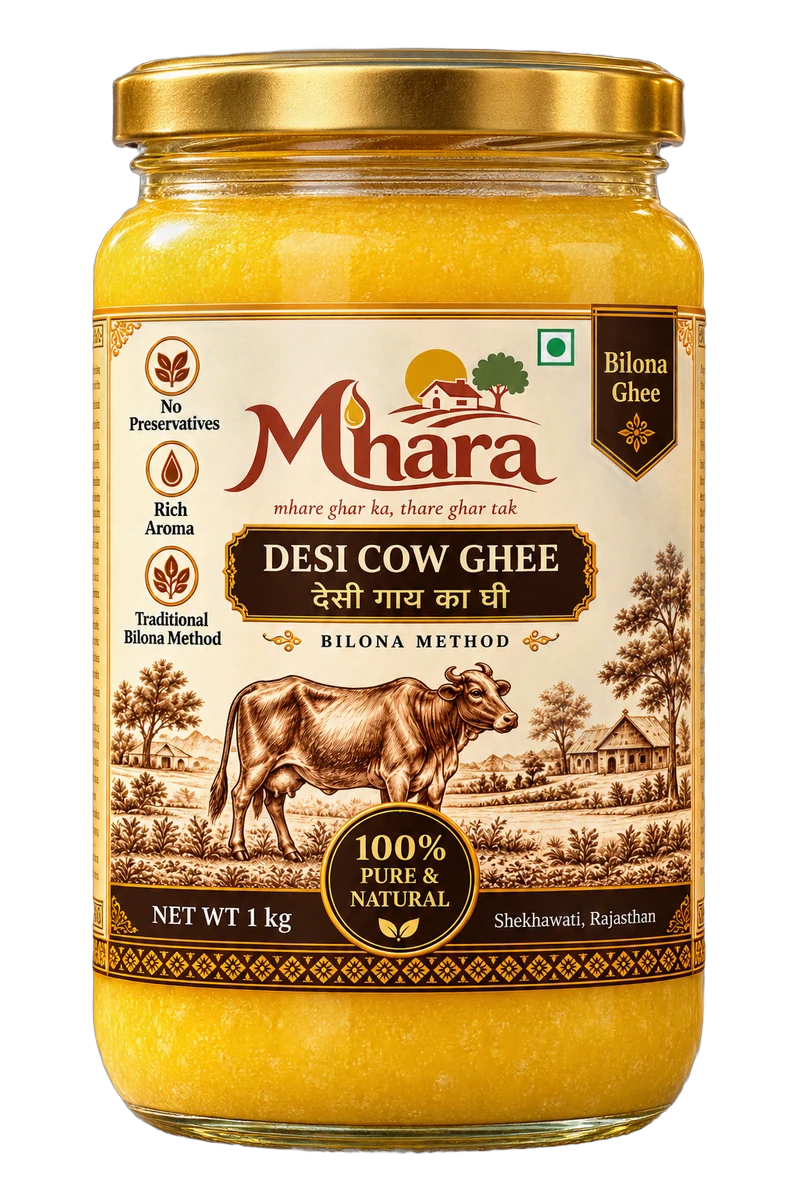
Purity matters a lot more for a baby than for us. Ghee mixed with vanaspati or other fats is not something you want in a baby's bowl. Our guide on how to check purity of ghee has simple home checks.
Ghee massage for babies
In many homes, the daily malish is done with ghee, mustard oil or coconut oil, and grandmothers have strong opinions about which. The massage itself, gentle hands and warm skin, is a lovely way to bond with a baby.
If your family uses ghee, keep it to a thin layer of lukewarm ghee, not hot, and wipe off the extra after. Do not use it on broken skin, rashes or eczema, and never put ghee or oil in the baby's nose, ears or eyes. In hot, humid weather, heavy fats can sit on the skin and add to heat rash. Many paediatricians prefer a plain, mild oil for massage, so ask yours which they suggest for your baby's skin. And nothing at all on a newborn's cord stump until it falls off; we explain why in ghee in navel.
A few drops, and your paediatrician's word
When you think about it, the old way and the new way are not far apart. Elders in the village say babies were given ghee because they needed energy and food was often short. Today's doctors also say a little fat in a baby's food is good. The difference is only in the amount, and in letting the doctor who weighs your baby every month have the final say.
For grown-ups in the house, our pages on desi ghee benefits and how much ghee per day cover the rest. Start with drops, not spoons, and let the growth chart settle the argument.
This is general information from a ghee-making family, not medical advice.
Questions people ask
When can I start giving ghee to my baby?
Only after your baby has started solid food, around 6 months, and as your paediatrician advises. Some doctors allow a few drops from the first weeks of solids, others prefer to wait until 7 to 9 months. Nothing except breast milk or formula before 6 months.
How much ghee can I give my baby?
Start with 2 to 3 drops in one meal. If the baby eats happily, go up slowly to about a quarter teaspoon per meal. Larger amounts, up to about a teaspoon at toddler age, should be decided with your paediatrician.
Is ghee good for baby weight gain?
A little ghee adds energy to a baby's food, but it is not a medicine for weight gain. If your doctor is worried about growth, the cause needs checking. Too much ghee can fill a small stomach and push out other foods.
Can I add ghee to my baby's dal and khichdi?
Yes, once solids have started and your paediatrician agrees. Stir a few drops into warm, soft dal-rice, moong dal khichdi or mashed vegetables just before serving. Keep the food plain, with no added salt or sugar in the first year.
Is cow ghee or buffalo ghee better for babies?
Most Indian families use cow ghee for babies because it is lighter in taste. Buffalo ghee is very rich. Whichever you use, it must be pure, fresh and kept clean, and the amount should stay small.
Is ghee massage good for babies?
Many families massage babies with ghee. If you do, use a thin, lukewarm layer, avoid broken skin and rashes, and never put it in the nose, ears or eyes. Many paediatricians prefer a mild plain oil, so ask yours.