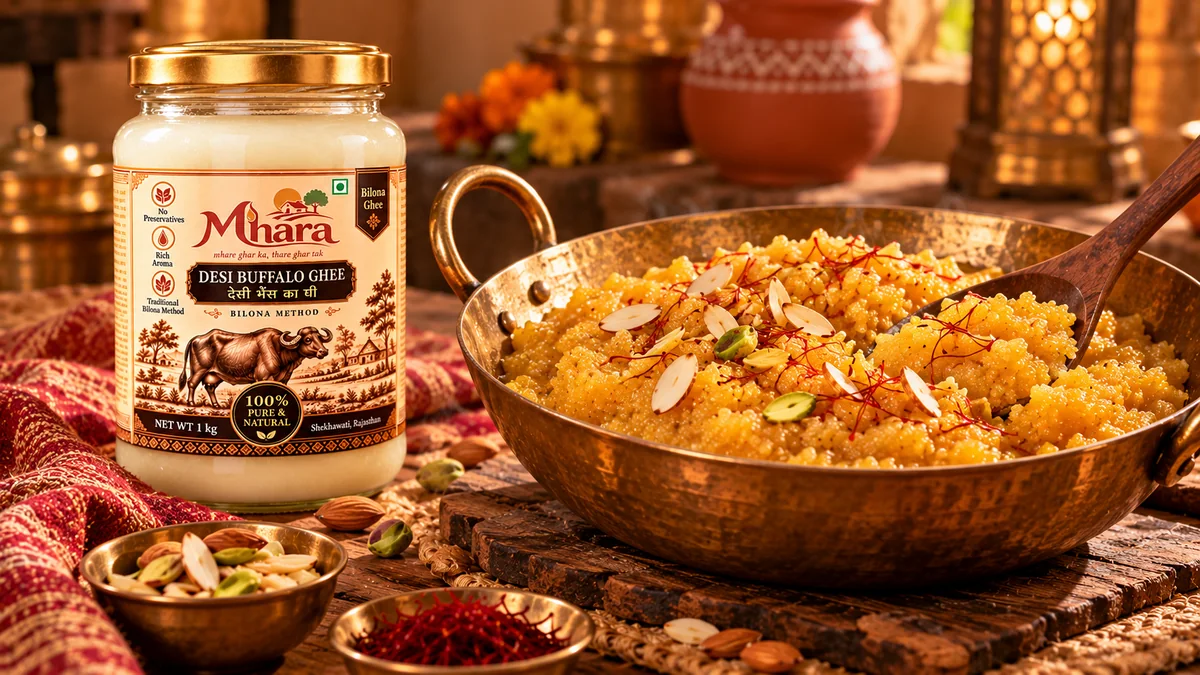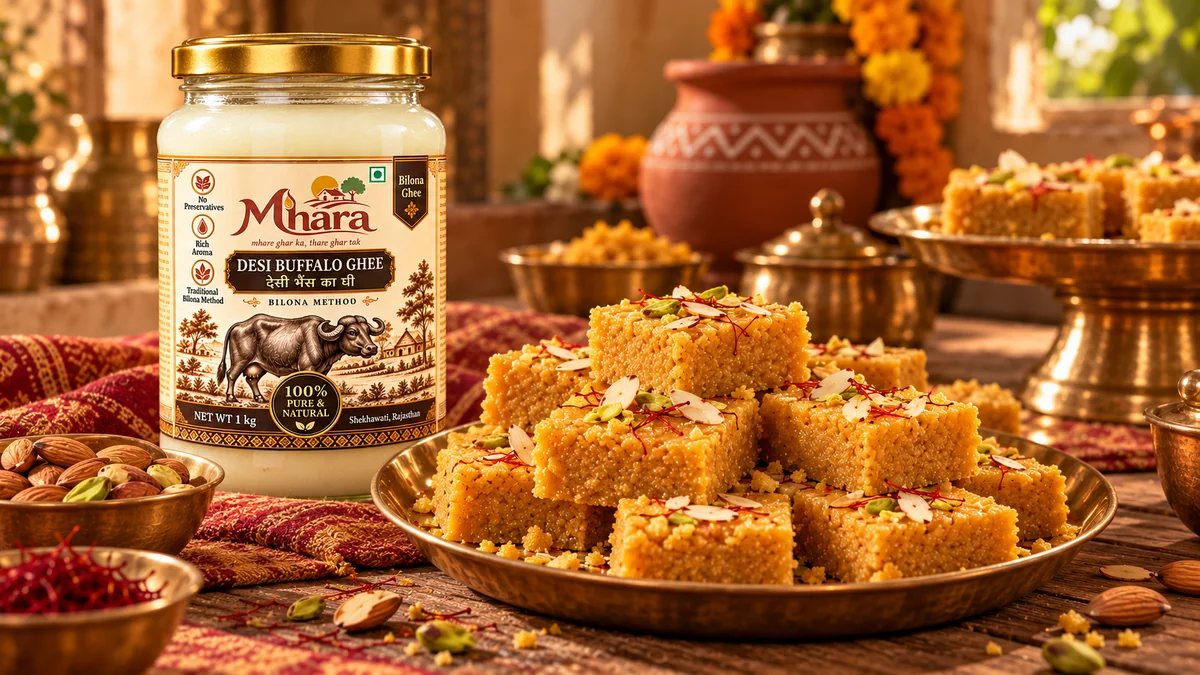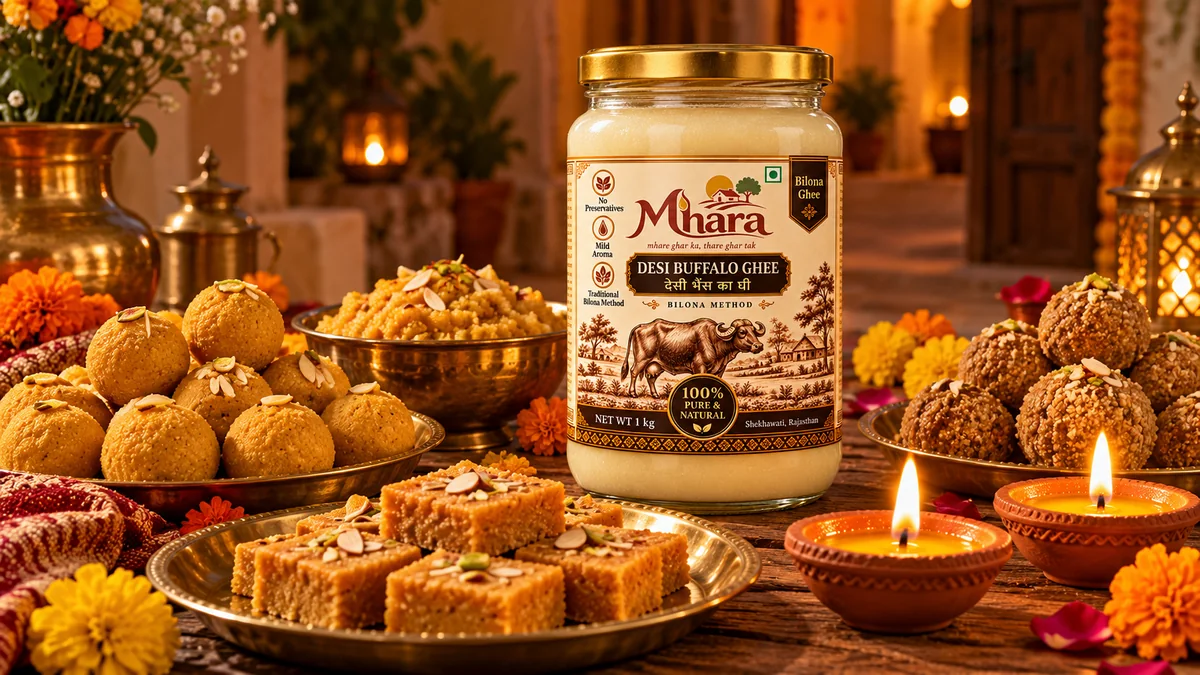

Rajasthani churma recipe with desi ghee
Churma is made by kneading coarse wheat atta with plenty of ghee into a stiff dough, cooking hand-pressed muthiya till crisp, grinding them into coarse crumbs and mixing in warm ghee, sugar or jaggery, cardamom and dry fruit. Press it with a little extra ghee and you have churma ladoo.
When guests come to a house in our village, or when there is a puja, a wedding or just a cold Sunday, someone puts a kadai of ghee on the chulha and the family knows dal baati churma is coming. This churma recipe is the plain home version: coarse wheat dough rubbed with ghee, shaped by hand, cooked till crisp, crushed, and mixed with more ghee, sugar or jaggery, cardamom and dry fruit.
It is not a difficult dish. It is a slow one. Most of the effort goes into small things: how coarse the atta is, how much ghee goes into the dough, how long the muthiya cook, and how you grind them. We go through each one below, with the reasons, and the exact quantities are in the recipe card.
Churma in a Rajasthani kitchen
Churma began as a way to use what the house already had: wheat, ghee and something sweet. Even today, the quickest churma in many village homes is made from the morning's leftover rotis, crumbled by hand with warm ghee and jaggery. In winter, some families make it with bajra instead of wheat. The festive version, the one served with dal and baati, is made from fresh dough cooked specially for it, and that is the one we are making here.
A good churma is loose and crumbly, not a paste. Each grain should be coated in ghee, so it feels soft in the mouth but still has a little bite. It should taste of roasted wheat first and sweetness second.
The atta and the moyan
Use coarse whole wheat atta, the kind called mota or dardara atta. Many chakki mills will grind it coarse if you ask. The regular fine atta used for rotis works, but the churma comes out softer and closer to a halwa. If you only have fine atta, add a couple of tablespoons of sooji to it.
Moyan is the ghee you rub into the dry atta before adding any liquid. For churma it has to be generous. Rub it in with your fingers until the atta looks like breadcrumbs, then take a fistful and press it. If it holds its shape, there is enough moyan. If it falls apart, add a little more ghee.
The moyan coats the flour so the dough does not turn chewy. The muthiya come out crisp outside and short and crumbly inside, which is what lets them break into grains later. With too little moyan, they turn hard like stones and grind into a dry powder.
Kneading and shaping the muthiya
Add warm milk, or half milk and half water, a little at a time and knead a stiff dough. It should be firmer than roti dough, close to what you would make for mathri. A soft dough soaks up more ghee while frying and stays doughy in the middle.
Divide the dough into eight to ten parts. Take each one in your fist and squeeze it, so it comes out as a rough log with the marks of your fingers on it. These are the muthiya. The finger grooves are not decoration. They give more surface for the heat to reach, so the muthiya cook through evenly.
Fry, bake or roast on the fire
In the village, the muthiya and baatis traditionally go into the hot ash of a fire made with kande, dried cow dung cakes, and come out with a smoky crust. In town kitchens there are two easier ways.
- Frying. Heat ghee in a kadai to a medium heat. Slide the muthiya in and fry on a low to medium flame for fifteen to eighteen minutes, turning them, till they are deep golden all over. Ghee handles this heat well, as we explain in ghee smoke point. If the ghee is too hot, they brown outside and stay raw inside.
- Baking. Bake at 200 °C for twenty five to thirty minutes, turning once halfway, until firm and lightly browned. Baked churma uses less ghee in the cooking but you add the same ghee at the end.
To check, break one open. The inside should be dry and cooked, with no wet dough.
Grinding, ghee and sweetness
Break the muthiya into pieces and grind them in short pulses in a mixer. Stop when you have coarse crumbs, like semolina. If you run the mixer for long, the warm ghee in the dough turns everything into a paste. Sieve it, and grind the big pieces left in the sieve once more. Older women in our village still crush them in a stone kundi or between their palms, and the texture is the best you will get.
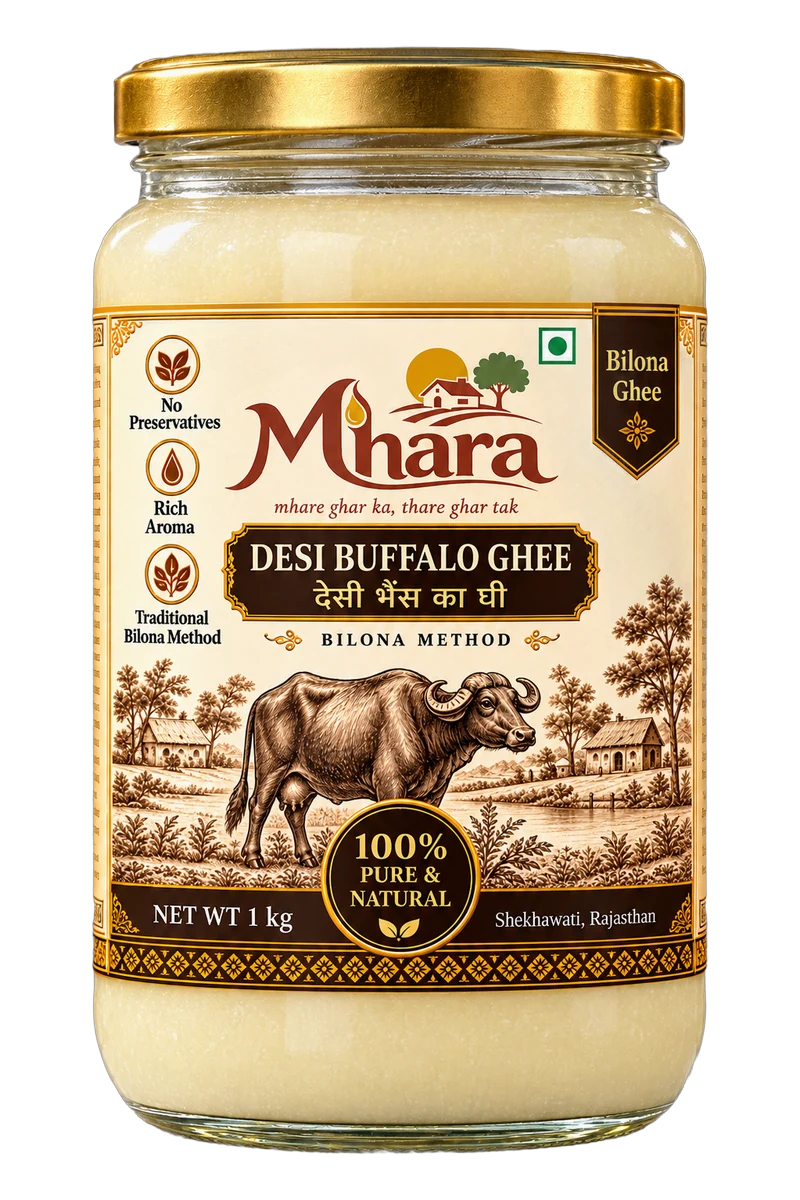
Now the ghee goes in. Pour warm melted ghee over the churma while it is still warm and rub it through with your hands. This is where the taste comes from, so this is where your best ghee should go. Many Shekhawati homes use buffalo ghee for churma. It is rich and creamy, it coats every grain and its mild taste lets the roasted wheat come through. Cow bilona ghee gives a stronger, nutty aroma and a more golden churma, and many families like that just as much. We compare the two in cow ghee vs buffalo ghee.
For sweetness you have three choices:
- Boora or powdered sugar. The most common. Mix it in once the churma has cooled to just warm, or it melts and makes lumps.
- Jaggery. Grate it, melt it with a spoon or two of ghee on a low flame only until it turns liquid, and pour it over the churma. Do not cook it into a syrup or the churma sets hard. Jaggery churma is darker and has a deep, earthy sweetness.
- Half and half. Some homes use a little jaggery for flavour and sugar for the rest.
Finish with cardamom powder and chopped almonds and cashews. A spoon of poppy seeds is also common in some families.
Churma ladoo
Churma ladoo are made from the same churma with a little extra ghee. Add two or three tablespoons of warm ghee, more if needed, until a fistful of churma holds together when pressed. Shape the ladoo while the mixture is still slightly warm. Once it cools fully, the ghee firms up and the ladoo crack instead of binding.
Ladoo are easier to serve at weddings and to pack for relatives, and they keep a little longer than loose churma because less of the surface is open to air.
Serving dal baati churma
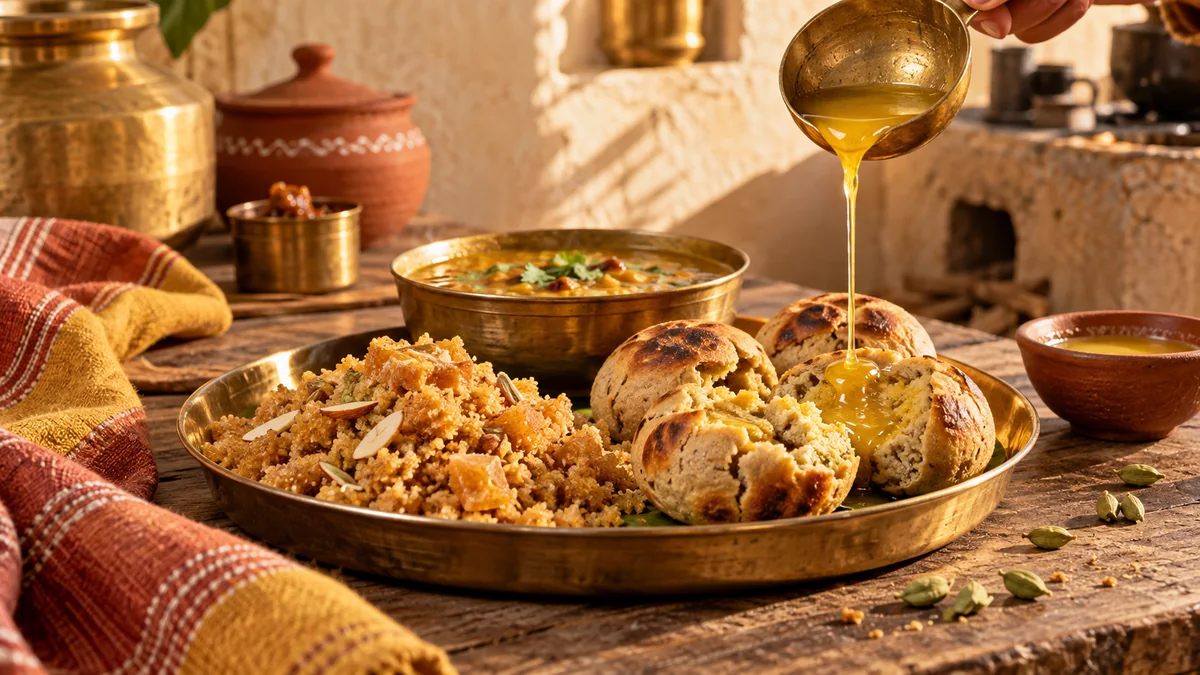
The full plate is dal baati churma: a thick panchmel or mixed dal with a ghee and hing tadka, baatis broken open and dipped in melted ghee, and a heap of churma on the side. Many people mix a little churma into the dal and baati. That is not wrong. That is how it is eaten here.
This is a heavy, festive meal, and it uses a lot of ghee in one sitting. If you are watching how much ghee you eat in a day, our guide on how much ghee per day will help. If you are making a sweet spread for Diwali, our besan chakki recipe uses the same slow roast in ghee and goes well next to churma.
Churma recipe mistakes to avoid, and how long it keeps
- Fine atta and little moyan: hard muthiya and a dry, powdery churma.
- Soft dough: oily, doughy muthiya.
- Frying on a high flame: brown outside, raw inside.
- Grinding too long or too hot: paste instead of grains.
- Adding sugar to hot churma: lumps and a sticky texture.
Churma keeps four to five days in a closed steel or glass box at room temperature, a little longer in winter. Churma ladoo keep about a week. Let it cool fully before closing the box so no steam is trapped inside. If you make churma often, buy ghee in a size you will finish in a few months and keep the jar closed between uses. Our how to store ghee guide has the details.
Recipe card
Ingredients
- 2 cups (300 g) coarse whole wheat atta (mota or dardara atta)
- 2 tbsp sooji (optional, use if your atta is fine)
- 1/3 cup (about 65 g) ghee, for the moyan
- About 1/2 cup (120 ml) warm milk, or half milk and half water
- Ghee for frying (or skip and bake the muthiya)
- 1/2 cup (about 100 g) buffalo ghee or cow bilona ghee, melted, for mixing
- 3/4 cup (150 g) boora or powdered sugar, or 150 g jaggery, grated
- 1/2 tsp green cardamom powder
- 2 tbsp chopped almonds
- 2 tbsp chopped cashews
- 1 tsp poppy seeds (optional)
- 2–3 tbsp extra ghee, only if making ladoo
Method
- Mix the atta and sooji. Add the moyan ghee and rub it in with your fingers until a fistful holds its shape when pressed.
- Add the warm milk a little at a time and knead a stiff dough, firmer than roti dough. Rest it for 10 minutes.
- Divide into 8–10 parts. Squeeze each in your fist to make a log with finger marks.
- Fry the muthiya in medium-hot ghee on a low to medium flame for 15–18 minutes, turning, until deep golden and cooked inside. Or bake at 200 °C for 25–30 minutes, turning once.
- Let them cool for about 10 minutes until warm, then break them into pieces.
- Grind in short pulses to coarse crumbs like semolina. Sieve, and grind the big pieces again.
- Pour the melted ghee over the warm churma and rub it through with your hands.
- When the churma is just warm, mix in the boora or sugar. If using jaggery, melt it with 1–2 tbsp ghee on a low flame only until liquid, and mix it in.
- Add the cardamom, almonds, cashews and poppy seeds. Serve with dal and baati.
- For ladoo, add 2–3 tbsp warm ghee until a fistful binds, and shape while slightly warm.
Questions people ask
Why is my churma hard and dry?
Usually there was too little moyan in the dough, or the atta was too fine. The dough needs enough ghee that a fistful holds its shape when pressed, and the finished churma needs warm ghee rubbed through it.
Can I make churma without frying?
Yes. Bake the muthiya at 200 °C for 25 to 30 minutes, turning once, until firm and lightly browned. The rest of the recipe stays the same, including the ghee mixed in at the end.
Should I use sugar or jaggery in churma?
Both are traditional. Boora or powdered sugar gives a lighter churma; jaggery gives a darker one with an earthy sweetness. If you use jaggery, melt it with a little ghee only until liquid and do not cook it into syrup.
How do I make churma ladoo?
Add two or three tablespoons of warm ghee to the churma until a fistful holds together when pressed. Shape the ladoo while the mixture is still slightly warm, because once it cools the ghee sets and the ladoo crack.
Which ghee is best for churma?
Many Rajasthani homes use buffalo ghee for churma because it is rich and coats every grain. Cow bilona ghee gives a stronger aroma and a more golden colour. Both make good churma.
How long does churma stay fresh?
Loose churma keeps four to five days in a closed box at room temperature, a little longer in winter. Churma ladoo keep about a week. Cool it fully before closing the box.