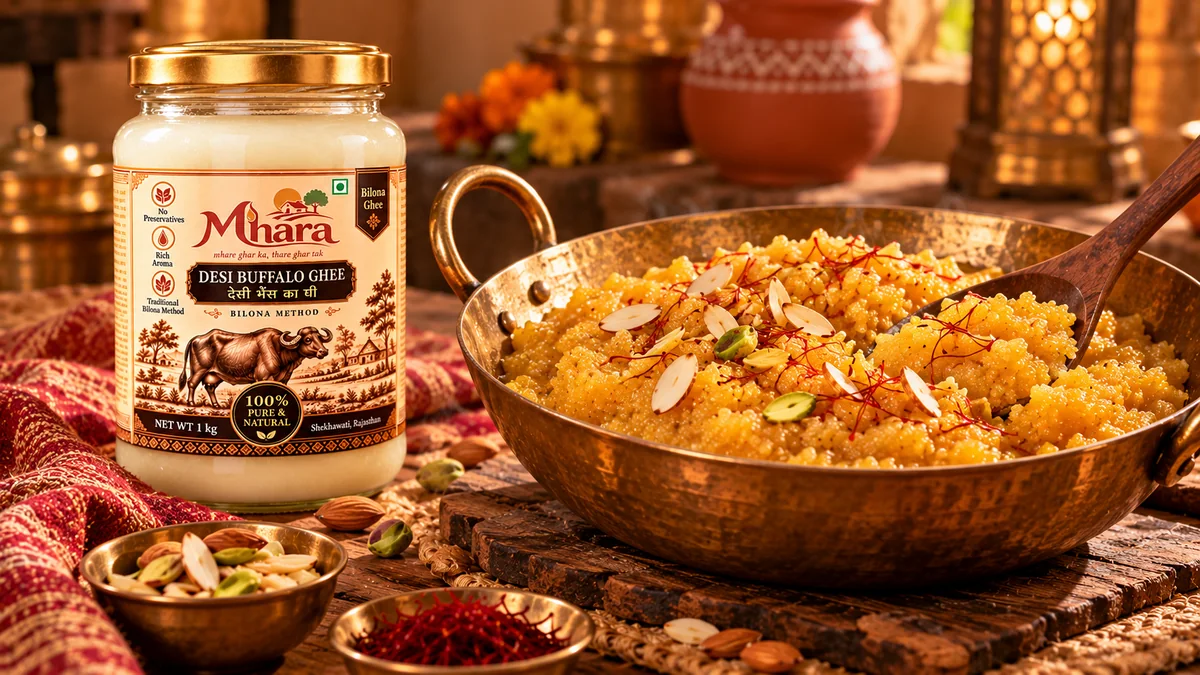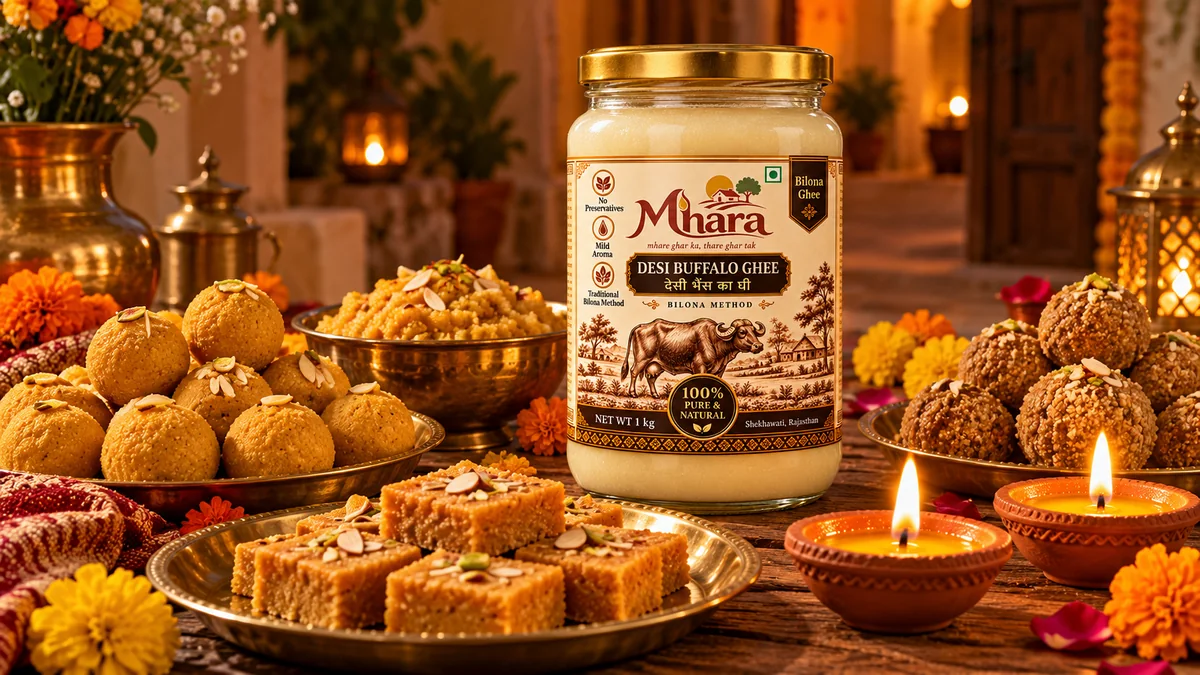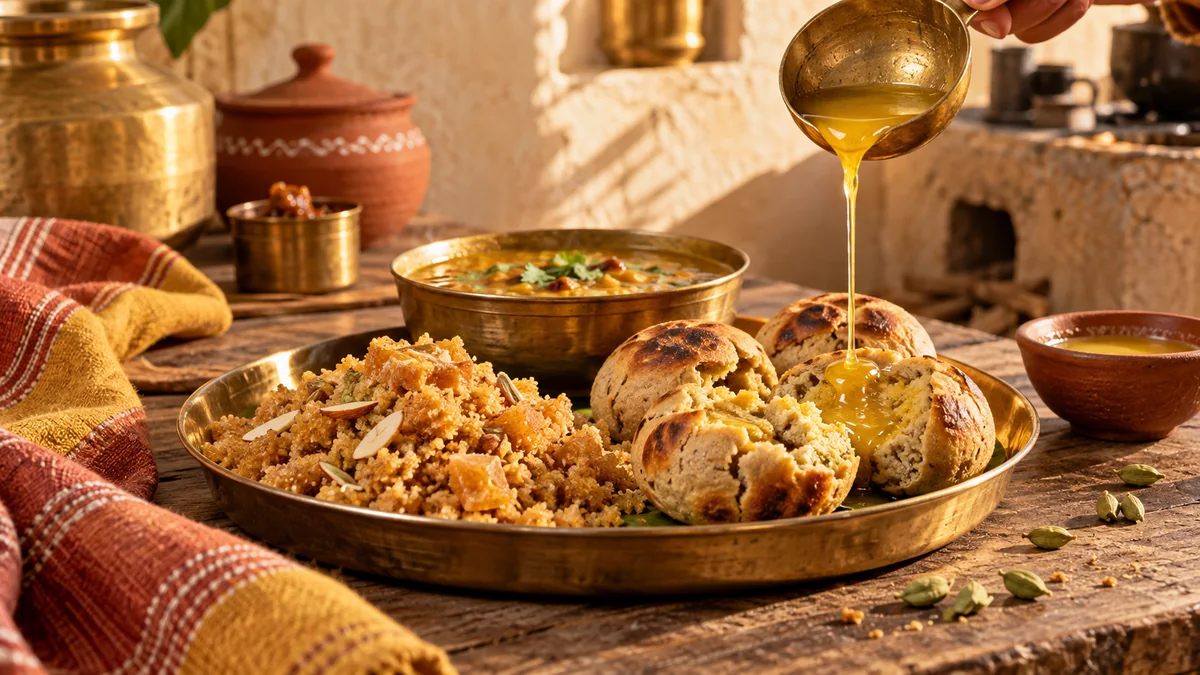

Mohanthal recipe: the grainy Rajasthani besan barfi we make for Diwali
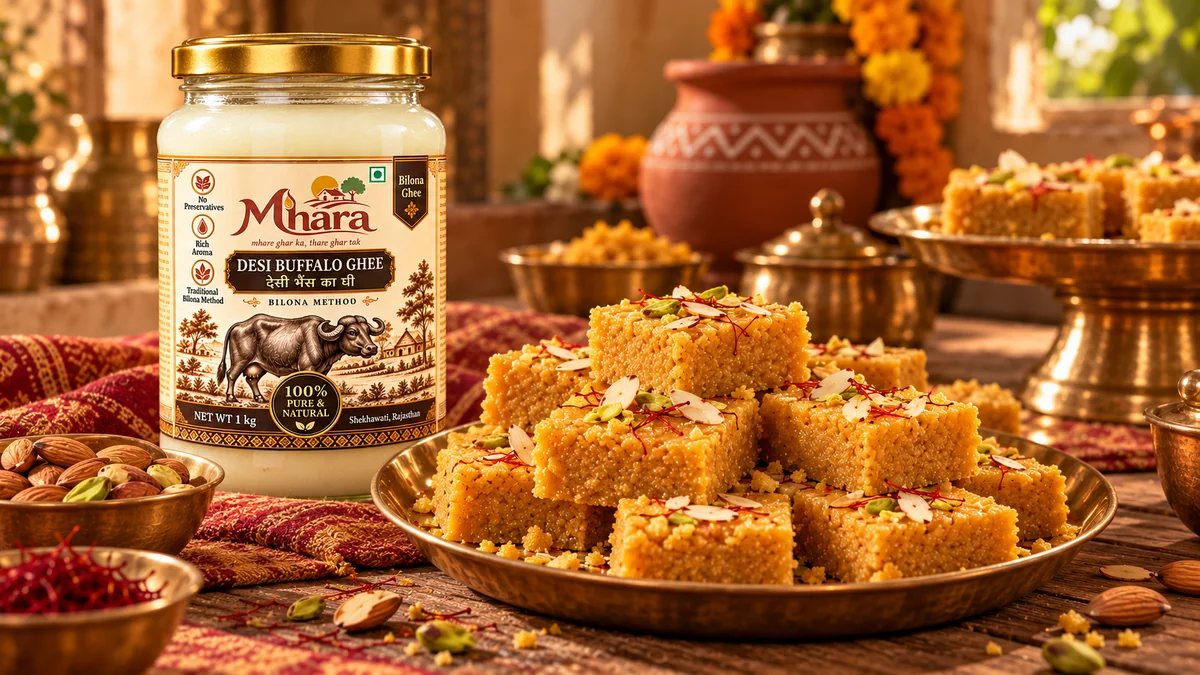
This mohanthal recipe makes the grainy Rajasthani besan barfi: coarse besan rubbed with ghee and milk (dhabo), roasted slowly in ghee until golden and nutty, then mixed with a one-string sugar syrup, cardamom and saffron and set in a thali. Cut it into squares once firm.
In our kitchen the first Diwali sweet is not bought. It is roasted. About a week before the festival the heavy kadhai goes on the stove, a jar of ghee is opened, and for the next half hour nobody talks to whoever is stirring. By evening a thali of mohanthal is cooling on the shelf and the whole lane can smell it. This mohanthal recipe is that one: coarse besan rubbed with ghee and milk, roasted slowly in ghee, set with a one-string syrup and cut into squares.
Mohanthal looks simple. It is fussy in exactly two places, the roasting and the syrup, so most of this page is about those two. The quantities are in the recipe card below.
What makes Rajasthani mohanthal different from besan barfi?
A plain besan barfi is fine besan roasted in ghee and set with sugar. Rajasthani mohanthal has three things more. The besan is coarse, so the sweet has a sandy, melting grain instead of a smooth fudge. It goes through dhabo first, where hot ghee and milk are rubbed into the flour and left to rest. And many homes add a little mawa, which keeps the middle soft and milky.
The texture you want is daanedar: small grains you can see when you break a piece, held together by ghee and syrup. It should give under your teeth and then melt. If it snaps, or crumbles to dust, something went wrong, and we cover what below.
Dhabo: the step most recipes skip
Dhabo is what gives mohanthal its grain. Warm 2 tablespoons of ghee with 2 tablespoons of milk until the ghee melts. Pour it over 2 cups of coarse besan and rub it in with your fingertips for two or three minutes, the way you rub moyan into atta. The besan turns damp and lumpy, like wet sand.
Cover it and leave it for 20 to 30 minutes. Then press it through a coarse sieve, or the wide holes of a puri jhara, with the heel of your palm. What comes through is even, fine crumbs. The milk swells each grain a little and the ghee keeps the grains apart, so when they roast they turn into tiny beads instead of a paste.
Can't find coarse besan? Ask for mota besan at the chakki, or mix 1¾ cups regular besan with ¼ cup fine sooji. It is not quite the same, but it is close.
Roasting besan in ghee: low flame, no shortcuts
Heat about ¾ cup of ghee in a heavy kadhai on a low flame. Add the sieved besan and start stirring. Keep stirring, scraping the bottom and sides, for 20 to 25 minutes. Do not turn the flame up to save time. Besan browns from the outside in. On a high flame it smells done long before the inside of each grain is cooked, and the finished mohanthal tastes raw and slightly bitter.
How to tell it is roasted:
- The colour has gone from pale yellow to deep golden, like the inside of a good biscuit.
- The mixture turns light and loose, and the ghee bubbles and froths around it.
- The smell changes from raw and beany to nutty, like roasted peanuts.
If you are using mawa, crumble ½ cup of it in now and stir for another 3 to 4 minutes until it melts in. Then take the kadhai off the heat. Some families sprinkle a tablespoon of milk at this point. It hisses and foams and leaves the mohanthal a little more porous. That part is optional.
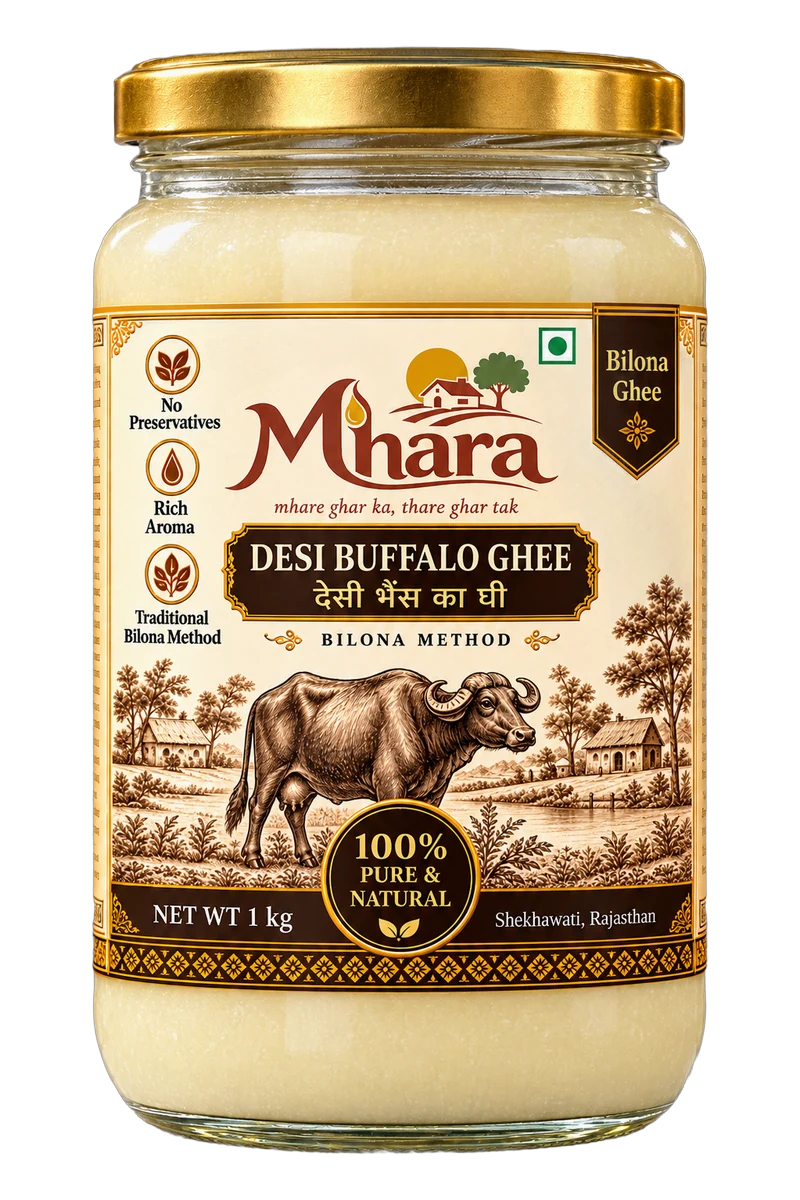
Ghee carries all the flavour in mohanthal, so the choice matters. We use buffalo ghee for it. It is thick and creamy, it gives that heavy, melting mouthfeel, and its mild taste lets the roasted besan lead. Cow bilona ghee works too and gives a stronger aroma and a more golden colour. Our cow ghee vs buffalo ghee page has the longer comparison.
The one-string syrup
Put 1 cup of sugar and ½ cup of water in a pan with a few strands of saffron. Stir until the sugar dissolves, then let it boil on a medium flame without stirring. After 5 to 7 minutes of boiling, start testing. Take a drop on a spoon, let it cool for a few seconds, touch it between your thumb and finger, and pull them apart. One thin thread that breaks quickly is one string. Stop right there and add ½ teaspoon of cardamom powder.
This is the step that decides everything. Two strings and the mohanthal sets like a brick. Half a string and it stays soft and sticky for days. If you are new to it, test early and test often. The syrup changes faster at the end than you expect.
Mohanthal recipe: mixing, setting and cutting
Let the roasted besan cool for 3 to 4 minutes off the heat. It should still be very hot, just not frying. Pour the syrup in slowly while you stir. The mixture hisses, then looks loose and shiny, almost like a thick batter. Do not panic. Keep stirring off the flame for 3 to 5 minutes. It thickens as it cools, and when it starts leaving the sides of the kadhai and looks slightly grainy, it is ready.
Grease an 8-inch thali with ghee. Pour the mixture in, tap the thali on the counter so it settles, and smooth the top with the back of a greased katori. Scatter sliced almonds and pistachios and press them in lightly. Varq is optional. At home we usually skip it.
Leave it for 2 to 3 hours at room temperature. Mark the squares with a knife after about 30 minutes, while it is still soft, then cut through once it has set. Cut too early and the pieces lose their edges. Wait until it is cold and hard, and the top cracks under the knife.
Why is my mohanthal too hard, or not setting?
When a mohanthal recipe goes wrong, it is almost always the syrup or the flame. Here is what usually happened:
- Hard like a stone: the syrup went past one string. Next time stop earlier. For this batch, crumble it, add a little warm milk and cook it on a low flame into a soft halwa. Nobody complains.
- Not setting after 3 hours: the syrup was under-cooked. Put the mixture back in the kadhai and stir on a low flame for 3 to 5 minutes until it leaves the sides, then set it again.
- Raw or bitter aftertaste: the besan was roasted on a high flame, or not long enough.
- A pool of ghee on top: too much ghee for the besan. Blot it with a clean cloth. It will still taste good.
- Smooth like fudge, no grain: fine besan and no dhabo.
How long does mohanthal keep?
Mohanthal made without mawa keeps about a week in a closed steel or glass box at room temperature, up to 10 days in cold weather. With mawa, finish it in 3 to 4 days or keep it in the fridge. Keep it away from the stove and the sun, and put butter paper between layers so the pieces do not stick. In the fridge it turns hard, so take it out half an hour before serving.
Without mawa it keeps well, so this is a good sweet to make a few days ahead of Diwali, which falls on Sunday, 8 November this year. If you are planning a full plate, our list of Diwali sweets with desi ghee has more ideas, and the besan ladoo recipe uses the same patient roast without any syrup. For a proper Rajasthani spread, churma sits well next to it.
Mohanthal is rich. One small square after a meal is how it is meant to be eaten, and honestly, that is when it tastes best.
Recipe card
Ingredients
- 2 cups (240 g) coarse besan (mota besan)
- 2 tbsp ghee and 2 tbsp milk, for the dhabo
- 3/4 cup (about 150 g) buffalo ghee or cow bilona ghee, for roasting
- 1/2 cup (100 g) mawa or khoya, crumbled (optional)
- 1 cup (200 g) sugar
- 1/2 cup (120 ml) water
- 10–12 saffron strands
- 1/2 tsp green cardamom powder
- 2 tbsp sliced almonds
- 2 tbsp sliced pistachios
- 1 tsp ghee, to grease the thali
- Silver varq (optional)
Method
- Warm 2 tbsp ghee with 2 tbsp milk until the ghee melts. Pour over the besan and rub in with your fingertips for 2–3 minutes.
- Cover and rest for 20–30 minutes, then press through a coarse sieve into even crumbs.
- Grease an 8-inch thali with ghee and keep it ready.
- Heat 3/4 cup ghee in a heavy kadhai on a low flame. Add the besan and stir continuously for 20–25 minutes, until deep golden, frothy and nutty-smelling.
- When the besan is about two-thirds roasted, start the syrup: stir the sugar, water and saffron until dissolved, then boil on a medium flame without stirring.
- Add the crumbled mawa to the besan, if using, and stir for 3–4 minutes more. Take the kadhai off the heat.
- Test the syrup after 5–7 minutes of boiling. Stop at one string (a single thin thread between thumb and finger) and add the cardamom.
- Let the besan cool for 3–4 minutes, then pour in the syrup slowly while stirring.
- Keep stirring off the heat for 3–5 minutes, until the mixture thickens and starts leaving the sides.
- Pour into the thali, level with a greased katori and press in the almonds and pistachios. Add varq if you like.
- Mark squares after 30 minutes and cut through after 2–3 hours, once set.
- Store in a closed box at room temperature for about a week (3–4 days, or in the fridge, if you added mawa).
Questions people ask
Why is my mohanthal hard?
The sugar syrup was cooked past one string. Even half a minute too long can make mohanthal set like a brick. Test the syrup early, stop at one thin thread that breaks quickly, and do not let it sit on the heat while the besan finishes.
What is dhabo in mohanthal?
Dhabo is rubbing warm ghee and milk into coarse besan, resting it for 20 to 30 minutes and pressing it through a sieve. It gives the besan an even grain, so the finished mohanthal is daanedar instead of smooth like fudge.
Can I make mohanthal without mawa?
Yes. Mawa makes the middle softer and milkier, but many village homes make mohanthal without it. Roast the besan a couple of minutes longer and add a tablespoon of milk at the end of roasting if you want a softer, more porous texture.
Which ghee is best for mohanthal?
Buffalo ghee is the traditional choice in many Rajasthani homes because it is thick and creamy and gives mohanthal a rich, melting feel. Cow bilona ghee also works and gives a stronger aroma and a more golden colour.
What is the difference between mohanthal and besan barfi?
Besan barfi uses fine besan and sets smooth. Mohanthal uses coarse besan that goes through dhabo, is often enriched with mawa, and sets with a grainy, melting texture. Both are roasted slowly in ghee and set with sugar syrup.
How long does mohanthal stay fresh?
Without mawa, about a week in a closed steel or glass box at room temperature, up to 10 days in winter. With mawa, eat it within 3 to 4 days or keep it in the fridge. Put butter paper between layers. In the fridge it hardens, so bring it to room temperature before serving.