
Besan chakki recipe and winter panjiri, the Shekhawati way
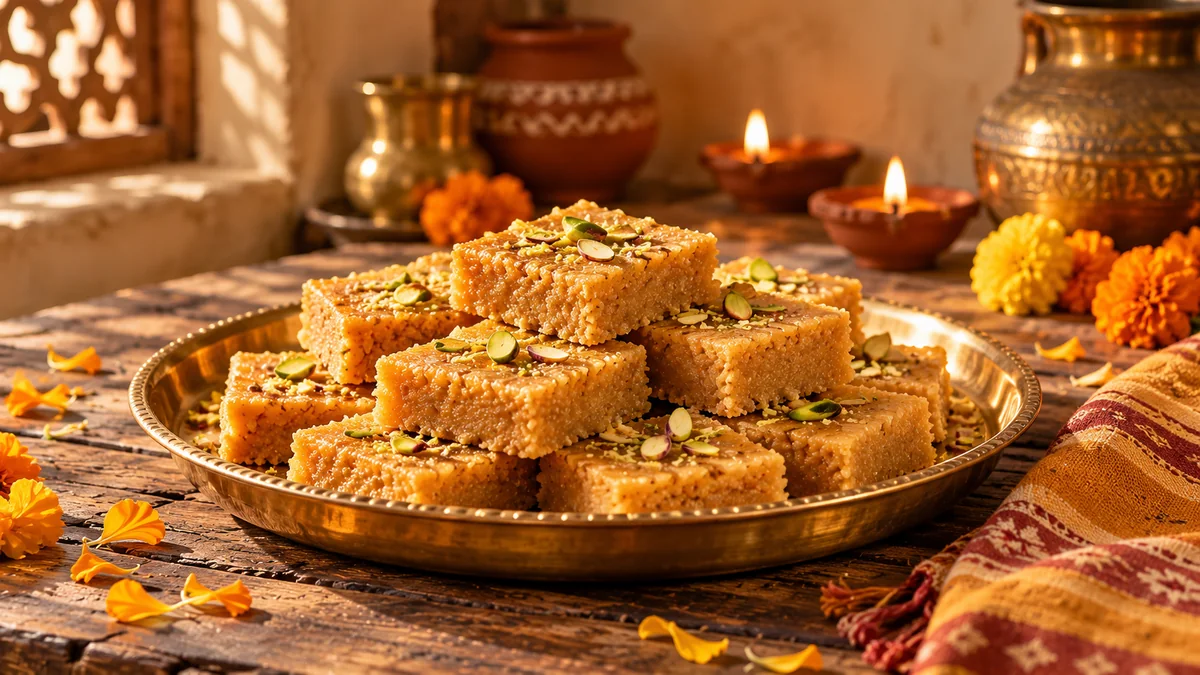
Besan chakki is made by roasting coarse besan slowly in plenty of ghee until it smells nutty, mixing it with a one-string sugar syrup, and setting it in a thali before cutting. The coarse besan, the low flame and the syrup are what decide whether it turns out right.
In the week before Diwali, many Shekhawati kitchens have a thali of besan chakki cooling on the floor, covered with a cloth to keep the flies off. This besan chakki recipe is the way it is made in our village: coarse besan, plenty of ghee, slow roasting and a sugar syrup cooked to exactly one string. It is a simple sweet with very few ingredients, which is why every small step shows in the final piece.
Chakki is the Rajasthani cousin of besan barfi, but firmer and more grainy. You should be able to see the texture of the besan when you break a piece. In winter, many of the same kitchens also roast a big kadai of panjiri, so we have added a short section on that at the end.
What makes a good besan chakki
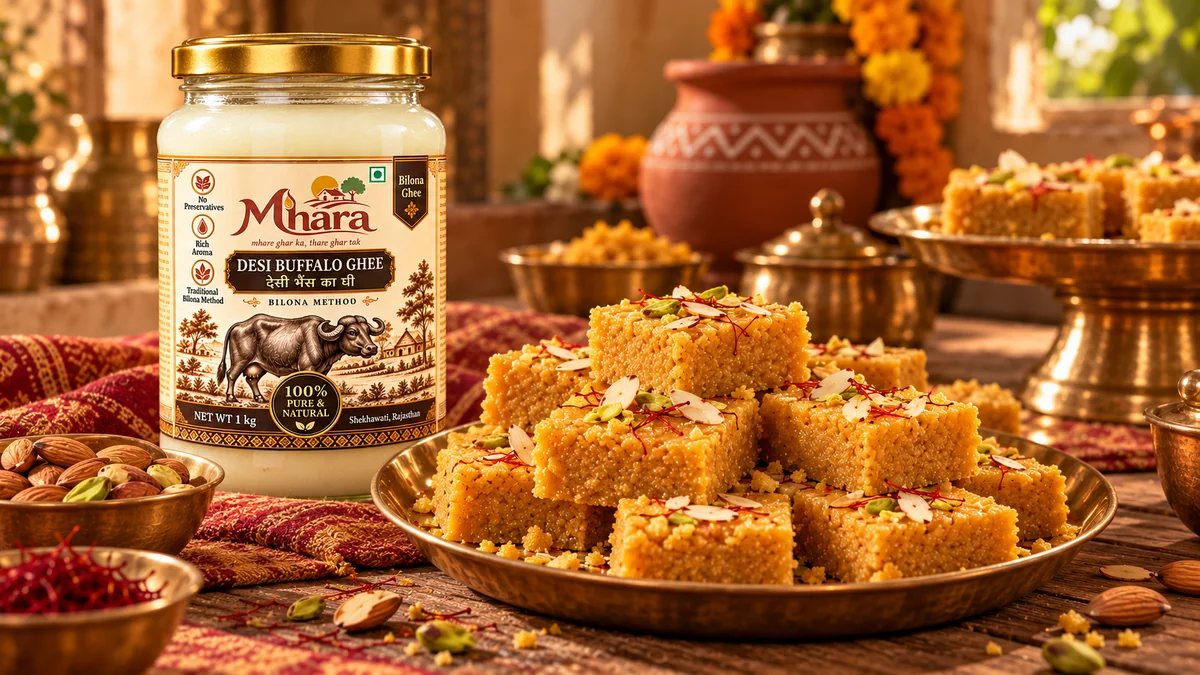
A good piece of chakki cuts clean, holds its shape on a plate and breaks into soft grains in the mouth. It should taste of roasted besan and ghee, with sugar in the background, not the other way round. The colour is a light golden brown, never dark.
Three things decide this. The besan has to be coarse. The roasting has to be slow. And the syrup has to stop at one string. If you get these three right, the rest is easy.
Choosing the besan and the ghee
Ask the shop for mota besan or chakki besan. It feels a little sandy between the fingers. Fine besan, the kind used for pakoras, also works, but the chakki comes out pasty and sticks to the teeth. If fine besan is all you have, mix in two tablespoons of sooji for every two cups. It gives back some of the grain.
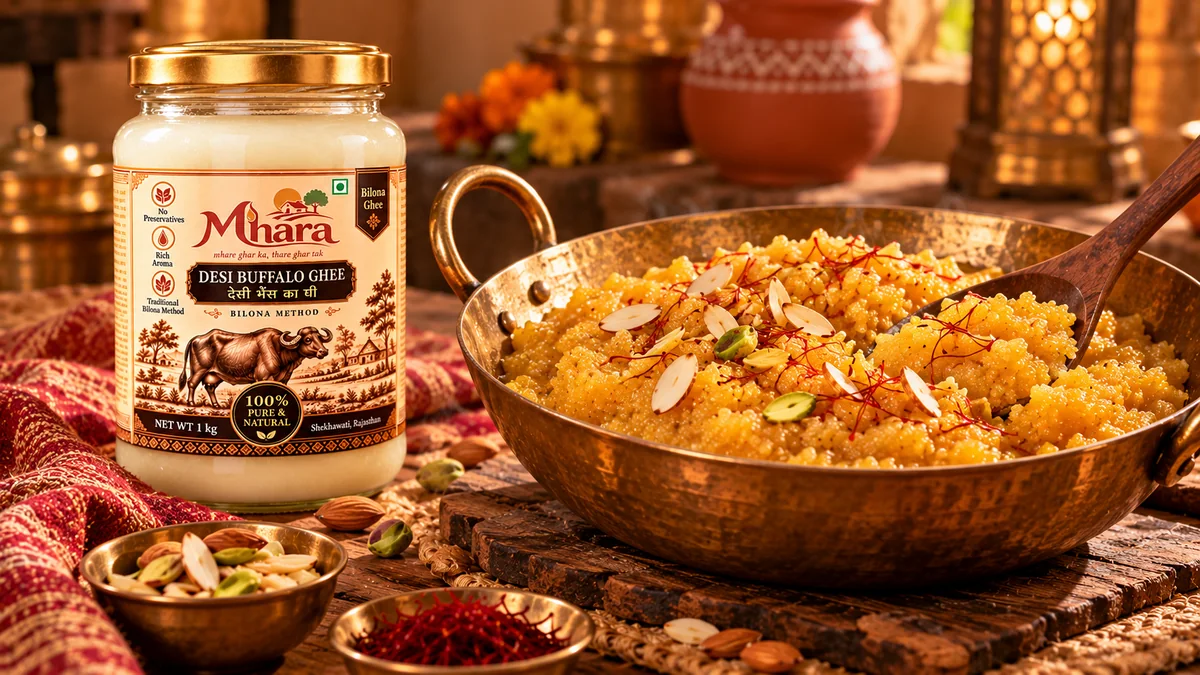
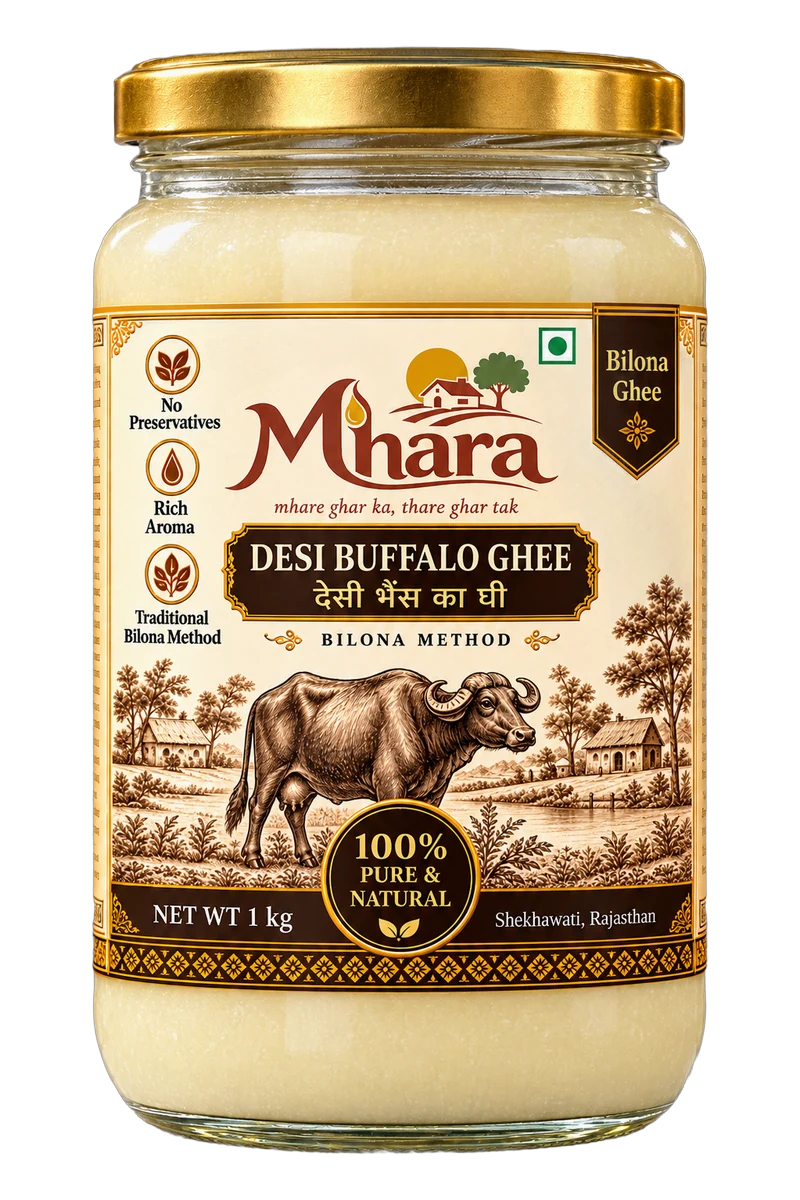
For the ghee, most homes here use buffalo ghee for sweets. It is richer and creamier, and because buffalo milk fat sets at a higher temperature, the chakki sets firm and holds its edges even in a warm room. The colour stays pale and clean. Cow bilona ghee works just as well and gives a deeper, nutty aroma and a more golden piece. Some families use half and half. We explain why the two behave so differently in cow ghee vs buffalo ghee.
Do not cut down on ghee for this sweet. The besan soaks it up while roasting, and too little ghee is the main reason for chakki that tastes raw or turns hard after a day.
Dhaba, the step most besan chakki recipes skip
Before roasting, our elders always gave the besan a dhaba. You rub a little ghee and a little milk into the dry besan with your fingertips until it looks like damp sand, cover it and leave it for twenty to thirty minutes. Then you press it through a coarse sieve, or rub it between your palms, to break any lumps.
Why bother? The small amount of moisture swells the besan grains. When they hit hot ghee, they roast into tiny, separate crumbs instead of a smooth paste. That is where the grainy, danedar bite of good chakki comes from. Skip the dhaba and you get something closer to a soft barfi.
Roasting till the aroma changes
Use a heavy kadai and keep the flame low from start to end. Melt the ghee, add the besan and keep stirring, scraping the bottom every few seconds. A wooden khurchi or a flat steel spatula is best for this.
For the first ten minutes nothing much seems to happen. The mixture is thick and pale. Then it loosens, starts to bubble, and the smell shifts from raw flour to something like roasted nuts. The colour moves from yellow to light golden brown. The whole thing takes twenty to twenty five minutes for two cups of besan. In our kitchen the rule is simple: you smell it before you see it. When the whole room smells of roasted besan, you are close.
If you turn up the flame to save time, the outside of each grain browns while the inside stays raw. The chakki will taste bitter at the edges and floury in the middle. There is no fixing that later.
The one-string syrup, and how to test it
Start the syrup in the last few minutes of roasting, so it is ready when the besan is. Sugar and water go into a separate pan, and you boil it till it reaches one string, ek taar ki chashni. Dip a spoon, let it cool for a few seconds, and touch a drop between your thumb and first finger. Pull them apart gently. If one thin thread forms and breaks, it is ready.
This is where most chakki goes wrong. Syrup that is too thin and the chakki never sets. You wait for hours and it stays soft like halwa. Syrup cooked past two strings and the chakki sets in minutes, before you can level it, and turns hard and crumbly. If you are unsure, take it off at one string. A thin batch can be saved by putting the mixture back on a low flame for a few minutes. A hard batch cannot be saved.
Let the roasted besan cool for three or four minutes before the syrup goes in. Hot ghee and hot syrup together spit, and the steam can burn your hand.
Setting and cutting the chakki
Pour the syrup into the besan in a thin stream, stirring fast. The mixture will hiss and bubble, then start to thicken and pull away from the sides of the kadai. This takes one or two minutes. Add the cardamom and pour it at once into a greased thali or tray. Spread it about half an inch (1 to 1.5 cm) thick and level the top with the back of a katori.
Press the sliced almonds and pistachios on top. After fifteen minutes, while it is still warm, mark the squares or diamonds with a knife. Then leave it alone for two to three hours. Cut along the marks and lift the pieces out. If you try to cut too early, the pieces break. If you wait till it is fully cold without marking it first, the edges crack.
In December the chakki sets faster and harder, because the ghee in it firms up in a cold room, the same thing you see in a jar. We wrote about that in why ghee solidifies in winter.
Winter panjiri in the same kadai
Once Diwali is over and the mornings turn cold, the same kadai comes out again for panjiri. It is a loose, sweet, roasted mixture eaten by the spoon, mostly in the morning with tea or milk. Every family has its own version. Ours is short:
- Roast one cup of whole wheat atta in half a cup of ghee on a low flame for twelve to fifteen minutes, till it turns brown and smells nutty.
- Fry two tablespoons of edible gond in a little hot ghee until it puffs up, then crush it with a katori.
- Add a handful of chopped almonds and roasted makhana.
- Let the atta cool completely, then mix in about three quarters of a cup of boora or powdered sugar.
The sugar must go in only after the atta has cooled. In warm atta it melts, makes lumps and the panjiri goes sticky. Kept in a dry, closed jar, panjiri lasts three to four weeks. If you also make dal baati at home, the churma recipe uses the same roast-in-ghee idea with wheat.
How long besan chakki keeps, and how to store it
Store the cut pieces in a steel or glass box with a tight lid, with butter paper between the layers so they do not stick. Never close the box while the pieces are still warm, or steam collects inside and the chakki goes soft and spoils faster.
At room temperature it keeps well for ten to twelve days in winter and about a week in warm weather. In summer you can keep it in the fridge for longer, and take it out half an hour before serving so the ghee softens again. If it ever smells sour or stale, throw it out. The ghee itself follows the same rules we give in how to store ghee: dry spoon, closed lid, away from steam.
Recipe card
Ingredients
- 2 cups (250 g) coarse besan (mota or chakki besan)
- 2 tbsp ghee and 3 tbsp milk, for the dhaba
- 3/4 cup (about 150 g) buffalo ghee or cow bilona ghee, for roasting, plus 1–2 tbsp extra if needed
- 1 1/4 cups (250 g) sugar
- 1/2 cup (120 ml) water
- 1/2 tsp green cardamom powder
- 2 tbsp slivered almonds and pistachios
- A little ghee to grease the thali
Method
- Rub 2 tbsp ghee and 3 tbsp milk into the besan with your fingertips until it looks like damp sand. Cover and rest for 20–30 minutes.
- Press the besan through a coarse sieve, or rub it between your palms, to break all the lumps.
- Grease a 10-inch thali or tray and keep it ready.
- Melt 3/4 cup ghee in a heavy kadai on a low flame. Add the besan and roast, stirring and scraping the bottom all the time, for 20–25 minutes, until it loosens, turns light golden brown and smells nutty. Add 1–2 tbsp more ghee if it looks dry.
- Take the kadai off the flame and let the besan cool for 3–4 minutes.
- Meanwhile, boil the sugar and water in another pan until the syrup reaches one string (about 6–8 minutes after it starts boiling).
- Pour the syrup into the besan in a thin stream, stirring fast. Keep stirring for 1–2 minutes until the mixture thickens and leaves the sides. Mix in the cardamom.
- Pour into the greased thali, spread about 1–1.5 cm thick and level the top. Press the almonds and pistachios on top.
- After 15 minutes, while still warm, mark squares or diamonds with a knife.
- Leave to set for 2–3 hours, then cut along the marks and lift the pieces out. Store in an airtight box.
Questions people ask
Why did my besan chakki not set?
The syrup was most likely too thin, below one string. Put the mixture back in the kadai on a low flame and stir for a few minutes until it thickens and leaves the sides, then pour it out again.
Why is my besan chakki hard and crumbly?
The syrup was cooked past one string, or too little ghee went into the roasting. Next time take the syrup off at one string and do not cut down on ghee, because the besan needs it to stay soft.
Can I make besan chakki with fine besan?
Yes, but it comes out smoother and a little pasty. Mix two tablespoons of sooji into every two cups of fine besan and give it a dhaba with ghee and milk before roasting to get some grain back.
Which ghee is best for besan chakki?
Buffalo ghee gives a rich, pale chakki that sets firm and holds its edges. Cow bilona ghee gives a deeper aroma and a more golden colour. Both work well, and some homes mix the two.
How long does besan chakki last?
In an airtight box at room temperature it keeps for ten to twelve days in winter and about a week in warm weather. In summer the fridge keeps it longer; bring it to room temperature before serving.
What is the difference between besan chakki and besan barfi?
They use the same ingredients. Chakki is made with coarse besan given a dhaba, so it is firmer and grainy, while besan barfi is usually softer and smoother, often with fine besan or mawa.