
Best ghee for Indian sweets: why halwais reach for buffalo ghee
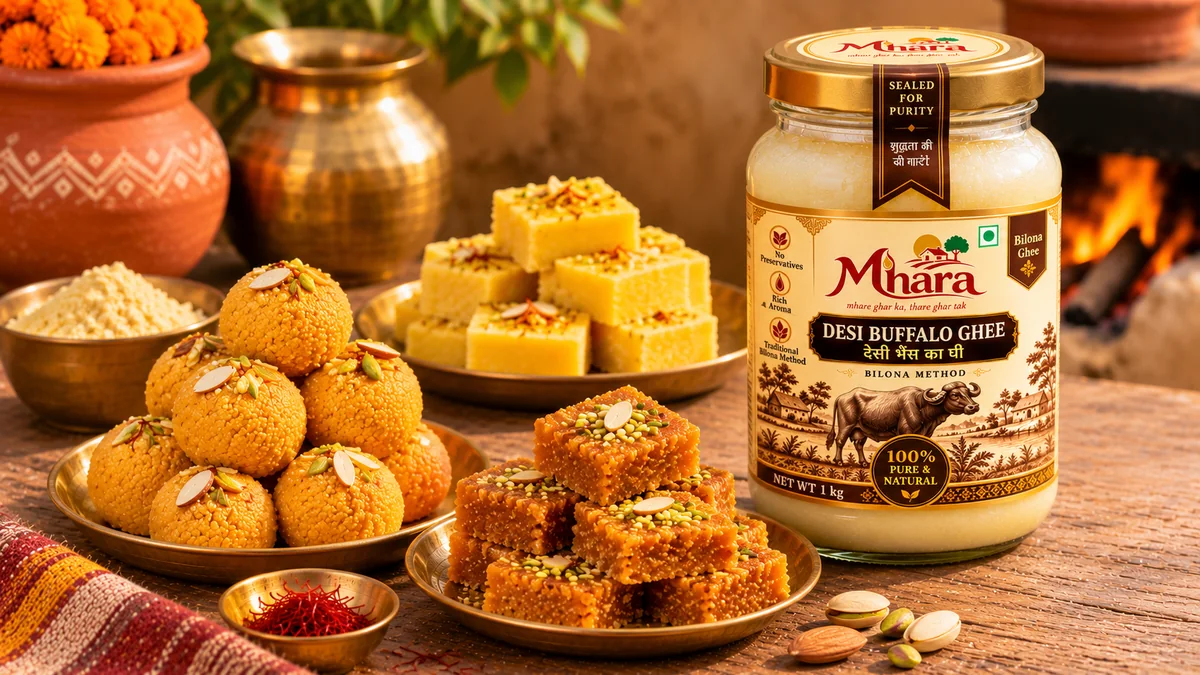
The best ghee for sweets is usually buffalo ghee. It is white, mild and rich, and it sets firm, so laddoo hold their shape, barfi cuts clean and milk sweets stay pale. Cow ghee is the better choice where aroma is the point, as in sooji halwa, lapsi, panjiri and prasad. Many cooks use both.
Two days before a wedding in our village, the halwai arrives with his own karigars and sets up a bhatti in the courtyard. The big iron kadhai goes on first, then the tins are opened. Almost always, the first tin is buffalo ghee, white and thick as fresh malai. The yellow cow ghee stays in the house kitchen, for the dal and the rotis. Nobody explains this. Everybody just knows it.
So if you are asking which is the best ghee for sweets, the honest answer is that it depends on the sweet. For most mithai, especially milk sweets, laddoo and barfi, buffalo ghee does the job better. For a few sweets where the smell of ghee is the whole point, cow ghee wins. Here is how to tell which is which.
Best ghee for sweets: the short answer
- Buffalo ghee for barfi, kalakand, laddoo, churma, mohanthal, besan chakki, ghevar and most halwai-style mithai.
- Cow ghee for sooji halwa, atta halwa, lapsi, panjiri and prasad, where you want the deep, nutty aroma to come through.
- Half and half when you want both: the body of buffalo ghee and the smell of cow ghee.
If you want the full comparison of colour, taste, fat and price, we have written it in cow ghee vs buffalo ghee. This post stays on one question: what happens to a sweet when you change the ghee.
Why halwais reach for buffalo ghee
Colour
Buffalo ghee is white or ivory. In a milk barfi, kalakand or a pale besan laddoo, that keeps the sweet looking clean and creamy. Cow ghee is yellow, and in a white sweet that tint shows. It is not a fault, but a halwai selling barfi by the tray wants it to look the way people expect.
Mouthfeel
Buffalo milk is richer, and the makkhan comes up heavy on the bilona. The ghee it gives tastes rounder and fuller. Inside a laddoo or a piece of churma, it coats the tongue and gives that soft, melt-in-the-mouth feel people describe as bhara hua. Once clarified, both ghees are almost all fat, so the difference is in texture and taste more than in the numbers.
It sets firm
Buffalo ghee sets at a higher temperature than cow ghee. That is useful in mithai. Barfi cuts clean, laddoo hold their round shape on a warm day, and mohanthal sets into neat squares. With cow ghee, the same laddoo can feel softer and a little oily in summer.
A mild flavour that lets the sweet lead
Buffalo ghee is mild and milky. It stays in the background and lets kesar, elaichi, roasted besan or khoya do the talking. Cow bilona ghee has a strong sondhi smell, which is lovely on a roti but can compete with a delicate kesar barfi.
Cost when you cook in bulk
Buffalo milk carries more fat, so fewer litres go into each kilo of ghee, and buffalo ghee usually costs a little less than cow bilona ghee. For a halwai going through tins in a wedding week, that adds up.

Where cow ghee is the better choice
Some sweets are really about the ghee itself. In those, the aroma of cow ghee is the flavour:
- Sooji halwa (sheera) made as prasad. The smell of sooji roasting in cow ghee is what people remember.
- Atta halwa and kada prasad, where only atta, ghee and sugar go in, so the ghee has nowhere to hide.
- Lapsi, the broken-wheat halwa of Rajasthan, which tastes flat without that nutty smell.
- Panjiri and atta laddoo for winter, where many homes like the yellow colour and the stronger taste.
Puja food is another reason. Many families prefer cow ghee for anything offered at the mandir, as a matter of tradition rather than cooking.
Which ghee for which sweet
This is how most kitchens in our village decide. Treat it as a starting point, not a rule.
- Besan laddoo and mohanthal: buffalo ghee for a soft, rich, grainy laddoo. Our mohanthal recipe and besan ladoo recipe both work well with it.
- Boondi laddoo: buffalo ghee or a mix. The boondi are fried, so you need a lot of ghee, and the mild taste suits the syrup.
- Churma and besan chakki: buffalo ghee, or half and half.
- Milk barfi, kalakand, khoya sweets: buffalo ghee, for the white colour.
- Ghevar, balushahi and other fried sweets: buffalo ghee, mostly for cost and a clean taste.
- Gajar or moong dal halwa: either. Buffalo ghee gives a richer halwa, cow ghee a more fragrant one.
- Sooji halwa, atta halwa, lapsi, panjiri: cow ghee.
For a whole festival list with methods, see the sweets we make with desi ghee every Diwali.
Mixing the two, and the winter problem
Many good home cooks use both. A common way is to roast the besan or atta in buffalo ghee, then add a few spoons of melted cow ghee at the end for aroma. You get the body and the smell.
Winter needs one adjustment. Because buffalo ghee sets firm, laddoo made with it can turn quite hard in a cold kitchen in December. That is not a fault in the ghee. Shape them while the mixture is still warm, keep them away from a cold window, and if your house is very cold, use part cow ghee in the mix. Why ghee hardens in the cold is explained in why ghee solidifies in winter.
How much ghee do sweets really take?
People are often surprised at how much ghee mithai needs. These are rough household ranges, and recipes vary:
- Besan laddoo: about 1 cup of ghee for 2 cups of besan.
- Sooji halwa: ½ to 1 cup of ghee for 1 cup of sooji, depending on how rich you like it.
- Gond or atta laddoo: close to 1 cup of ghee for 2 cups of atta.
- Moong dal halwa: ¾ to 1 cup of ghee for 1 cup of dal.
- Fried sweets: enough ghee for the pieces to float, often 1 to 2 litres in a wide kadhai.
Cutting the ghee too far is the most common reason home sweets turn dry or crumbly. If you want less, make fewer pieces rather than thinner ones.
Buying ghee for a sweets season
Whichever ghee you choose, make sure it is real desi ghee. Shop mithai is sometimes made with vanaspati or a blend, which gives a waxy feel on the tongue. We explain the difference in desi ghee vs vanaspati.
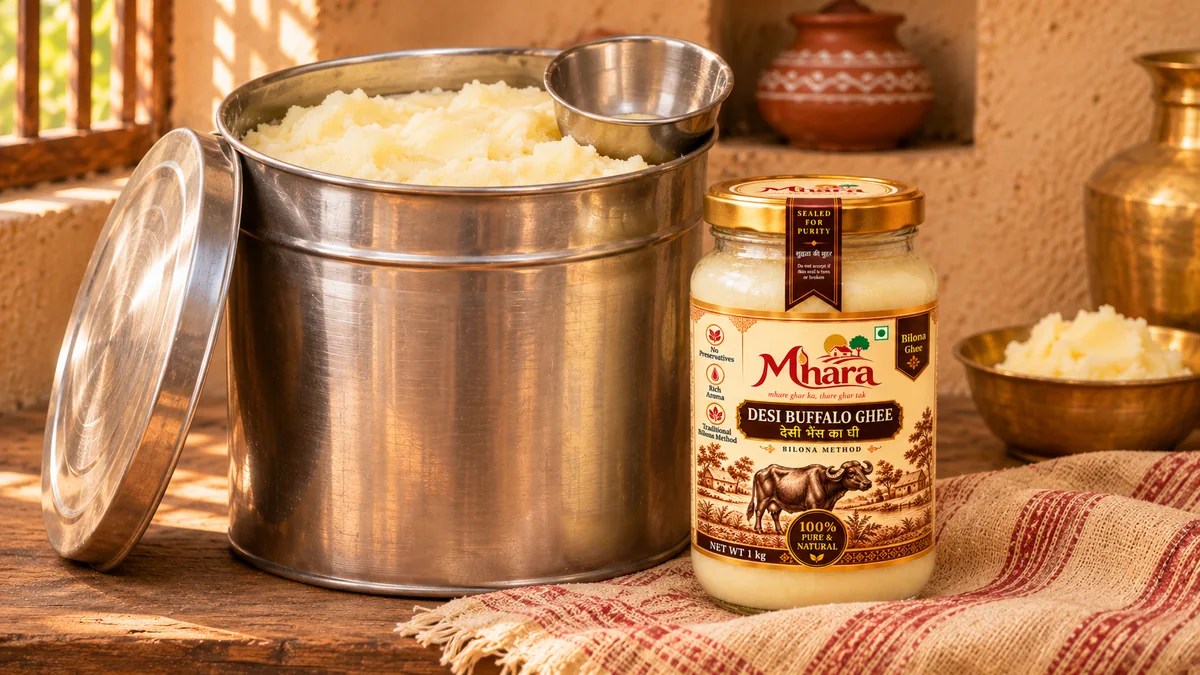
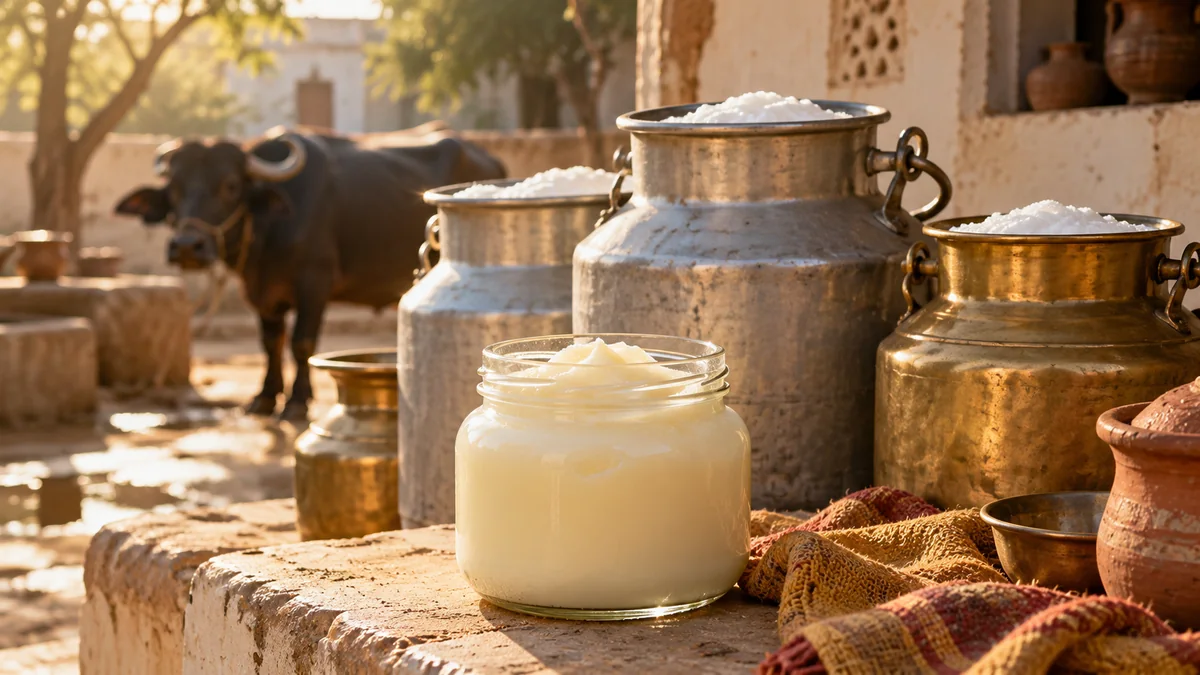
Our Desi Buffalo Ghee is made in village kitchens near Pilani from whole buffalo milk set to curd in a clay matka, churned by hand with a wooden bilona and cooked slowly over a wood and kanda fire. It comes white, rich and thick, which is exactly what the best ghee for sweets should be.
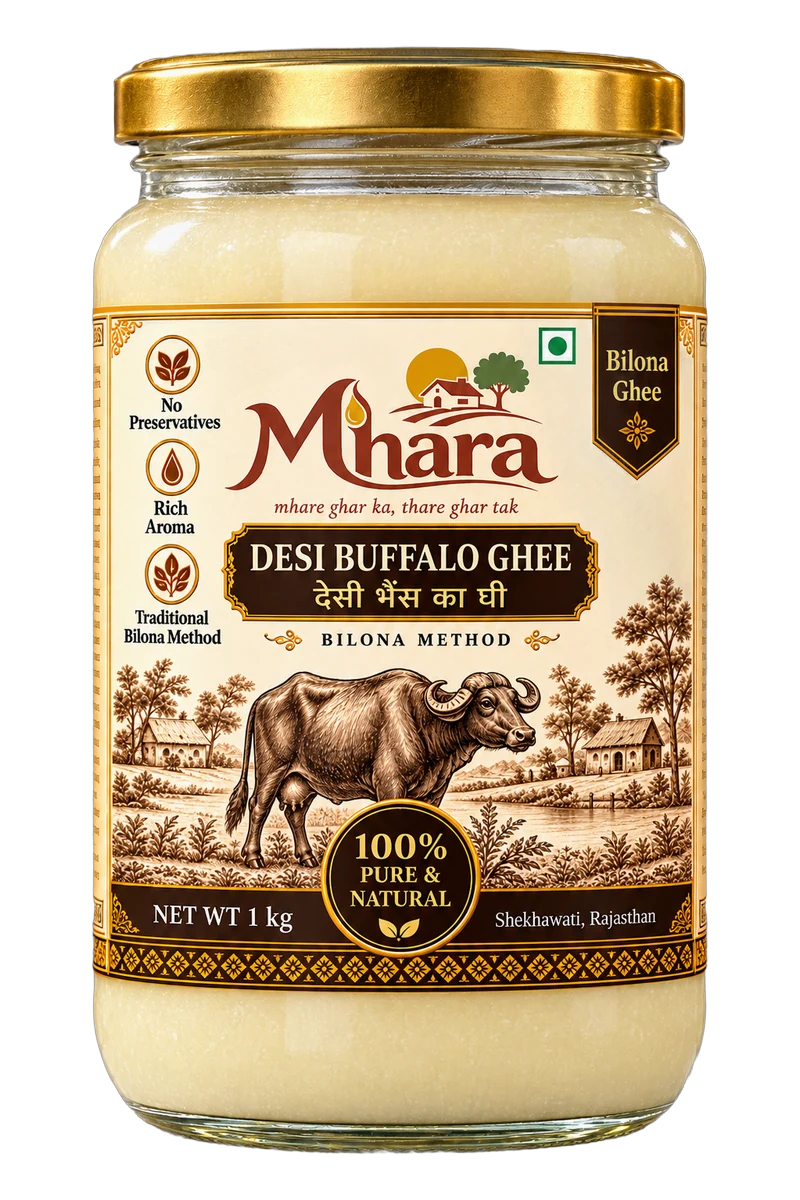
For a family making laddoo for Diwali or winter, a 1 litre glass jar (₹1,899) is usually enough. If you make sweets often or are cooking for a function, the 2 litre steel tin (₹3,699) or 5 litre steel tin (₹8,999) works out more practical. If you also want the aroma for halwa and prasad, keep a 500 ml jar of Desi Cow Bilona Ghee (₹1,099) beside it.
Questions people ask
Why do halwais use buffalo ghee?
Buffalo ghee is white, mild and rich, and it sets firm at room temperature. That keeps milk sweets pale, helps laddoo and barfi hold their shape, and lets kesar and elaichi lead the flavour. It also usually costs a little less than cow bilona ghee, which matters in bulk.
Can I use cow ghee for barfi and laddoo?
Yes. Cow ghee gives a softer laddoo with a stronger, nutty aroma and a light yellow tint. In white milk barfi the colour shows, and in summer cow-ghee laddoo can feel a little oily. Many cooks roast in buffalo ghee and add some cow ghee at the end.
Which ghee is best for sooji halwa?
Most homes prefer cow ghee for sooji halwa, especially when it is made as prasad. The halwa has only sooji, ghee, sugar and water, so the nutty smell of cow ghee becomes the main flavour. Buffalo ghee makes a richer but milder halwa.
Why do my laddoo turn hard in winter?
Ghee sets firm in the cold, and buffalo ghee sets earlier than cow ghee. Laddoo kept in a cold kitchen can become quite hard. Shape them while the mixture is warm, store them away from cold windows, and in a very cold house use part cow ghee.
How much ghee do I need for 1 kg of besan laddoo?
As a rough household guide, besan laddoo take about one cup of ghee for every two cups of besan. For a batch of around a kilo, plan on roughly 300 to 400 grams of ghee. Recipes vary, so adjust by how the mixture binds.
Is buffalo ghee good for deep-frying sweets?
Yes. Halwais often fry ghevar, balushahi and boondi in buffalo ghee because it handles high heat well, tastes clean and usually costs less in large amounts. Strain the ghee after frying and store it covered if you plan to use it again soon.