
Why ghee looks whiter in winter and more yellow in summer
A ghee colour change between seasons is normal. In winter, ghee sets and its tiny fat crystals scatter light, so it looks paler; melted ghee is clear and shows its true gold. Cow ghee also turns yellower when cows eat more green fodder, which carries beta-carotene. Neither change means the ghee is adulterated.
Put the same jar of cow ghee on a kitchen shelf in Shekhawati in May, and it looks like dark honey: clear, liquid, deep gold. Look at a jar from the same kind of batch in January, and it is set soft and pale, closer to the colour of fresh makkhan than to gold. Every winter somebody writes to us asking whether we have changed our ghee. We have not. The ghee has changed its look, and there are good, simple reasons for it.
Ghee colour change: the two main reasons
Most of the ghee colour change you see between seasons comes from two things working together:
- Whether the ghee is solid or liquid in your kitchen today. This is the bigger effect, and it changes week to week with the weather.
- What the cows were eating when the milk was made into ghee. This changes batch to batch through the year.
A third, smaller factor is how long and how hot the makkhan was cooked. We take them one at a time.
Solid ghee looks paler than liquid ghee
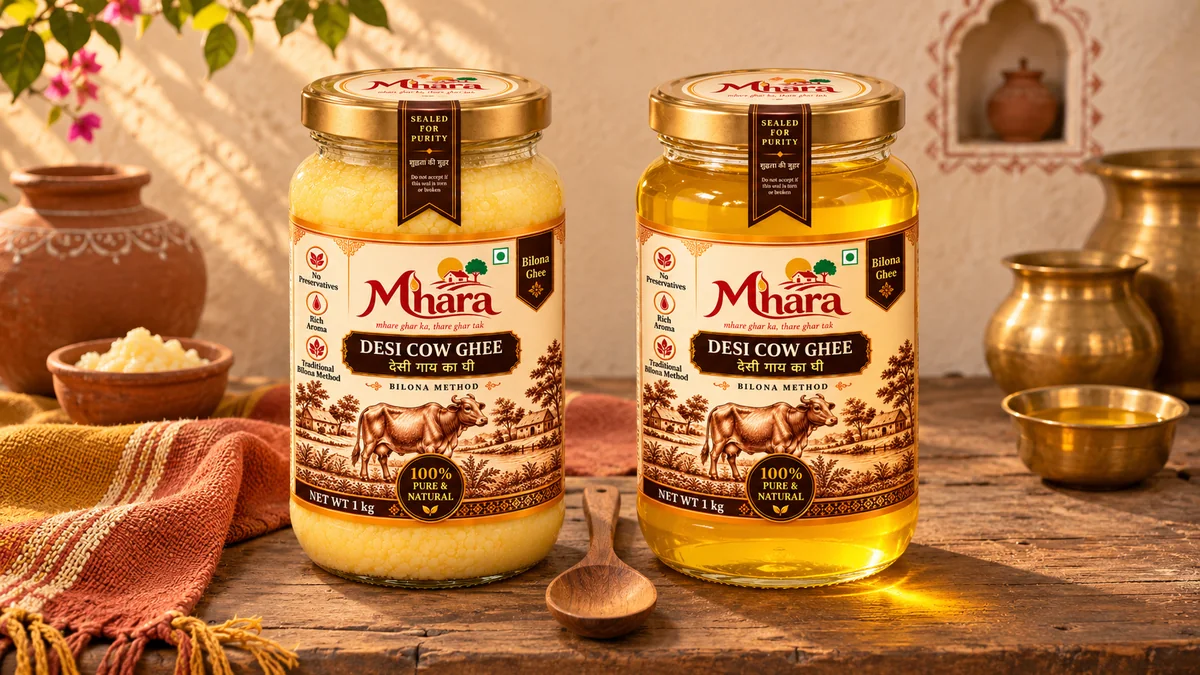
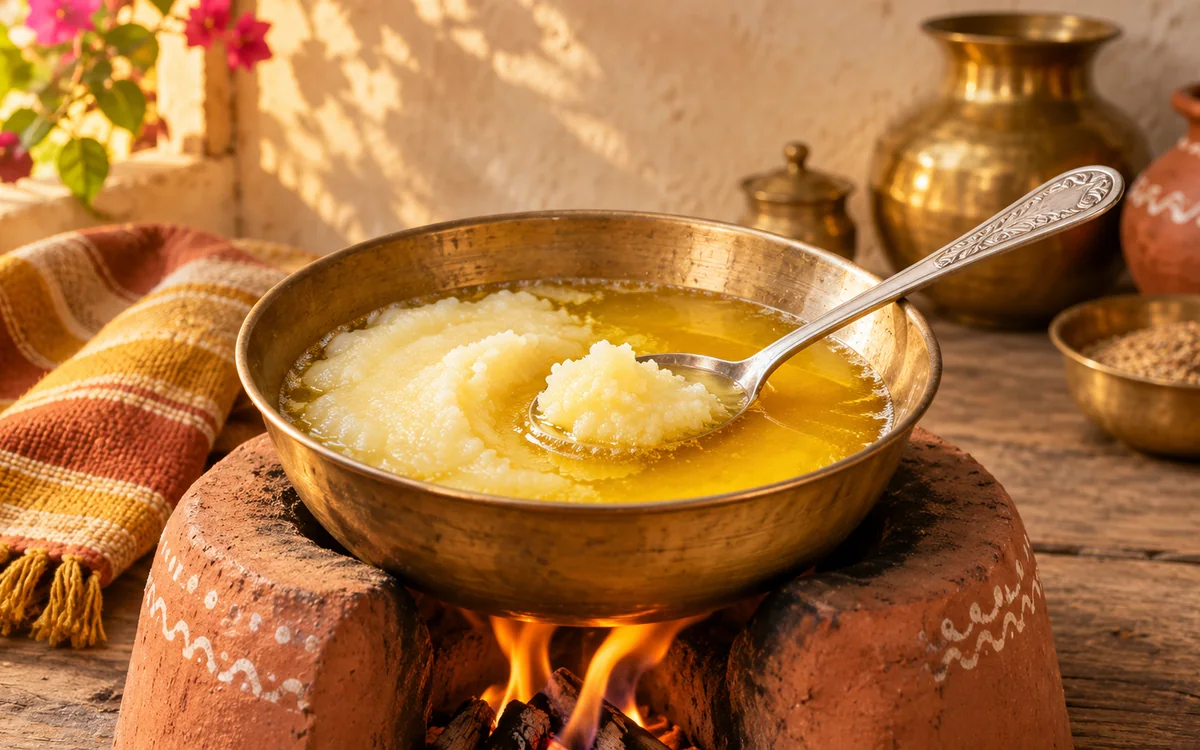
When ghee melts, it is a clear liquid, and you see its true colour all the way through, the way you see the colour of a glass of tea. When it sets, the fat forms countless tiny crystals. Those crystals scatter light, the way frost looks white even though it is only water. The colour is still there, but it is spread through a pale, cloudy mass, so the jar looks lighter, creamier and sometimes almost white.
You can test this in ten seconds. Take a spoon of your pale winter ghee and warm it gently in a katori. As it melts, the golden colour comes back. Nothing has been added and nothing has been removed.
So when people say ghee is "more yellow in summer", much of what they are seeing is simply liquid ghee. In Shekhawati, ghee stays liquid from roughly April to September and starts to set when the nights cool in October. Why it sets, and why grains form, is a separate question that we answer in why ghee solidifies in winter.
What the cow eats changes the colour of the fat
The yellow in cow ghee comes from beta-carotene, the same pigment that colours carrots. Cows eat it in green fodder and pass part of it into their milk fat. More fresh green fodder usually means more beta-carotene in the milk and a deeper yellow ghee. More dry fodder, such as bhusa and straw, usually means a paler ghee.
In our dry part of Rajasthan, green grass and green fodder are most plentiful during and after the rains, and less so in the hot, dry months before them. So in our village the deepest yellow ghee tends to come from milk in the months after the monsoon, and a pale batch in a dry month is perfectly normal. Every farmer feeds a little differently, so this is a pattern, not a rule. We go into feed, breeds and colour in what a desi cow eats, and why it changes the ghee.
This is why the honest answer to "why is my summer ghee yellower" is usually "because it is liquid", while the answer to "why is this batch paler than the last" is often "because of the fodder".
Why buffalo ghee stays white all year
Buffalo eat much the same fodder, but they convert most of the beta-carotene into vitamin A before it reaches the milk fat. So buffalo ghee is white or ivory in every season. When it melts, it turns a pale, clear straw colour, never the deep gold of cow ghee.
If you buy ghee that is a mix of cow and buffalo milk, it will sit somewhere in between. We compare the two side by side in cow ghee vs buffalo ghee.
Cooking time, heat and storage also play a part
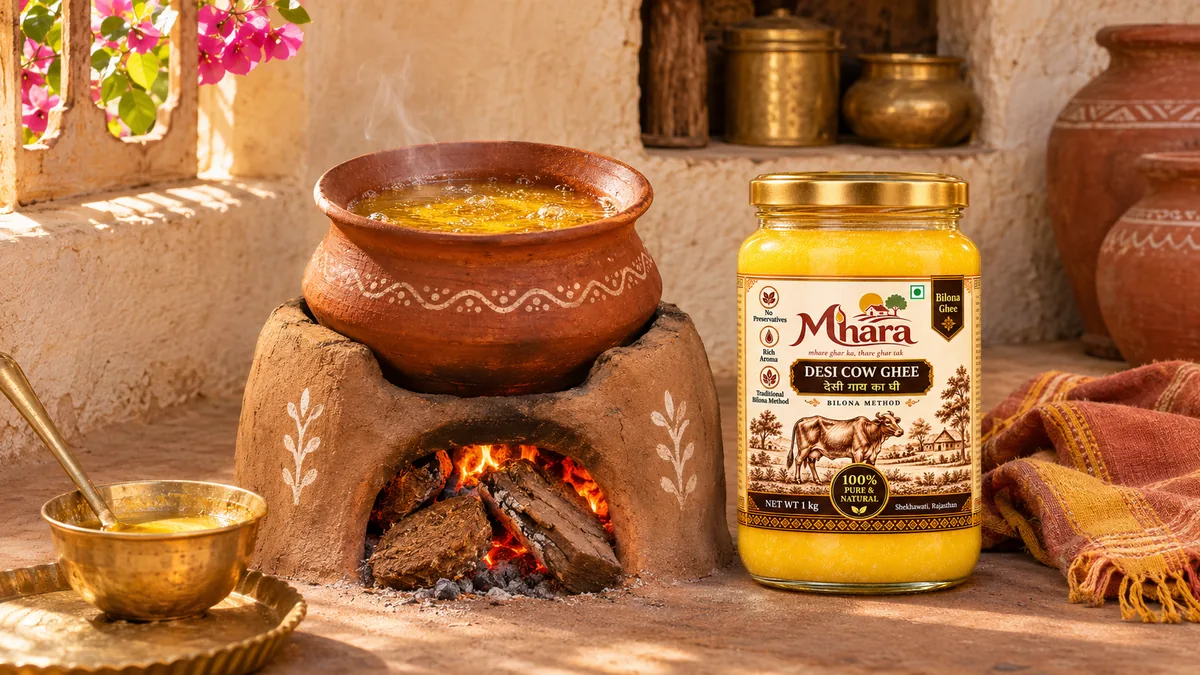
- Cooking: when makkhan is cooked longer or a little hotter, the milk solids brown more and the ghee comes out a shade deeper, with a stronger aroma. A gently cooked batch is lighter. In bilona ghee cooked slowly on a wood and kanda fire, small differences between batches are normal.
- Grains: ghee that sets slowly in mild cold forms visible grains, and grainy ghee looks lighter than smooth set ghee.
- Light and age: ghee kept in strong light for a long time can slowly lose some colour and flavour. This is one reason to store it in a dark cupboard, as we explain in how to store ghee.
Is a ghee colour change a sign of adulteration?
Not by itself. A change in colour between seasons, or between batches, is what real ghee from real cows does. White winter ghee is not bleached, and deep yellow ghee after the rains is not coloured.
The flip side matters just as much: colour cannot prove ghee is pure. Colour can be added to almost anything, and a ghee that is the same bright yellow in every jar, every month, is not a reason for comfort. Judge ghee by its smell, its taste and how it melts. Our guide to home tests for pure ghee covers what those tests can and cannot tell you.
Signs that something is actually wrong are a sharp, stale or soapy smell, a bitter taste, or mould, which only appears when water has got into the jar. A change in colour alone is not on that list.
What our ghee looks like through the year
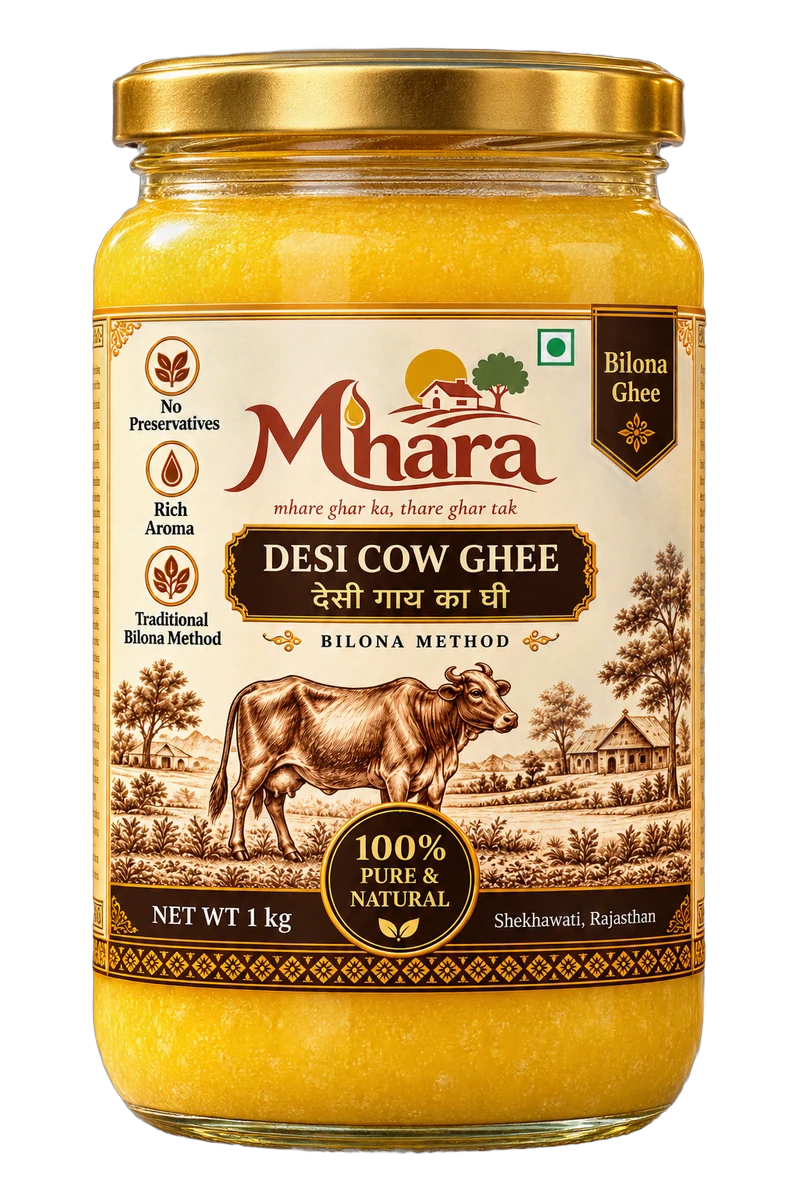
Our desi cow bilona ghee is made in village kitchens near Pilani in small weekly batches, from the milk of desi cows kept by the households themselves. Because it is made every week, it follows the seasons:
- Summer: liquid and clear, light gold to deep gold depending on the fodder.
- After the rains: often the deepest yellow of the year.
- Winter: set soft, pale cream to light yellow in the jar, golden again the moment it melts in the pan.
Our buffalo ghee stays white, thick and creamy all year.
If you buy two jars at once in winter, one may arrive fully set and the other half set, depending on where each sat on the journey and where it sits on your shelf. That too is temperature, not quality, and both will look the same once they melt in the pan.
If you notice a ghee colour change from one jar to the next, take it as a sign that the ghee came from real animals in a real season. Melt a spoon, smell it, and taste it on a hot roti. That will tell you more than the colour ever can.
Questions people ask
Why has my ghee turned white?
Most likely it has set in the cold. Solid ghee forms tiny fat crystals that scatter light, so it looks pale or almost white. Melt a spoon in a katori: if it turns clear and golden and smells clean, the ghee is fine.
Is yellow ghee better than white ghee?
No. Yellow cow ghee gets its colour from beta-carotene in green fodder, and white buffalo ghee is white because buffalo convert it to vitamin A. Both are real ghee. Choose by taste and use, not by colour.
Does the colour of ghee show its purity?
No. Colour can be added to almost anything, and real ghee changes colour with season and fodder. Judge ghee by its smell, taste and how it melts. A ghee that is the same bright yellow every month is not proof of purity.
Why is my new jar of ghee paler than the last one?
Often because of fodder. Cows on more dry fodder give paler milk fat than cows on fresh green fodder. Kitchen temperature, cooking time and grain size also change the look. A paler batch is normal if it smells and tastes good.
Why does ghee turn darker when cooked longer?
When makkhan is cooked longer or hotter, the milk solids brown more and the ghee picks up a deeper amber shade and stronger aroma. Gently cooked ghee is lighter. Small batch-to-batch differences are normal in slow-cooked bilona ghee.
Can ghee lose its colour over time?
It can fade a little if kept in strong light for a long time, along with some flavour. Store ghee in a dark cupboard with the lid closed. Fading alone is not spoilage; a sharp, stale or soapy smell is.