
Gajar ka halwa recipe with milk and desi ghee (no khoya needed)
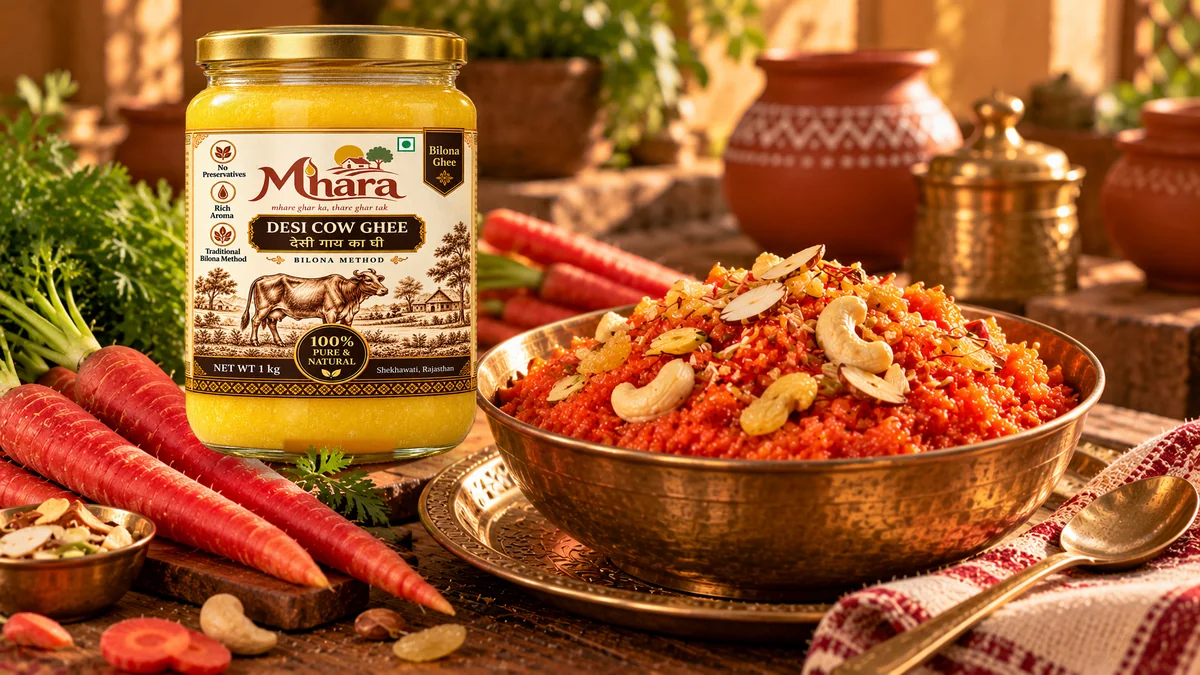
This gajar ka halwa recipe cooks grated red carrots in full-cream milk for 40 to 50 minutes until the milk is absorbed, then adds desi ghee and sugar and cooks it dry and glossy. Finish with cardamom, nuts and raisins. The slow-cooked milk gives the richness, so khoya is optional.
When the red carrots arrive at the sabzi mandi in Jhunjhunu, every kitchen in the village knows what Sunday looks like. Someone buys a kilo too many, the women sit in the winter sun in the angan with steel graters and a big parat, fingers turn orange, and by afternoon the kadhai of milk and carrots is bubbling on the stove. This gajar ka halwa recipe is how we make it in our kitchen: carrots cooked slowly in full-cream milk until it disappears, then ghee and sugar, then cardamom and nuts.
No khoya, no condensed milk, no shortcuts that change the taste. Just one long, easy cook, and two things, ghee and sugar, that must not go in too early.
Which carrots make the best gajar ka halwa?
The long red carrots, often called Delhi carrots, are the ones. They are juicy, sweet, and turn the halwa that deep red colour. They are in season roughly from November to February, and they are at their best in December and January.
The orange carrots sold all year also work. The halwa is paler and a little less sweet, so you may want a spoon more sugar. If Diwali on 8 November comes before the red carrots reach your market, use orange ones without guilt. It is still gajar halwa.
A few buying tips:
- Choose firm, thin-to-medium carrots. Very thick ones often have a hard, woody core.
- Avoid carrots that bend or look dry. Those have lost their juice and sweetness.
- Taste a raw slice. If it is sweet, your halwa will be too.
Peel them, trim the ends and grate them on the large holes of the grater. Finely grated carrots turn mushy. A food processor with a grating disc saves an hour, but the hand-grated halwa has a better bite.
Gajar halwa with milk: the slow first stage
Put 1 kg of grated carrots and 1 litre of full-cream milk in a heavy, wide kadhai. Bring it to a boil, then lower the flame to medium and let it cook. Stir every few minutes, scraping the bottom and the sides, where milk solids collect. Those bits are good. Scrape them back in.
It takes 40 to 50 minutes for the milk to be fully absorbed. The carrots soften, the milk thickens into something like rabdi, and then it is gone. When you draw the spatula through the kadhai and no milk runs back into the gap, this stage is done.
A wide kadhai matters more than you think. In a narrow, deep pot the milk takes far longer to reduce and catches at the bottom.
When to add ghee and sugar in gajar ka halwa
This is the mistake almost everyone makes once. Do not add the sugar with the milk. Sugar pulls water out of the carrots, so the halwa turns runny again just when it should be drying. Add it too early and you will be stirring for another half hour, and the carrots will taste stewed.
The order is:
- Cook carrots in milk until the milk is absorbed.
- Add 4 to 5 tablespoons of ghee and sauté for 8 to 10 minutes on a medium flame, stirring. The carrots darken a little and the raw edge goes.
- Add ¾ cup of sugar. The halwa loosens and turns wet again, which is normal. Cook for another 10 to 12 minutes until it is dry, glossy and leaves the sides.
Then stir in 1 teaspoon of cardamom powder. Fry the cashews, almonds and raisins in a spoon of ghee until the raisins puff up, and mix them in.
How much ghee in gajar halwa?
For 1 kg of carrots, 4 to 5 tablespoons of ghee (about 60 to 75 g) is plenty. Gajar halwa with ghee does not need the large amounts a moong dal halwa does, because here the milk does most of the work and the ghee is for flavour and gloss. Add too much and it just pools on the plate.
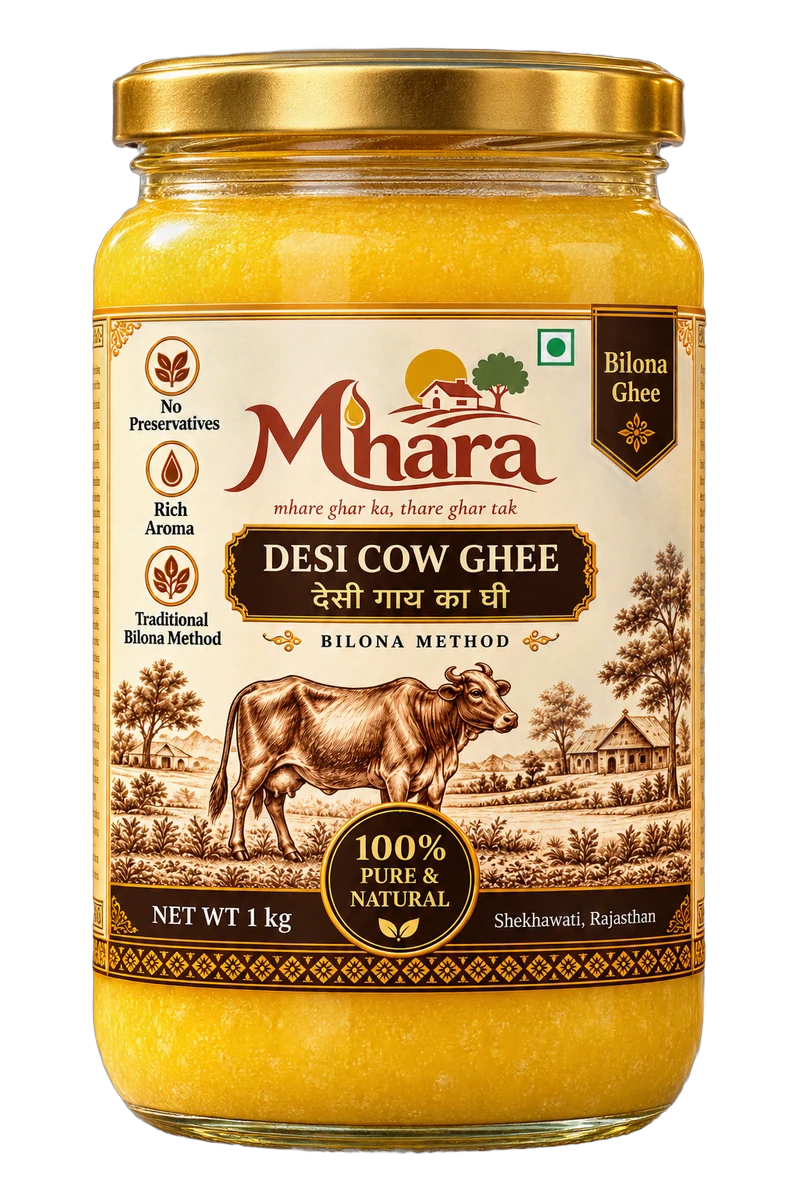
Because the ghee is there for flavour, its aroma comes through clearly. We use desi cow bilona ghee for gajar halwa. Its nutty smell sits well with the sweet carrots and the cardamom, and it gives the halwa a warm golden shine. Buffalo ghee makes it heavier and milder, which some families prefer. If you want to know why bilona ghee smells the way it does, read what is bilona ghee.
Gajar ka halwa without khoya, or with it
This recipe needs no khoya because the litre of milk, cooked down slowly, gives the same milky richness. That is how most village homes make it, since fresh milk is always in the house and khoya is not.
If you want a richer, mithai-shop version, crumble 100 g of khoya into the halwa in the last 5 minutes and stir until it melts. A few spoons of milk powder do something similar in a pinch. Neither is needed.
The pressure-cooker shortcut
On a busy day, put the grated carrots in a pressure cooker with 1 cup of milk and cook for 1 whistle on a medium flame. Let the pressure drop on its own. Tip everything into a kadhai, add the rest of the milk, and cook until it dries, which takes about 25 minutes instead of 45. Then carry on with ghee and sugar as usual.
The taste is a little less deep because the milk spends less time reducing, but it is a good weekday winter gajar halwa.
However you cook it, serve it warm. Many homes now serve it to children with a scoop of vanilla ice cream on top, and it is a good pairing. A good gajar ka halwa recipe needs no silver varq or heavy decoration. A few fried nuts on top are enough.
Gajar ka halwa recipe mistakes, and how long it keeps
- Watery halwa: sugar went in before the milk dried. Keep cooking on a medium flame until it leaves the sides.
- Pale colour: orange carrots, or ghee and sugar not cooked long enough. Give it a few more minutes after the sugar.
- Burnt bottom: a thin kadhai, or not scraping often in the milk stage.
- Chewy, dry halwa: cooked too long after the sugar. Stir in a few spoons of warm milk.
- Grainy milk bits: these are milk solids and they are fine. Some people like them most.
Gajar ka halwa keeps 3 to 4 days in a closed box in the fridge. Warm it in a kadhai with a splash of milk before serving. It does not keep well at room temperature because of the milk, so do not leave it out overnight. Ghee itself keeps far longer if you store it right; see how to store ghee.
If gajar halwa is the winter halwa of the city, moong dal halwa is the winter halwa of the village wedding, and our kitchen makes both every winter. For a complete festive plate, see our Diwali sweets with desi ghee.
Recipe card
Ingredients
- 1 kg red carrots (about 7–8 medium), peeled and grated
- 1 litre full-cream milk
- 4–5 tbsp (60–75 g) desi cow bilona ghee, plus 1 tsp for the nuts
- 3/4 cup (150 g) sugar, adjust to taste
- 1 tsp green cardamom powder
- 2 tbsp cashews, chopped
- 2 tbsp almonds, chopped
- 2 tbsp raisins
- 100 g khoya, crumbled (optional)
Method
- Peel and grate the carrots on the large holes of the grater.
- Put the carrots and milk in a heavy, wide kadhai and bring to a boil.
- Cook on a medium flame for 40–50 minutes, stirring every few minutes and scraping the sides, until the milk is fully absorbed.
- Add 4–5 tbsp ghee and sauté for 8–10 minutes on a medium flame, stirring.
- Add the sugar. The halwa will turn wet again. Cook for 10–12 minutes, stirring, until dry, glossy and leaving the sides.
- If using khoya, crumble it in and stir for the last 5 minutes until it melts.
- Fry the cashews, almonds and raisins in 1 tsp ghee until the raisins puff up.
- Stir in the cardamom and the fried nuts. Serve warm.
- Shortcut: pressure-cook the carrots with 1 cup of the milk for 1 whistle, then add the rest of the milk in a kadhai and continue from step 3 (about 25 minutes).
- Refrigerate leftovers in a closed box for 3–4 days and reheat with a splash of milk.
Questions people ask
Can I make gajar ka halwa without khoya?
Yes. Cook 1 kg of grated carrots in 1 litre of full-cream milk until the milk is fully absorbed. The slowly reduced milk gives the same rich, milky taste, which is how most village homes make it. Khoya is an optional extra.
When should I add sugar to gajar halwa?
Only after the milk has dried and the carrots have been sautéed in ghee for 8 to 10 minutes. Sugar draws water out of the carrots, so adding it early makes the halwa runny and adds half an hour of cooking.
How much ghee is needed for 1 kg gajar halwa?
About 4 to 5 tablespoons, or 60 to 75 g. The milk gives most of the richness, so the ghee is mainly for flavour and gloss. More than that usually just pools on the plate.
Which carrots are best for gajar ka halwa?
The long red Delhi carrots that come in winter, roughly November to February. They are sweet, juicy and give a deep red colour. Orange carrots also work but give a paler, slightly less sweet halwa.
How long does gajar ka halwa last?
About 3 to 4 days in a closed box in the fridge. Because it is cooked in milk, do not leave it at room temperature overnight. Reheat it in a kadhai with a splash of milk before serving.
Why is my gajar halwa watery?
Usually the sugar went in before the milk had dried, or the halwa was taken off the heat too soon. Keep cooking on a medium flame, stirring, until it turns glossy and leaves the sides of the kadhai.